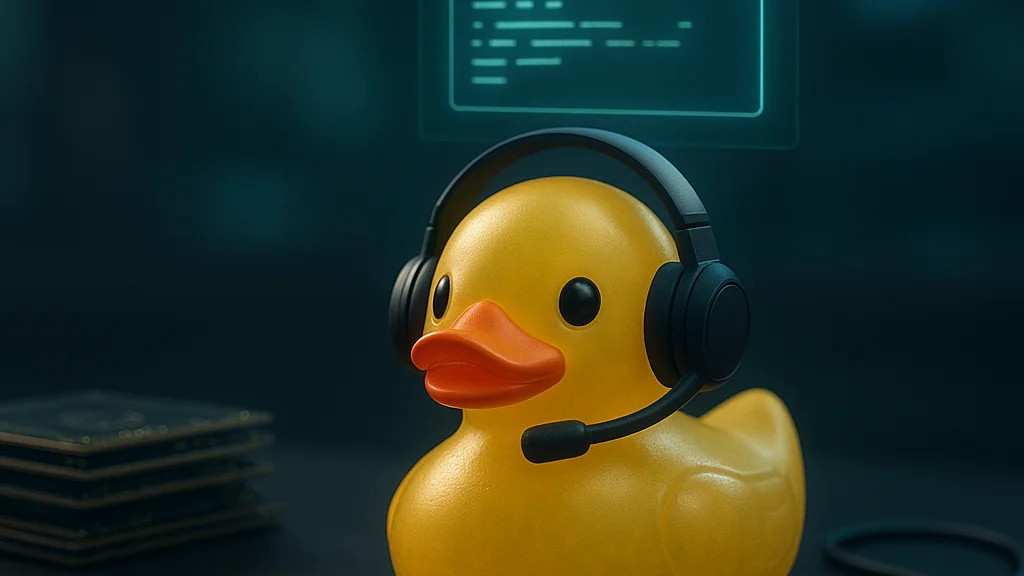

A small prompt, a larger shift
Most developer tools promise speed. Far fewer promise better thinking. That is why GitHub Copilot CLI’s new Rubber Duck review agent feels notable; it does not simply try to write code faster, but to slow the right moment down. The old rubber duck ritual is familiar in engineering teams: you explain your bug, line by line, to an inanimate listener; somewhere in the act of speaking, the answer appears. GitHub has now folded a version of that habit into the command line, where many developers still do their clearest work.
The timing matters. By mid-2026, Copilot is no longer a novelty bolted onto editors. It is part of a broader GitHub platform push around agentic assistance, review automation, and security checks closer to the terminal. A recent TechTimes report on Copilot CLI’s pre-commit security scanner described GitHub’s move toward applying LLM inference at the detection layer before code even leaves a local workflow. The Rubber Duck review agent sits neatly beside that trend; one feature scans for likely risks, the other interrogates logic, assumptions, and intent.
That sounds modest. It is not. Code review has long been one of software’s hidden bottlenecks; expensive in senior attention, uneven in quality, and often reduced to syntax nits because time is short. An agent that can ask clarifying questions, summarise a change set, point out edge cases, and prompt the author to justify design choices changes the shape of review before a pull request reaches another human being.
Several early write-ups on WriteUpCafe have already framed the release from different angles, including GitHub Copilot CLI Adds Rubber Duck Review Agent to Boost Developer Workflow and Why GitHub Copilot CLI’s Rubber Duck Agent Matters. What deserves closer attention is not the novelty of the name, but the practical consequence: GitHub is trying to move AI assistance from generation to reflection; from autocomplete to argument.
Rubber ducking has always been less about the duck than about disciplined explanation. Turning that into a CLI agent suggests GitHub sees reasoning support as the next battleground for developer tools.
There is also a cultural point here. Developers have spent the past three years learning where AI helps and where it quietly introduces fragility. The appetite now is not for louder automation, but for tools that fit existing habits and reduce avoidable mistakes. A review agent in the terminal does exactly that; it meets engineers where commits, diffs, tests, and second thoughts already live.
How we got here: from autocomplete to review intelligence
To understand why this release matters, it helps to place it on a short timeline. GitHub Copilot launched publicly in 2021 as an AI pair programmer focused on code completion. In its first phase, the value proposition was obvious and narrow: type less; scaffold faster. By 2023 and 2024, the product expanded into chat, inline explanation, test generation, and repository-aware assistance. Across the industry, rivals pursued similar territory. Amazon pushed CodeWhisperer and then Q Developer; Google integrated Gemini more deeply into developer workflows; startups such as Cursor, Replit, and Sourcegraph each built their own blends of code generation, search, and agentic help.
Yet one lesson kept recurring. Generating code is easy to demo; validating code is harder, slower, and more consequential. Enterprises care less about whether a tool can produce a function in ten seconds than whether it reduces defects, shortens review cycles, and lowers the load on senior engineers. That is why the centre of gravity has shifted from “write this for me” to “check this with me.”
GitHub has been edging in that direction for some time. Copilot Workspace experiments, issue-to-code flows, repository chat, and CLI integrations all hinted at a broader ambition: to make Copilot present across the full software lifecycle. The June 2026 addition of a pre-commit security scanner, reported by TechTimes, reinforced that strategy. Security screening before commit is not glamorous; it is infrastructural. A Rubber Duck review agent belongs to the same family of ideas; review earlier, closer to authorship, before friction compounds.
The command line is a particularly telling venue. Browser-based and IDE-based assistants are useful, but they can encourage a passive habit: accept suggestion, move on. The terminal has a different rhythm. It is where developers inspect diffs, run tests, stage files, amend commits, and retrace decisions. A review agent there can become part of the moment when a coder asks, quietly, “Have I really thought this through?”
That may explain why commentary such as GitHub Copilot CLI’s Rubber Duck Agent Changes Code Review has resonated. The change is not merely feature-level. It reflects a maturing view of AI in software engineering: assistance should not only accelerate output; it should sharpen judgement.
- Phase one of coding AI focused on completion and boilerplate generation.
- Phase two added chat, explanation, and repository context.
- Phase three, now emerging, targets review, security, and decision support inside existing workflows.
Seen in that light, the Rubber Duck agent is less a quirky add-on than a marker of where developer tooling is heading.
What the Rubber Duck review agent likely changes in practice
The phrase “review agent” can sound abstract, so it is worth reducing it to workflow. In a healthy engineering team, code review is not a ceremonial gate. It is where maintainability, correctness, readability, and operational risk are tested before software hardens into production reality. The trouble is that human review often arrives late and under pressure. A feature branch is already large; deadlines are close; reviewers are juggling their own work. As a result, comments skew toward what is visible quickly rather than what matters most deeply.
A Rubber Duck review agent has the potential to intervene earlier. Instead of waiting for a colleague to notice a hidden assumption, the author can ask the CLI agent to inspect a diff, summarise intended behaviour, identify untested branches, flag ambiguous naming, or surface places where a function’s contract is unclear. Even if the agent is imperfect, it can force articulation. That alone has value.
The best code review question is often not “Is this line correct?” but “What did you assume here, and what happens when that assumption breaks?” A good rubber-duck tool should keep asking exactly that.
There are several concrete ways such an agent could shift day-to-day practice.
- Smaller, cleaner pull requests: if authors receive structured feedback before opening review, they are more likely to split changes logically and annotate intent.
- Better test discipline: AI prompts around edge cases and missing assertions can catch omissions before CI does.
- Reduced reviewer fatigue: human reviewers can spend less time on first-pass explanation and more on architecture, product logic, and long-term maintainability.
- Improved onboarding: junior developers often do not know what to check before requesting review; a CLI agent can model the questions seniors tend to ask.
There are limits, of course. An LLM-based review agent may overstate confidence, miss domain-specific hazards, or produce generic feedback if repository context is weak. It may also normalise a style of “AI-approved” code that appears tidy while still being conceptually wrong. That risk is familiar from earlier Copilot debates. The answer is not to reject the tool, but to place it correctly. It is a pre-review companion, not a final arbiter.
The strongest use case may be in the space between coding and committing. That interval is usually private; a developer catches obvious mistakes, rewrites a comment, reruns a test, and decides whether the change is coherent enough to show another person. If GitHub can make the Rubber Duck agent genuinely useful in that moment, it will have improved one of software engineering’s least visible but most important habits: self-review.
Recent coverage around GitHub Copilot CLI Introduces Rubber Duck Review Agent in 2026 has emphasised productivity. Fair enough. But productivity here should be read carefully. The real gain is not simply fewer minutes spent; it is fewer weak assumptions escaping into team review queues.
The 2026 context: agentic tools are moving closer to the commit
This release lands in a year when the developer-tool market has become markedly more agentic. The broad pattern across 2025 and 2026 has been clear: AI vendors are no longer content with passive suggestion boxes. They want systems that inspect, plan, revise, and act across multiple steps. In software engineering, that means tools that can read a repository, infer likely intent, compare changes against conventions, and intervene before code reaches shared branches.
GitHub is hardly alone. Competing platforms have been extending AI into debugging, documentation, issue triage, and test generation. What distinguishes GitHub’s current direction is the density of its workflow surface. It owns, or at least mediates, many of the places where software work already happens: repositories, pull requests, actions, issues, and now more of the terminal loop. If Copilot CLI becomes a serious checkpoint for security and review, GitHub gains leverage not just as a host but as an active participant in development decisions.
The TechTimes report on the pre-commit security scanner is useful here because it shows GitHub thinking beyond convenience. Security checks before commit suggest a philosophy of early interception. A Rubber Duck review agent extends that philosophy into reasoning and code quality. One catches suspicious patterns; the other probes intent. Combined, they point toward a future in which the local development environment becomes a layered conversation between human author and machine critic.
That matters for enterprise adoption. Large organisations have spent the past two years trying to move from experimental AI use to governed deployment. Their concerns are predictable: data handling, auditability, hallucination risk, code provenance, and return on investment. A terminal-based review agent is easier to justify than a fully autonomous coding system because it keeps the human in the loop and targets a measurable pain point. Teams can ask practical questions: Did review cycles shorten? Did reopened pull requests fall? Did post-merge defects decline?
- Enterprise buyers increasingly favour AI tools that fit existing controls rather than bypass them.
- Review and security features are easier to operationalise than open-ended autonomous coding.
- CLI-based assistance appeals to experienced developers who resist heavy workflow disruption.
There is also a softer, but important, cultural shift. The first wave of coding AI often felt performative; screenshots of generated apps, prompts as party tricks, productivity claims too broad to test. The 2026 mood is more sober. Teams want tools that save attention, not just keystrokes. The Rubber Duck agent aligns with that mood rather well; it offers a structured pause, not a flourish.
Where the feature could help most, and where it may struggle
No tool lands evenly across software teams. The Rubber Duck review agent is likely to be more valuable in some settings than others. Start with younger teams, distributed teams, and organisations with high review volume. In those environments, the friction of code review is not merely technical; it is social. Junior engineers hesitate to ask basic questions. Reviewers default to terse comments. Context lives in heads and chat threads. A CLI agent that asks for rationale and spots common omissions can smooth that terrain.
It may also prove useful in polyglot repositories where reviewers cannot be experts in every language. If a backend engineer opens a pull request touching shell scripts, infrastructure code, and a small front-end change, a first-pass AI review can at least surface obvious concerns and summarise the blast radius. That does not replace specialist review, but it can make the eventual human conversation sharper.
Open-source maintainers might benefit too. Many maintainers are overwhelmed less by code complexity than by contributor management. Pull requests arrive with thin descriptions, inconsistent testing, and assumptions left unstated. If contributors use a Rubber Duck review step before submission, maintainers receive cleaner material. In theory, that could reduce triage burden.
Still, the weaknesses are plain enough.
- Domain blindness: highly regulated, safety-critical, or deeply specialised codebases often hinge on context no general model can infer reliably.
- False reassurance: a neat AI summary can make a change look more coherent than it is.
- Prompt dependency: the quality of feedback may vary dramatically depending on how the user frames the request.
- Review homogenisation: teams may drift toward generic “best practice” advice even when local conventions differ for good reasons.
These trade-offs are not disqualifying; they are operational. The best teams will treat the agent as a disciplined checklist with conversational flexibility. They will likely define internal patterns: ask it to summarise the diff, list edge cases, identify missing tests, and challenge naming or coupling. Then compare its feedback against local standards.
That is why the feature’s success may depend less on model sophistication than on product design. A review agent should know when to be specific, when to ask a question rather than assert a fix, and when to admit uncertainty. In literature, the most useful companion is not the loudest one; think of the patient interlocutors in George Eliot, who clarify by listening. Developer tools rarely earn that description. This one might, if GitHub resists the temptation to make it sound more certain than it is.
What teams should measure before calling it a success
AI releases often arrive wrapped in broad claims about productivity. Sensible engineering leaders will want narrower metrics. The Rubber Duck review agent should be judged not by how impressive a demo looks, but by whether it improves review quality without adding friction. That requires measurement; preferably over several sprints, and with a baseline taken before rollout.
The most useful indicators are not mysterious. Teams already track many of them, or could do so with modest effort.
- Pull request cycle time: how long from opening to approval and merge.
- Review round count: how many back-and-forth cycles occur before approval.
- Post-merge defect rate: bugs traced to recently merged changes.
- Reopen frequency: pull requests or issues reopened because a concern was missed.
- Reviewer comment mix: whether comments shift from syntax and explanation toward architecture and product logic.
- Onboarding speed: time for newer developers to produce review-ready pull requests.
If those numbers improve modestly, the feature is doing real work. If they remain flat while prompt volume rises, the tool may be adding ceremony rather than value.
Leaders should also watch for hidden costs. Does the agent encourage larger diffs because authors feel pre-cleared? Do developers spend too long iterating against AI feedback? Does the team begin to outsource judgement instead of sharpening it? These are harder to quantify, but retrospectives can surface them.
A practical rollout might look like this:
- Trial the agent with one team for four to six weeks.
- Require a lightweight pre-review checklist using the tool on selected pull requests.
- Compare review metrics against the previous sprint average.
- Collect qualitative feedback from both authors and reviewers.
- Refine prompts and usage guidance before wider adoption.
There is a pleasing irony here. Rubber ducking began as a personal, almost private act of thought. Product teams now need to assess it with the same seriousness they would any engineering process change. The ritual has become infrastructure.
If the agent works, humans should spend less time explaining what changed and more time debating whether the change is the right one. That is the clearest sign of progress.
For readers following this topic across WriteUpCafe, the companion pieces on workflow impact and on code review change are useful reference points. The common thread is simple: the value of this feature will be proven in team habits, not launch language.
The deeper implication: AI coding tools are being trained to ask better questions
There is a temptation to read every Copilot update as another step toward autonomous software creation. Some investors and vendors still prefer that story; it is cinematic. But the more durable story may be quieter. The best AI tools in engineering are increasingly those that help people inspect their own thinking. A Rubber Duck review agent is emblematic of that shift.
Good engineering has always depended on structured doubt. What if this input is malformed? What if the cache is stale? What if the user retries? What if the dependency changes behaviour? Senior developers are valuable partly because they have accumulated these questions and know when to ask them. If AI tools can reliably surface a portion of that questioning for less experienced engineers, the result is not magical automation. It is distributed judgement.
That could have broad consequences. Teams may flatten some of the expertise bottlenecks that make senior reviewers perpetually overloaded. Documentation may improve because authors are prompted to explain intent before review. Security and quality checks may move earlier, reducing the cost of correction. Over time, organisations may come to expect that every meaningful code change passes through not just tests and linters, but a machine-led reasoning pass.
Yet the human role becomes more, not less, important. Someone must decide which questions matter, which trade-offs are acceptable, and which local conventions outrank generic advice. In Chapter 22 of Middlemarch, Eliot writes of “the growing good of the world” depending partly on unhistoric acts; software teams know the feeling. Much of engineering quality is built in small, unglamorous moments of checking and rechecking. A terminal agent that improves those moments deserves attention.
The near future will show whether GitHub can make this feature sticky. If the agent remains a novelty command, it will fade into the long list of AI demos that were pleasant but forgettable. If it becomes a trusted pre-review habit, it could influence how repositories are prepared, how pull requests are written, and how teams teach code quality to newcomers.
For now, the clearest conclusion is this: GitHub Copilot CLI’s Rubber Duck review agent is not important because it sounds clever. It is important because it treats software development as a thinking discipline, not just a typing exercise. In 2026, that feels like the more mature bet.






























Sign in to leave a comment.