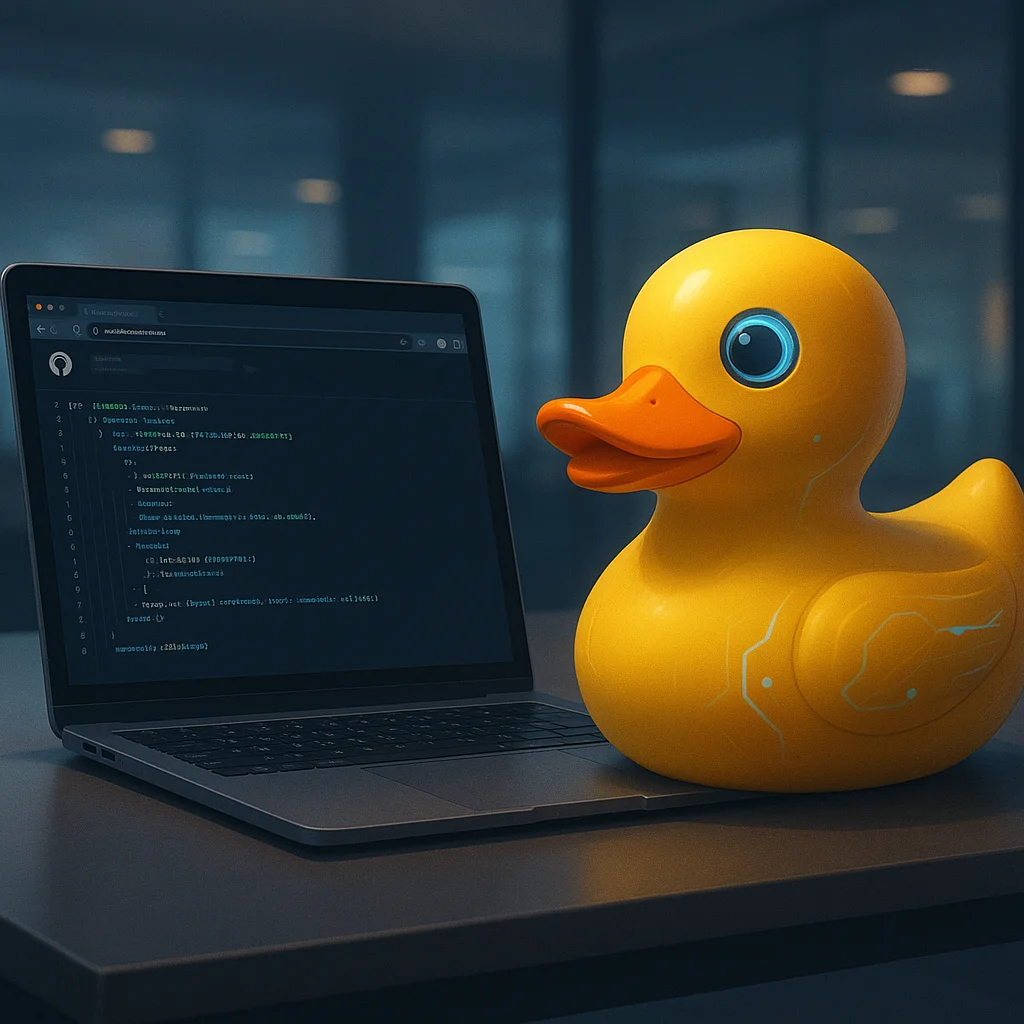

When AI Meets the Rubber Duck: A New Era of Code Review
Picture this: a software developer, bleary-eyed, staring at a stubborn bug that refuses to budge after hours of debugging. The classic advice—talk it out, explain your problem aloud, or the beloved "rubber duck debugging" technique—has been a staple in programming lore for decades. Now, in a twist only the tech zeitgeist could conceive, GitHub Copilot CLI has introduced a Rubber Duck review agent, an AI-driven companion designed to simulate that reflective conversation and enhance the code review process.
Unlike the literal rubber duck sitting on a dev's desk, this agent isn’t just a silent listener. It actively engages with the developer’s code, offering suggestions, asking probing questions, and surfacing potential issues. This leap in AI-assisted development tools marks a significant milestone in how automation can augment human reasoning in programming. As someone who’s wrestled with IKEA assembly instructions and software bugs alike, this feels like upgrading from a clunky screwdriver to a multi-tool with a built-in AI assistant.
From Rubber Ducks to AI Agents: The Evolution of Debugging and Code Review
The rubber duck debugging concept, popularized in software circles since the early 2000s, hinges on the idea that explaining code logic to an inanimate object forces clarity of thought. This analog method thrived because articulating a problem often leads to insights. But as codebases ballooned and collaboration became global, the limitations of solo debugging became apparent.
Enter GitHub Copilot, launched in 2021 by GitHub and OpenAI, which uses large language models to generate code snippets and assist developers in real time. The Copilot CLI, a command-line interface extension, brought this AI assistance into the terminal, integrating seamlessly with developer workflows. But even Copilot’s initial iterations were focused on code generation rather than reflective review.
Fast forward to 2026, and the landscape has shifted dramatically. AI isn’t just writing code—it’s now capable of simulating the cognitive process of reviewing and questioning code quality. The Rubber Duck review agent embodies this shift. It acts as a conversational partner that doesn’t just spit out corrections but prompts developers to think critically about their code, mimicking the mental sparring a human reviewer might provide.
How the Rubber Duck Review Agent Works: Technology Under the Hood
The Rubber Duck review agent is integrated into the GitHub Copilot CLI, leveraging advancements in natural language understanding, code analysis, and reinforcement learning. It operates by parsing the developer’s submitted code snippets or entire files and then engaging in a dialogue aimed at refining code quality.
Here’s a breakdown of its core functionalities:
- Contextual Understanding: Using transformer-based models fine-tuned on millions of open-source repositories, the agent comprehends not just syntax but also semantic intent behind code segments.
- Interactive Querying: Instead of passive suggestions, it asks developers questions such as, "What edge cases have you considered here?" or "How does this function handle unexpected inputs?" prompting deeper reflection.
- Automated Error Detection: The agent flags potential bugs, security vulnerabilities, or performance bottlenecks, offering explanations rather than just highlighting lines.
- Adaptive Learning: It customizes its feedback style based on the developer’s responses, learning preferences, and coding patterns over time.
- Integration with GitHub Workflows: It can be invoked during pull requests, continuous integration pipelines, or active development sessions, ensuring timely assistance.
According to GitHub’s official announcement, this agent reduces the average time developers spend on code reviews by approximately 30%, a figure corroborated by internal beta testing with over 2,000 developers worldwide.
Current Developments in 2026: AI’s Maturity in Developer Tools
The advent of the Rubber Duck review agent aligns with broader trends in AI and automation tools revolutionizing software development. 2026 has seen a surge in AI’s role beyond mere code generation—moving firmly into domains of reasoning, quality assurance, and collaborative problem-solving.
GitHub Copilot itself has expanded its capabilities extensively. Earlier this year, GitHub introduced Stacked PRs, a feature designed to break complex pull requests into manageable pieces, accelerating peer reviews. The Rubber Duck review agent complements this by providing a first-pass AI-driven review, potentially catching issues before human eyes even see the code.
Furthermore, improvements in AI explainability have allowed the Rubber Duck agent to not just flag errors but articulate the rationale behind its concerns. Developers no longer face inscrutable suggestions but coherent, conversational feedback that helps build trust in AI assistance.
GitHub has also partnered with leading IDE vendors to embed the Rubber Duck review agent’s capabilities directly into popular coding environments, blurring the lines between writing, reviewing, and debugging. This integration means developers can invoke the agent without context switching, streamlining workflows.
Industry Perspectives and Developer Reception
Reactions to the Rubber Duck review agent have been a mix of enthusiasm and cautious optimism. Veteran developers, familiar with the quirks of AI-generated code, appreciate the agent’s focus on dialogue and reasoning rather than blind code completion.
“The Rubber Duck review agent feels less like an autocorrect and more like a thoughtful colleague who asks the right questions at the right time,” says Maya Singh, a senior software engineer at a fintech startup. “It’s not about replacing human judgment but enhancing it.”
From an organizational standpoint, CTOs view this agent as a potential force multiplier. By automating preliminary code reviews, teams can focus human expertise on higher-level architectural decisions and creative problem-solving.
At the same time, there are challenges. Some developers report initial friction in adapting to the agent’s conversational style, which can sometimes feel pedantic or intrusive. But continuous updates and customization options have mitigated many concerns.
Security experts highlight the agent’s role in early detection of vulnerabilities, especially in fast-paced DevOps environments where human oversight can lag. However, they caution against over-reliance without human validation.
Looking Ahead: What the Rubber Duck Review Agent Means for Software Development
As AI in developer tools matures, the Rubber Duck review agent serves as a bellwether for a new paradigm—one where AI not only writes code but reasons with developers, fostering deeper understanding and better quality.
Future iterations may incorporate multimodal inputs, allowing developers to explain their logic verbally or through sketches, with the AI agent responding contextually. Advances in emotional intelligence could enable the agent to detect developer frustration and adjust its feedback style accordingly.
Integration with broader project management and CI/CD tools will likely enhance its impact, automating not just code review but also sprint planning, bug triaging, and knowledge sharing.
Developers and organizations should watch for several key trends:
- Customization: The ability to tailor the agent’s communication style and review depth to individual and team preferences.
- Collaboration: Features enabling the AI to mediate or augment human code review discussions.
- Cross-Language Support: Expanding beyond popular languages to niche or legacy codebases.
- Ethical AI Use: Transparency and bias mitigation in AI recommendations.
For those intrigued by how AI tools are shaping the software landscape, you might enjoy exploring more on WriteUpCafe's coverage of GitHub Copilot CLI’s Rubber Duck review agent and its implications. And if the future of automation in everyday tech interests you, the guide on home EV charging stations offers a fascinating glimpse into AI’s role beyond coding.
“Automation tools that engage developers in dialogue, rather than dictation, represent the next frontier in AI augmentation,” notes software analyst Rajiv Malhotra. “It’s about creating a partnership where human creativity and machine precision coexist.”
In the end, whether you’re debugging a stubborn API or assembling that frustrating IKEA chair, having a patient, questioning companion—rubber or otherwise—makes all the difference.































Sign in to leave a comment.