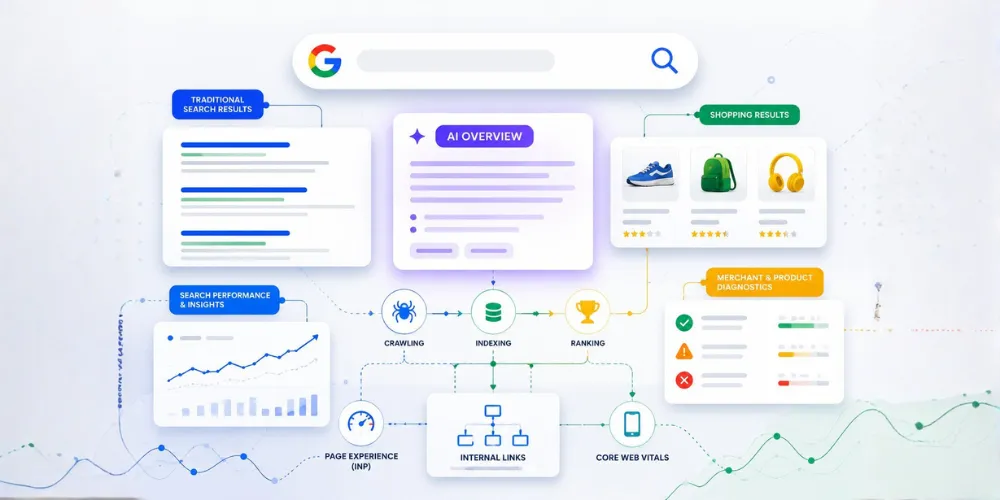

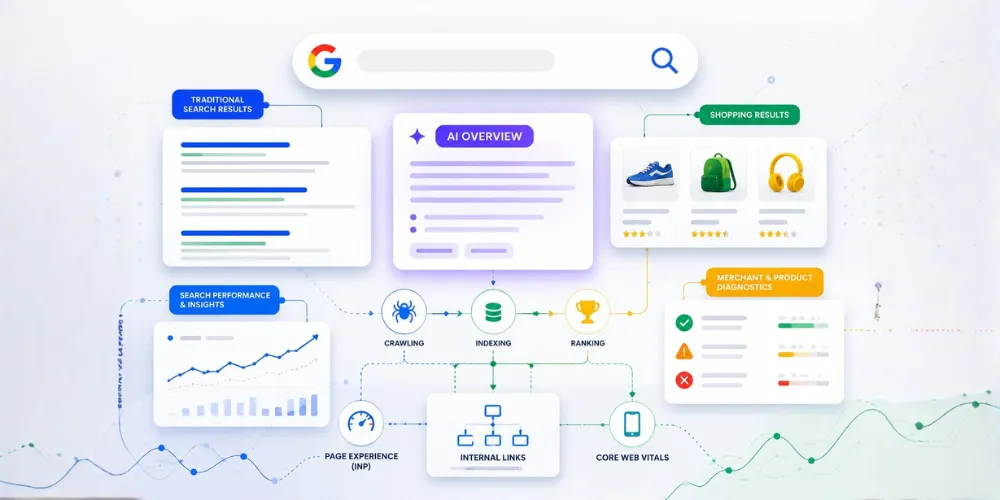
For years, Google Search Console has answered a familiar question: How is my website performing in search? We checked clicks, impressions, average position, and called it a day.
But search isn't the same anymore.
With AI Overviews and AI-powered search experiences becoming part of how people discover information, marketers have been asking a different question:
"Is my content actually appearing in AI search results?"
Until recently, there wasn't a reliable way to find out.
That changed when Google introduced dedicated Search Generative AI Performance reports in Google Search Console, giving website owners their first official look at how their content appears across AI-powered search experiences like AI Overviews and AI Mode.
Why This Matters
For many businesses, SEO success has traditionally been measured by rankings and organic traffic. While those metrics are still important, AI-powered search is adding another layer to the picture.
A page may now receive visibility because Google's AI references it when generating answers—even if users don't always click through immediately.
That doesn't mean clicks have stopped mattering. It simply means visibility is becoming more nuanced than a list of blue links.
Understanding where your content appears is becoming just as important as understanding where it ranks.
What the New Reports Actually Show
The new reports focus on impressions generated from Google's AI-powered search experiences.
You can see how often your pages appeared in:
- AI Overviews
- AI Mode
- AI features within Discover
The data can also be filtered by page, country, device, and date, making it easier to identify which content is gaining visibility inside Google's evolving search experience.
At the moment, Google hasn't included click or query-level reporting in these AI-specific reports, so they're best used as a visibility indicator rather than a complete performance dashboard. More reporting capabilities are expected over time.
Don't Replace Your Existing SEO Workflow
One mistake many marketers make whenever Google launches a new feature is abandoning everything else.
This isn't one of those moments.
Your indexing reports still matter.
Core Web Vitals still matter.
Internal linking still matters.
High-quality content still matters.
The new AI reports simply give you another perspective on how your content is being discovered.
Think of them as an additional layer of insight rather than a replacement for traditional SEO metrics.
The Bigger Opportunity
Perhaps the most interesting takeaway isn't the report itself.
It's what it represents.
For the first time, Google is officially acknowledging that visibility inside AI-generated answers deserves its own reporting.
That sends a clear message to publishers, marketers, and businesses alike: search is evolving, and measuring success needs to evolve with it.
The websites that pay attention to these changes early are often the ones that adapt fastest.
If you're interested in exploring these reports in greater detail—including how to use regex filters, analyze Interaction to Next Paint (INP), strengthen internal linking, and connect Search Console with GA4—we recently published a comprehensive guide on Google Search Console advanced features at AdsLectic that dives deeper into practical workflows for SEO teams.
Final Thoughts
Google Search Console has always been one of the most valuable free tools available to marketers.
The addition of AI performance reporting doesn't change that—it expands it.
As AI continues reshaping how people search, understanding your visibility across both traditional results and AI-powered experiences will become an increasingly important part of every SEO strategy.
Sometimes, the biggest opportunities aren't hidden in a new tool. They're hidden inside a tool you've been using all along.


















Sign in to leave a comment.