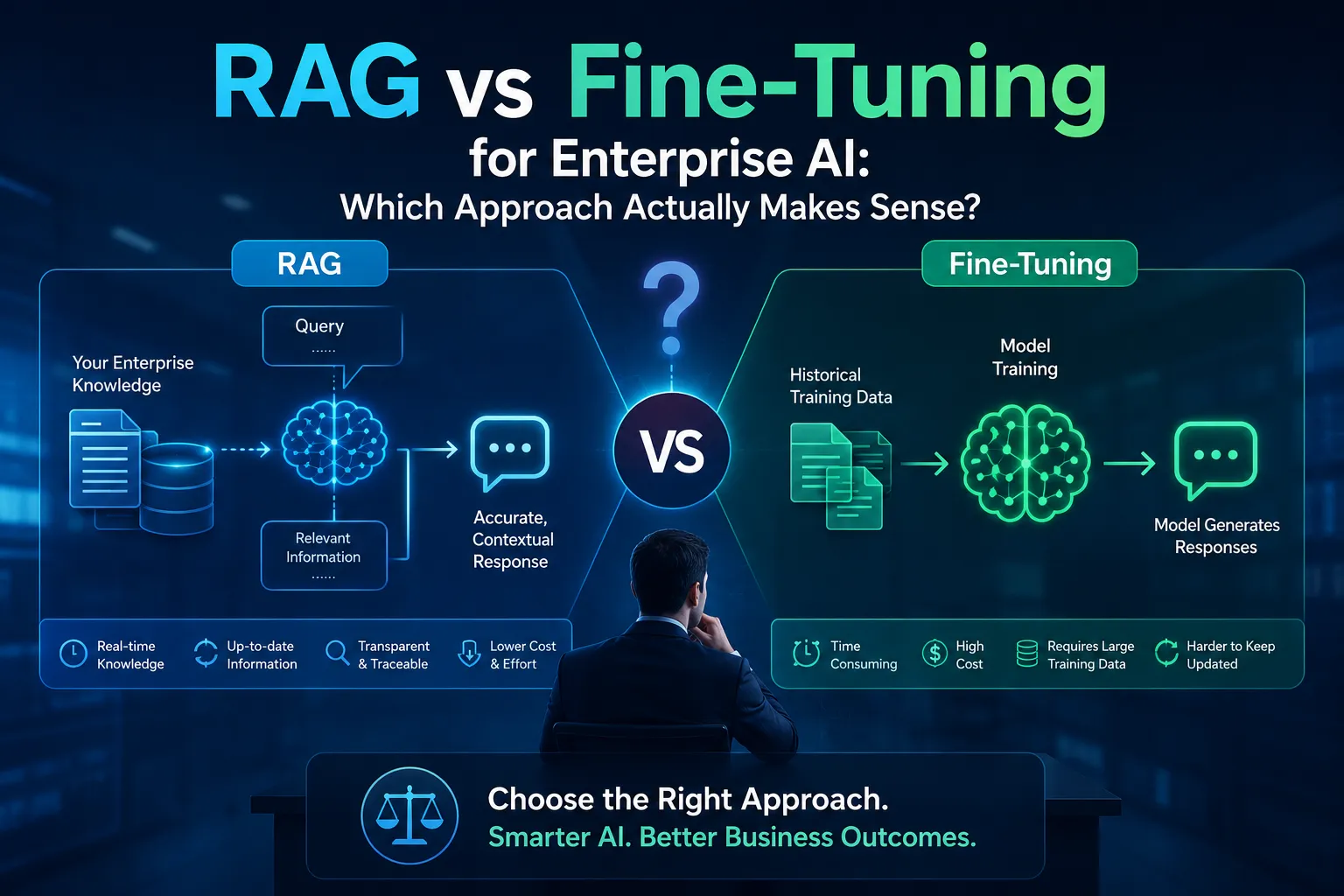

If you've spent any time in enterprise AI conversations over the past year, you've probably heard the terms "RAG" and "fine-tuning" tossed around like everyone already knows exactly what they mean and exactly when to use them. In reality, most teams are still figuring this out, often the hard way — after burning weeks of engineering time and a chunk of budget on the wrong approach.
The debate around rag vs fine tuning enterprise deployment isn't just a technical curiosity anymore. It's become one of the first real decision points companies hit when they move from "let's experiment with AI" to "let's put this in front of customers or employees at scale." And the choice you make here shapes everything downstream cost, maintenance burden, accuracy, and how quickly you can adapt when your business changes.
Two Different Ways of Teaching a Model What It Doesn't Know
Large language models are trained on a huge but fixed snapshot of text. They don't automatically know your internal policies, your product catalog, your latest pricing sheet, or what happened in your industry last Tuesday. There are two broad ways to close that gap.
Retrieval-Augmented Generation, or RAG, keeps the model itself untouched. Instead, it pulls relevant documents or data from an external knowledge base at the moment a question is asked, and feeds that context into the prompt alongside the user's query. The model then generates its answer grounded in whatever was retrieved. Think of it like giving a smart employee a search engine over your company's internal wiki instead of expecting them to memorize the whole thing.
Fine-tuning takes the opposite route. You take a pretrained model and continue training it on your own examples support transcripts, internal documentation, labeled question-answer pairs so the model's internal weights actually shift to reflect that specialized knowledge and style. The information becomes baked into the model itself rather than something it looks up.
Both are legitimate, well-established techniques, and neither is universally "better." That's exactly why so many teams get stuck.
Why This Decision Matters More in Enterprise Settings
In a hobby project, picking the wrong method just costs you a weekend. In an enterprise environment, the stakes look different:
- Data freshness: Enterprises deal with constantly changing information — new SKUs, updated compliance rules, shifting HR policies. RAG systems can reflect these changes almost instantly because you just update the underlying document store. Fine-tuned models need retraining to catch up, which is slower and more expensive.
- Auditability and trust: Regulated industries like finance and healthcare often need to show where an answer came from. RAG naturally supports this because it can cite the specific documents it retrieved. Fine-tuned models, by contrast, generate answers from internalized patterns, which makes source attribution much harder.
- Cost structure: Fine-tuning, especially on large models, requires meaningful compute and MLOps expertise. RAG shifts more of the cost toward building and maintaining a solid retrieval pipeline and vector database, which is often cheaper and more flexible to iterate on.
- Domain-specific tone or reasoning style: This is where fine-tuning tends to shine. If you need a model that consistently reasons like a legal analyst or writes in a very specific brand voice across thousands of interactions, fine-tuning can bake that behavior in more reliably than retrieval alone.
None of these factors exist in isolation, which is why so many mature enterprise deployments end up blending the two rather than picking one exclusively.
A Closer Look at RAG in Practice
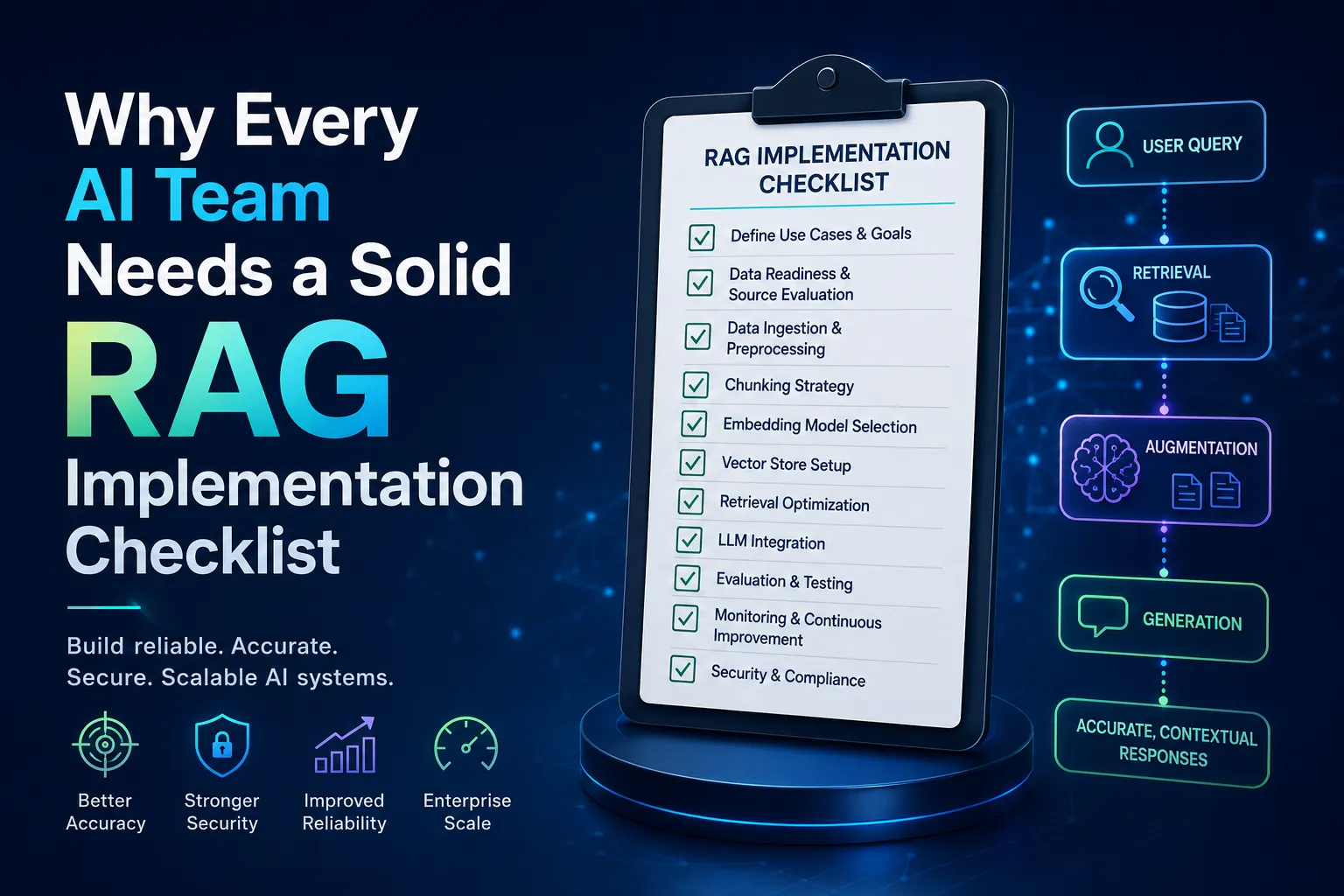
RAG has become the default starting point for a lot of enterprise teams, and there's a practical reason for that: it's faster to stand up and easier to govern. A typical pipeline chunks internal documents, generates embeddings, stores them in a vector database, and retrieves the most relevant chunks at query time.
The appeal is obvious for knowledge-heavy use cases internal support bots, customer-facing FAQ assistants, contract review tools, research assistants that need to reference the latest internal reports. Because the knowledge lives outside the model, updating it is often as simple as re-indexing a document, not retraining a multi-billion parameter network.
That said, RAG isn't magic. Retrieval quality is the whole game if your chunking strategy is sloppy or your embeddings don't capture the right semantic relationships, the model will confidently generate answers based on irrelevant context. Teams that treat RAG as a "set it and forget it" system tend to be disappointed. It requires ongoing tuning of retrieval parameters, evaluation of chunking strategies, and monitoring for retrieval failures just as much as any other production system does.
For organizations trying to map out this decision more concretely, resources like this detailed breakdown comparing RAG and fine-tuning for enterprise use cases can be useful for benchmarking your own requirements against common implementation patterns before committing engineering resources.
Where Fine-Tuning Still Wins
Fine-tuning hasn't gone anywhere, and dismissing it because RAG is trendier would be a mistake. There are scenarios where fine-tuning is genuinely the better tool:
- When you need consistent structured outputs (specific formatting, strict schema adherence) across a huge volume of requests.
- When latency matters enormously and you can't afford the extra retrieval step in the pipeline.
- When the domain language is so specialized that general embeddings struggle to retrieve the right context reliably, such as certain areas of scientific or legal terminology.
- When you're optimizing a smaller, cheaper model to perform a narrow task extremely well, rather than relying on a large general-purpose model plus retrieval overhead.
Research from academic institutions has also explored how parameter efficient fine-tuning methods can reduce the traditional cost barrier. Studies published through university AI labs, including work referenced by Stanford's Institute for Human-Centered Artificial Intelligence, have examined how targeted fine-tuning approaches can achieve strong task-specific performance without the resource demands of full model retraining.
The Hybrid Reality Most Enterprises Land On
In practice, the "RAG vs fine-tuning" framing is a bit of a false binary. Many production systems use both. A common pattern looks like this: fine-tune a model lightly so it understands your industry's tone, terminology, and typical reasoning patterns, then layer RAG on top so it always has access to the most current, specific information it needs to answer accurately.
This hybrid approach acknowledges a simple truth fine-tuning is good at shaping how a model thinks and communicates, while RAG is good at making sure what it knows stays current. Trying to force one technique to do both jobs usually leads to either a stale model or a model that technically retrieves the right facts but presents them in an inconsistent, off-brand way.
Government-backed research guidance has also started addressing how organizations should think about grounding AI systems in verifiable data sources. The NIST AI Risk Management Framework specifically discusses the importance of traceability and data provenance in deployed AI systems — both of which are directly relevant when deciding how much of your system's knowledge should live in retrievable documents versus baked into model weights.
Practical Questions to Ask Before You Commit
Before your team locks in a direction, it helps to walk through a few grounded questions rather than defaulting to whichever approach is getting the most attention this quarter.
How often does the underlying information change? If it's weekly or daily, lean RAG. If it's genuinely static domain knowledge, fine-tuning becomes more attractive.
Do you need to show your work? If compliance or customer trust requires citation of sources, RAG's built-in traceability is hard to replace.
What's your actual engineering capacity? Fine-tuning pipelines require more specialized MLOps skill and ongoing retraining discipline. RAG requires strong data engineering and retrieval tuning, which is a different but not necessarily lighter lift.
What does failure look like in your use case? A hallucinated internal policy answer is a very different risk than a slightly off brand-voice response. Match the technique to the cost of getting it wrong.
There's no universal answer here, and anyone claiming otherwise is oversimplifying a genuinely nuanced engineering decision. What matters is starting from your actual constraints data volatility, compliance needs, budget, and team skill set rather than chasing whichever method sounds more sophisticated in a conference talk. The enterprises getting real value out of this technology right now are the ones treating it as an ongoing architectural decision, not a one-time choice made in a planning meeting and never revisited.



























Sign in to leave a comment.