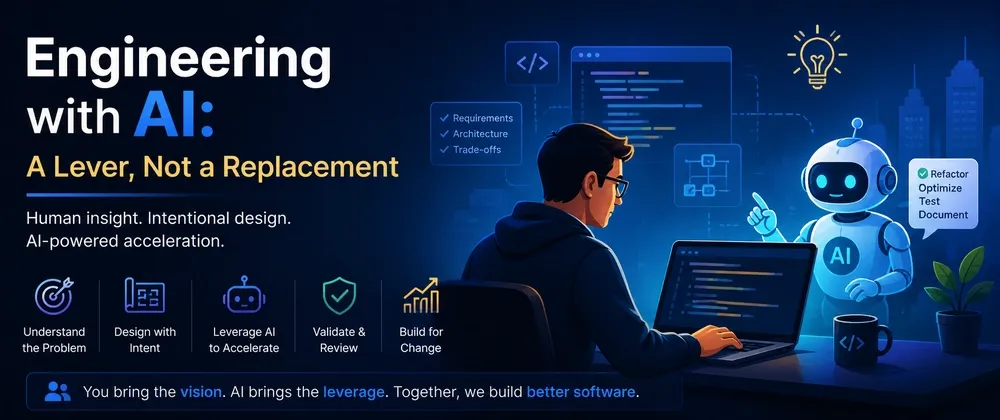

AI coding tools have rapidly transformed the way software is built. From generating boilerplate code to suggesting optimizations and even writing entire modules, these tools promise unprecedented speed and efficiency. But with great power comes a subtle risk: confusing acceleration with replacement.
Engineering is not just about writing code; it is about understanding systems, modeling business problems, making trade-offs, and evolving architectures over time. AI can assist in these tasks, but it cannot own them.
This article explores how engineers can leverage AI as a force multiplier enhancing productivity, improving quality, and accelerating delivery without compromising the critical human elements of design, reasoning, and ownership.
Background
Over the past few years, AI-powered developer tools have matured significantly:
- Code generation (functions, APIs, tests)
- Intelligent autocomplete and refactoring
- Debugging assistance
- Documentation synthesis
- Architecture suggestions
These tools are increasingly embedded into IDEs, CI/CD pipelines, and developer workflows. As a result, engineering teams are producing more code faster than ever before. However, speed alone does not guarantee correctness, scalability, or maintainability.
Historically, software failures rarely stem from syntax errors whereas they arise from:
- Poor system design
- Misunderstood requirements
- Lack of domain modeling
- Weak abstractions
- Inability to adapt to change
AI can generate code, but it does not own context. That responsibility remains with engineers.
Problem Statement
The growth of AI coding assistants (e.g., GitHub Copilot, Cursor, ChatGPT) has fundamentally shifted how software is written. While these tools offer undeniable productivity gains, a concerning pattern is emerging across engineering teams: AI is increasingly being treated as a substitute for critical thinking rather than an accelerator of it.
The central issue is not whether teams adopt AI tools; it is how they integrate them into their development workflow. Many engineering teams are beginning to exhibit the following behavioral patterns:
- Over-reliance on AI-generated code without validation: Accepting suggestions at face value without analyzing correctness, performance implications, or security vulnerabilities.
- Treat AI suggestions as authoritative rather than advisory: Viewing generated code as "the solution" rather than "a possible approach" that requires human evaluation.
- Skip foundational thinking: Bypassing essential engineering practices such as design exploration, trade-off analysis, constraint identification, and domain modeling.
- Lose clarity on system boundaries and responsibilities: Failing to maintain mental models of how components interact, who owns what, and where architectural seams exist.
Organizations are achieving short-term speed at the expense of long-term sustainability. Systems are faster to build initially but increasingly difficult to maintain, extend, debug, and scale. The productivity curve inverts: early gains are offset by mounting technical debt, incident response delays, and architectural stagnation.
Solution
- A fundamental shift from restrictive AI policies to intentional usage, framing AI as a powerful "Assistant" while reserving the role of "Architect" for human engineers. This distinction ensures that while productivity increases, the integrity and long-term viability of the software remain under human control.























Sign in to leave a comment.