
The AI industry crossed an inflection point. We stopped asking "can the model answer my question?" and started asking "can the system complete my goal?" That shift from inference to agency changes everything about how we build, deploy, and scale AI in the cloud.
Google Kubernetes Engine (GKE) has quietly become the platform of choice for teams running production AI workloads. Its elastic compute, GPU node pools, and rich ecosystem of observability tools make it uniquely suited not just for model serving but for the orchestration challenges that agentic AI introduces.
This blog walks through the full landscape: what kinds of AI systems exist today, how agentic architectures differ, and what it actually looks like to run them reliably on GKE.
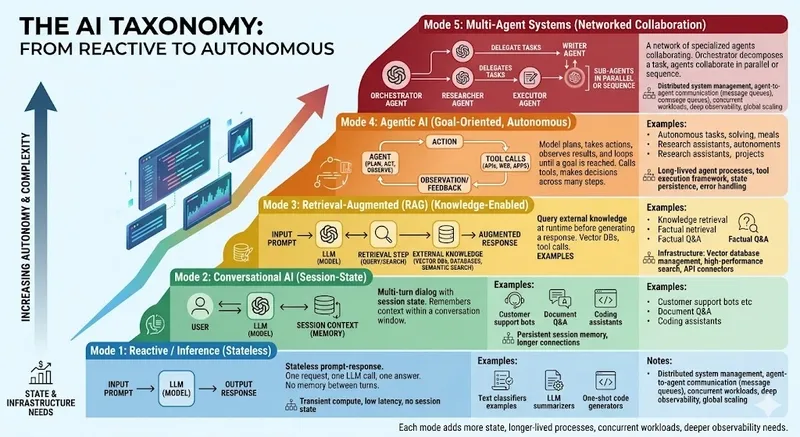
The AI Taxonomy: From Reactive to Autonomous
Before diving into infrastructure, it's worth establishing what we mean by the different modes of AI deployment. Not all AI is "agentic," and the architecture you choose should match the behavior you need
Reactive / Inference
Stateless prompt-response. One request, one LLM call, one answer. The model has no memory between turns. Examples: text classifiers, summarizers, one-shot code generators.
Conversational AI
Multi-turn dialog with session state. The model remembers context within a conversation window. Examples: customer support bots, document Q&A, coding assistants.
Retrieval-Augmented (RAG)
The model can query external knowledge at runtime before generating a response. Introduces a retrieval step vector DBs, semantic search, tool calls to databases.
Agentic AI
The model plans, takes actions, observes results, and loops until a goal is reached. It can call tools, spawn subagents, and make decisions across many steps autonomously.
Multi-Agent Systems
A network of specialized agents collaborating: an orchestrator decomposes a task and delegates to researcher, writer, executor agents that work in parallel or sequence.
Each mode up the stack introduces new infrastructure requirements: more state to manage, longer-lived processes, more concurrent workloads, harder failure modes, and deeper observability needs.






















Sign in to leave a comment.