


Software quality has become an important part of modern product development. Applications are updated frequently, users expect reliable experiences, and development teams need quick feedback when something goes wrong. In this environment, QA professionals often need to handle a large number of repetitive checks while also spending time on more complex testing activities.
This is where Automation testing can make a practical difference. By using scripts and appropriate testing tools, repetitive test scenarios can be executed more consistently and efficiently. However, successful automation requires more than knowing a particular tool. Testers also need a solid understanding of software testing, programming logic, test design, debugging, and maintenance.
Why Automation Skills Matter in QA
Manual testing remains valuable, especially for exploratory testing, usability checks, and scenarios that require human observation. At the same time, repeating the same test cases manually after every application change can consume considerable time.
Automation is particularly useful for scenarios that are:
- Repeated frequently
- Stable and predictable
- Time-consuming to execute manually
- Suitable for clear expected results
- Part of regression testing
- Required across multiple environments
The goal is not to automate every possible test. Instead, QA teams should identify areas where automation can provide meaningful value.
Start With Strong Testing Fundamentals
Before learning automation frameworks, it is useful to understand the fundamentals of software testing. Concepts such as test cases, test scenarios, defects, regression testing, functional testing, test data, and expected results form the foundation of effective QA work.
A tester who understands these concepts can make better decisions about which scenarios should be automated.
For example, a frequently executed login test may be a suitable candidate for automation. On the other hand, evaluating whether a newly designed page feels intuitive may require human judgment.
Understanding this difference helps create a balanced testing strategy.
Develop Programming and Scripting Skills
Programming knowledge is another important part of automation. Beginners do not need to become expert software developers, but they should understand basic programming concepts.
Useful topics include:
- Variables and data types
- Conditional statements
- Loops
- Functions
- Classes and objects
- Collections
- Exception handling
- File handling
Languages such as Java, Python, and JavaScript are used in different testing environments. The best choice depends on the project, framework, and technology stack.
The main objective should be understanding programming logic rather than memorizing code. When testers understand why a script works, they can modify and troubleshoot it more effectively.
Choosing the Right Automation Framework
There are many tools available for different types of testing. Selenium and Playwright, for example, are commonly used for web application automation.
For beginners, trying to learn every framework at once can create unnecessary confusion. A better approach is to select one suitable framework and understand its core concepts thoroughly.
Important areas to practice include:
- Locating web elements
- Performing user actions
- Creating assertions
- Managing waits
- Handling test data
- Executing test cases
- Generating reports
- Debugging failures
Once the fundamentals of one framework are clear, moving to another becomes easier.
Practical Learning Is More Valuable Than Memorization
A strong Automation testing Training approach should give learners opportunities to work with realistic testing scenarios.
Instead of simply following examples, learners can create a small project that covers common workflows such as login, registration, search, form validation, and navigation.
During practical work, unexpected problems are likely to appear. An element may not be found, a page may load slowly, test data may be incorrect, or an application change may cause an existing script to fail.
Learning how to investigate these problems develops practical troubleshooting skills.
What to Consider When Learning in India
People researching Automation Testing training in india may find many different learning options. Rather than choosing based only on the number of tools included, it is useful to examine the overall curriculum.
A practical learning path should ideally include:
- Testing fundamentals
- Programming basics
- Automation frameworks
- Test case design
- Debugging
- API testing
- Reporting
- Version control
- CI/CD concepts
- Test maintenance
Hands-on exercises are also important because they allow learners to apply concepts instead of only reading about them.
Understanding API and Backend Testing
Modern applications often depend on APIs and backend services. Therefore, QA professionals can benefit from understanding how these components are tested.
API testing can be used to validate responses, authentication, request parameters, data handling, and communication between services.
Database knowledge can also help testers verify whether information is being stored and retrieved correctly.
When evaluating an Automation Testing course, it can be useful to check whether the curriculum covers these areas along with UI automation.
The Importance of Test Maintenance
Creating an automated test is only the beginning. Applications change over time, and automation scripts need to change with them.
A test can become unreliable when locators change, workflows are updated, test data becomes outdated, or application behavior changes.
Good automation therefore requires regular maintenance. Reusable functions, clear naming conventions, appropriate waits, organized test data, and useful reporting can make test suites easier to maintain.
Reliable automation should provide trustworthy feedback rather than simply increasing the number of automated scripts.
Avoid the “Automate Everything” Approach
One common mistake among beginners is assuming that more automated tests always mean better testing.
Automation requires development and maintenance effort. If a scenario changes constantly or requires significant human observation, automating it may not provide enough value.
A better approach is to consider the purpose of each test before automating it.
Ask questions such as:
- How often will the test be executed?
- Is the expected result clearly defined?
- Is the functionality stable?
- Will automation reduce meaningful effort?
- How much maintenance will it require?
These questions can help testers build a more effective automation strategy.
Building a Step-by-Step Learning Path
Someone exploring an Automation testing course in India can follow a gradual learning path rather than trying to learn everything simultaneously.
A simple progression is:
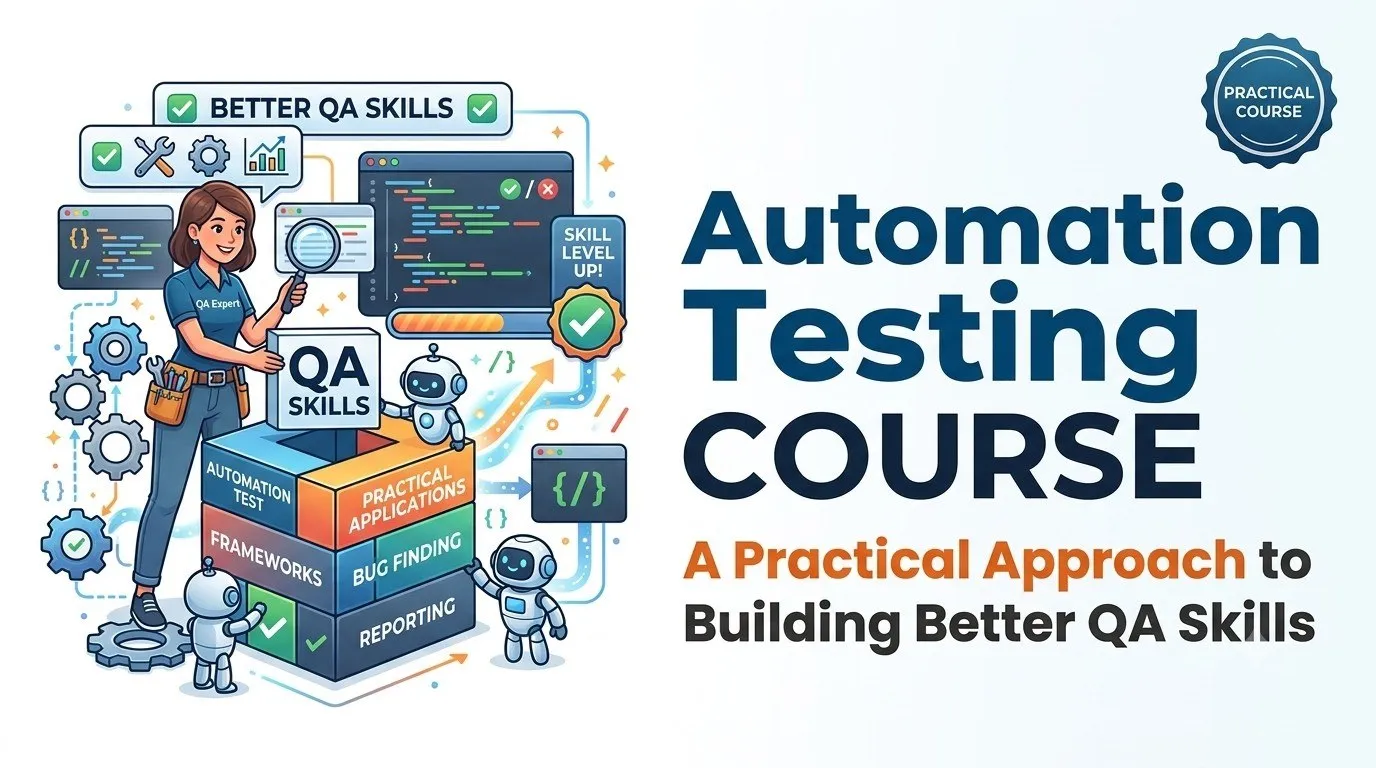
Testing Fundamentals → Programming → Automation Framework → Test Design → Practical Project → API Testing → CI/CD → Maintenance
This approach allows each skill to support the next one.
Regular practice is especially important. Writing test cases, creating scripts, debugging failures, and improving an existing framework can build confidence over time.
Final Thoughts
Automation has an important role in modern QA, but effective automation depends on much more than knowing a testing tool. Strong testing fundamentals, programming knowledge, practical experience, debugging ability, and maintenance practices all contribute to reliable automation.
A well-planned Automation testing Training journey can help learners develop these skills gradually and understand how automation fits into real software testing workflows.
The focus should not be on automating everything. Instead, the objective should be to identify the right testing scenarios, create reliable automated checks, and maintain them as applications evolve. With consistent practice and a problem-solving mindset, QA professionals can build practical skills that remain useful across different projects and technologies.

























Sign in to leave a comment.