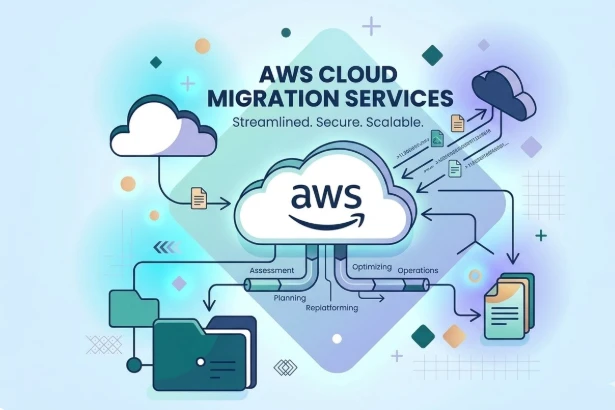

AWS Cloud Migration Services for Real Business Systems
AWS cloud migration services are often sold as a smooth upgrade, almost like flipping a switch. That’s not how it works in real environments. I’ve led multiple migrations where the biggest challenge wasn’t moving workloads it was dealing with what happens after the move.
Most teams don’t struggle with “how to migrate.” They struggle with “what breaks when we do.”
And that’s exactly where decisions around AWS cloud migration services start to matter not during planning slides, but during real execution.
Why migration decisions fail after go-live
There’s a pattern I’ve seen across companies, especially those exploring AWS cloud migration in India. The focus stays heavily on getting to the cloud. Very little attention goes to how systems behave once they’re there.
Latency changes. Cost patterns shift. Monitoring becomes more complex.
And suddenly, the system that worked fine on-prem starts behaving unpredictably.
This is where most “successful migrations” quietly turn into operational headaches.
What AWS cloud migration actually feels like on the ground
Migration is rarely a clean process. It’s messy, layered, and sometimes uncomfortable.
You start with dependencies you didn’t fully map. A database tied to an internal service. A legacy corn job nobody documented. Small things, until they aren’t.
During one project, we moved a mid-sized application using Amazon EC2 and Amazon RDS. Everything looked stable in staging. Production told a different story.
Traffic spikes exposed database connection limits. Auto-scaling worked, but not fast enough. Costs started climbing before performance stabilized.
That’s when you realize AWS Cloud Migration Services are not about moving servers. They’re about understanding behavior under real conditions.
The cost reality most CTOs underestimate
Let’s talk about AWS cloud migration cost in India, because this is where expectations usually break.
Many teams assume cloud automatically reduces costs. It can but only if architecture is optimized.
Otherwise:
- EC2 instances run oversized
- Data transfer charges quietly increase
- Idle resources keep billing in the background
In one case, a client expected a 30% cost reduction. Within two months, their AWS bill was 18% higher than their previous setup.
Why?
Because migration happened without optimization.
That’s a common mistake when aws cloud migration services are treated as a one-time activity instead of an ongoing process.
Where most migration strategies go wrong
There’s too much focus on “lift and shift.” It sounds simple. Move everything as-is and optimize later.
In reality, “later” rarely happens.
Systems carry inefficiencies into the cloud. And the cloud charges you for those inefficiencies.
Cloud modernization should start early, not after migration. Even small changes—like moving workloads to AWS Lambda or using Amazon S3 instead of traditional storage—can make a significant difference.
But these decisions require time and clarity. And most teams rush through them.
What real downtime risk looks like
Everyone talks about cloud migration without downtime, but it’s rarely zero downtime in strict terms. It’s controlled downtime.
The difference matters.
In critical systems, even a few minutes can impact revenue or user trust.
I’ve seen teams attempt aggressive cutovers and roll back within hours because dependencies were missed.
A better approach is phased migration.
Move smaller components first. Validate behavior. Then scale.
That’s how AWS cloud migration services reduce risk not by eliminating downtime completely, but by controlling it intelligently.
What good AWS cloud migration services include
- Clear dependency mapping before migration
- Cost modeling based on real usage, not assumptions
- Gradual workload transition instead of full cutover
- Post-migration performance monitoring and tuning
This is the only part worth listing, because these elements directly affect outcomes.
Everything else depends on how these are executed.
The small business angle most people ignore
When it comes to cloud migration for small business india, the challenges are slightly different.
Budgets are tighter. Teams are smaller. There’s less margin for error.
But interestingly, smaller systems are often easier to optimize if approached correctly.
Instead of replicating large enterprise architectures, simpler setups using managed services like AWS Lightsail or serverless options can work better.
The mistake is trying to copy enterprise patterns without enterprise resources.
Choosing the right partner (and why it matters more than tools)
A lot of companies look for the best cloud migration company in india assuming tools will solve most problems.
They won’t.
Tools like AWS Migration Hub or Database Migration Service are useful, but they don’t decide strategy.
The real difference comes from experience.
Someone who has handled migrations knows where things usually break. They anticipate issues that aren’t obvious in documentation.
That’s what makes enterprise cloud migration consulting India valuable—not the tools, but the judgment behind decisions.
What changes after migration (this is where reality hits)
This part is rarely discussed.
After migration, teams expect stability. What they get instead is a learning curve.
Monitoring shifts from server health to service-level metrics. Costs need continuous tracking. Performance tuning becomes ongoing.
And sometimes, teams realize they don’t fully understand their own system behavior yet.
That’s normal.
But it’s also why aws cloud migration services shouldn’t end at deployment.
They should extend into optimization and operational alignment.
A perspective most vendors won’t tell you
Migration success is not defined by completion.
It’s defined by how the system performs three months later.
If costs are predictable, performance is stable, and teams are confident managing the system—then it worked.
Otherwise, it’s just a partial success.
That’s why I usually tell clients—don’t rush migration timelines. Rushed migrations almost always create longer-term problems.
Conclusion
AWS cloud migration services are not just about moving infrastructure. They’re about reshaping how systems behave, scale, and cost over time.
The real challenge is not getting to AWS. It’s staying efficient once you’re there.
If decisions are rushed, costs increase. If dependencies are ignored, systems break. If optimization is delayed, benefits never fully show up.
Migration is not a project. It’s a transition.
And the way you handle that transition determines whether the move actually makes sense.
FAQs
1. How much does AWS cloud migration cost in India?
Ans. It varies widely, but small to mid-sized migrations can range from ₹5 lakh to ₹50 lakh depending on complexity, architecture, and optimization level.
2. Is cloud migration possible without downtime?
Ans.Not completely, but downtime can be minimized with phased migration and proper planning.
3. What is the biggest mistake in AWS migration?
Ans.Treating it as a one-time activity instead of an ongoing optimization process.
4. Are AWS services like EC2 and RDS enough for migration?
Ans.They are part of the solution, but architecture decisions and monitoring are equally important.
5. How long does a typical migration take?
Ans.Anywhere from a few weeks to several months depending on system complexity.
























Sign in to leave a comment.