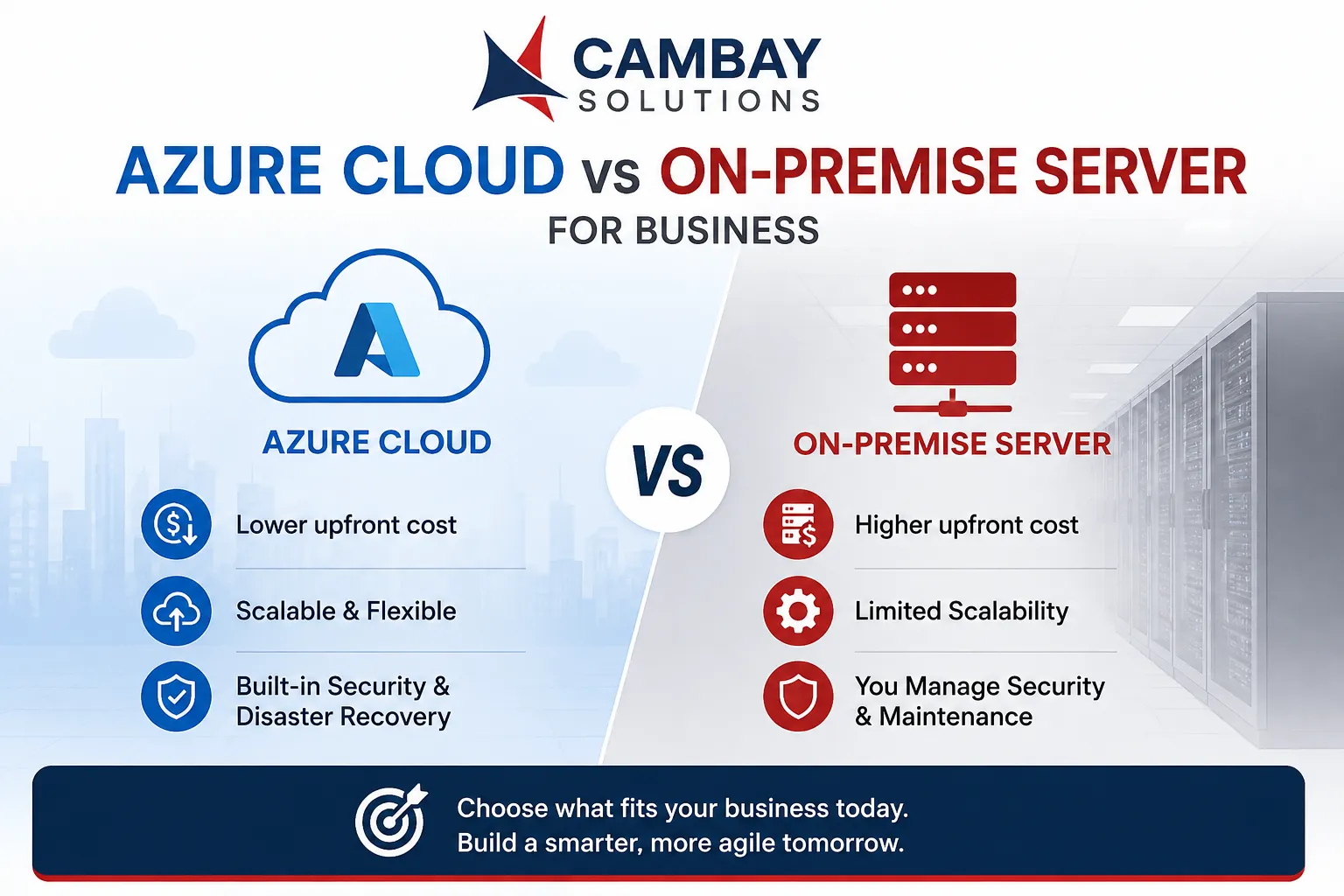

Businesses today need reliable, secure, and scalable IT infrastructure to support daily operations and future growth. When planning their infrastructure strategy, many organizations consider Azure cloud vs on-premise server for business.
Both options can support business applications, databases, storage, and critical workloads. However, they work differently and offer different advantages depending on a company's goals, budget, security requirements, and workload needs.
Understanding these factors can help businesses make a smarter infrastructure decision.
What Is Azure Cloud?
Microsoft Azure is a cloud computing platform that provides businesses with access to computing power, storage, databases, networking, security, analytics, and other technology services.
Instead of purchasing and maintaining physical servers, businesses can use Azure resources according to their requirements.
Azure can be used for application hosting, data storage, backup, disaster recovery, development environments, analytics, and enterprise workloads.
What Is an On-Premise Server?
An on-premise server is physical IT infrastructure managed by a business within its own facility or data center.
The organization is responsible for purchasing and maintaining servers, storage, networking equipment, security systems, backups, software, and other infrastructure components.
While this approach provides direct control over the physical environment, it also requires continuous investment and IT management.
Why Businesses Are Considering Azure Cloud
Cloud adoption has become an important part of modern IT strategies. Azure can help businesses reduce their dependency on physical infrastructure while providing access to scalable cloud resources.
One major benefit is flexibility. Businesses can increase or decrease resources based on changing workloads without purchasing additional physical hardware.
Azure can also help reduce infrastructure maintenance responsibilities. Instead of managing physical servers, businesses can focus more on applications, data, security, and business operations.
Another advantage is access to modern cloud capabilities, including analytics, AI, databases, automation, and application development services.
When On-Premise Servers Still Make Sense
Moving to the cloud isn't automatically the right decision for every business.
Companies with significant existing investments in physical infrastructure may prefer to continue using on-premise servers for certain workloads.
On-premise infrastructure can also be appropriate for businesses with specialized hardware requirements, stable workloads, or specific operational and compliance considerations.
Organizations that require extensive control over their physical infrastructure may also prefer an on-premise environment.
How to Decide Between Azure and On-Premise Infrastructure
Rather than asking which technology is universally better, businesses should evaluate their own requirements.
Start by considering your workloads. Applications that require frequent scaling may benefit from Azure, while stable workloads may continue to operate effectively on existing infrastructure.
Next, evaluate IT costs. Azure can reduce upfront hardware investment, but cloud expenses depend on resource consumption and configuration. On-premise infrastructure requires spending on hardware, maintenance, electricity, support, upgrades, and data center requirements.
Security should also be evaluated carefully. Both environments can be secure when properly designed and managed. Businesses need to consider identity management, access controls, monitoring, encryption, backups, and compliance requirements.
Finally, consider your future growth. If your business expects rapid expansion or changing technology requirements, cloud infrastructure can provide greater flexibility.
Consider a Hybrid Approach
Businesses don't always have to choose between Azure and on-premise servers.
A hybrid infrastructure combines both environments. For example, a company could keep critical legacy applications on-premise while using Azure for backup, disaster recovery, development, analytics, or scalable applications.
This approach can allow businesses to modernize gradually without immediately replacing their entire IT environment.
How Cambay Solutions Can Help
Cambay Solutions helps businesses evaluate cloud transformation and technology modernization opportunities based on their specific requirements.
For organizations evaluating Azure cloud vs on-premise server for business, Cambay Solutions can help assess existing infrastructure, identify suitable cloud workloads, develop migration strategies, and explore hybrid infrastructure options.
The goal is to help businesses adopt technology strategically rather than moving workloads simply because cloud adoption is popular.
A well-planned infrastructure strategy can help organizations improve scalability, manage technology costs, strengthen operational efficiency, and prepare for future growth.
Frequently Asked Questions
Is Azure better than an on-premise server?
Neither option is universally better. Azure provides scalability and cloud flexibility, while on-premise servers provide greater physical control. The right choice depends on business requirements.
Is Azure cheaper than on-premise infrastructure?
It depends on usage and business requirements. Azure can reduce upfront hardware costs, while on-premise infrastructure involves hardware, maintenance, power, support, and upgrade expenses.
Can businesses use Azure and on-premise servers together?
Yes. A hybrid approach allows businesses to keep selected workloads on-premise while using Azure for applications, backup, disaster recovery, analytics, or other cloud services.
Is Azure secure for businesses?
Azure provides extensive security capabilities. However, businesses are still responsible for properly configuring and managing their cloud environments, including identities, access, applications, and data.
Should a small business move to Azure?
Azure can be a useful option for businesses that want scalable infrastructure without managing extensive physical hardware. However, the decision should be based on workload requirements, budget, security, and business goals.
Conclusion
Choosing between Azure cloud vs on-premise server for business requires careful consideration of workloads, costs, security, scalability, existing infrastructure, and future business objectives.
Azure can provide flexibility and scalability, while on-premise servers can offer greater physical control. For many organizations, a hybrid approach can provide a practical path between the two.
The most effective strategy is the one that aligns your IT infrastructure with your business goals and prepares your organization for sustainable growth.





















Sign in to leave a comment.