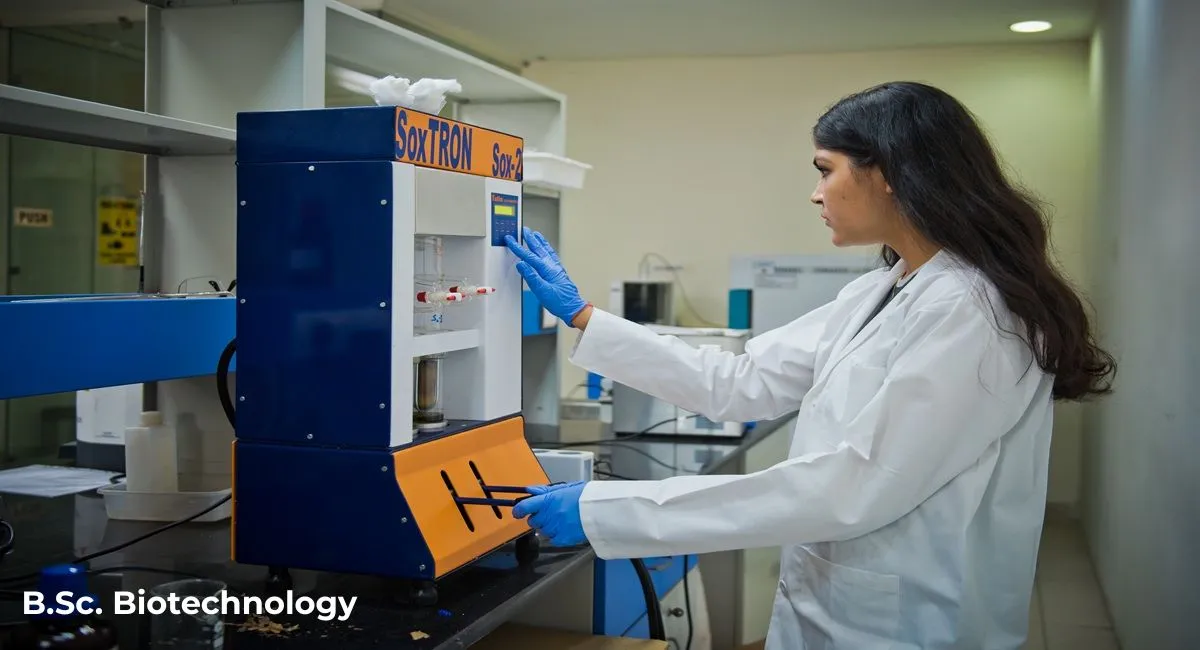

Picture a future in which a genetic disorder is corrected before symptoms emerge; imagine agricultural crops grown with less water but delivering larger yields; bacteria that remove pollution from contaminated rivers instead of harmful chemicals or medicines created specifically for you and your unique genetic makeup. This is not a futuristic vision of the coming century, it is taking place right now.
Biology is no longer just a discipline that understands the nature of life; it is the science of redesigning life. Computer technology transformed the world for years because humans found ways to use computers to their advantage. Today, biotechnology is transforming our world because scientists know how to program life to solve problems that could never be solved before. Cells, microbes and DNA are becoming tools for solving problems that once seemed impossible.
This is what makes a B.Sc. Biotechnology degree much more than a traditional life science major. It prepares you to work in a field where biology, technology and innovation converge to create solutions for healthcare, agriculture, environmental sustainability and industrial manufacturing.
The Biggest Scientific Revolution Isn't Happening on Screens
Artificial Intelligence fills news headlines, electric cars fill discussions, space exploration fires imagination. However, another revolution is brewing in research laboratories. Scientists have created gene-editing techniques to fix defective DNA; they have used microorganisms to create medicines that previously relied on complicated chemical reactions and engineers are making biodegradable materials using biological processes rather than oil-derived plastics.
What do all of these innovations have in common? They all start with biotechnology. The next great innovations could very well come not from writing better computer programs, but from studying life itself.
Why Biology Is Becoming the New Engineering
Biology has been all about observations for years. Research has been done on how organisms behave, how diseases propagate and how ecological systems develop.
Today's biotechnology raises another kind of question. "Is there a way to optimize these processes?" This shift has made biology an engineering field. Nowadays, scientists do not analyze DNA anymore but manipulate it; they do not detect microorganisms but re-engineer them to produce vaccines, enzymes and renewable fuels and they do not just diagnose illnesses but create personalized treatments according to genetic information. B.Sc. Biotechnology program is your opportunity to join the world of innovation and discoveries.
What You'll Actually Learn
Contrary to many traditional science degrees, B.Sc. Biotechnology combines both theoretical knowledge and application. Molecular biology, genetics, microbiology, biochemistry, immunology and bioinformatics are studied, with laboratory work being performed throughout the program.
However, most importantly, you’ll learn how scientific innovations are applied not just in books but in hospitals, drug companies, agricultural research organizations and biotech firms. This is what sets modern Biotechnology courses apart from other science courses. The aim here is not only to study biology, but to apply biology to solve real-life issues that trouble thousands of people.
The Industries Waiting for Biotechnology Graduates
Not only research laboratories, but B.Sc. Biotechnology offers opportunities in a multitude of sectors where biological innovations continue to revolutionize the ways in which we live and work, including:
- Healthcare & Pharmaceutical
- Agricultural & Food Technology
- Environmental Biotechnology
- Biomedical Research
- Industrial Biotechnology
- Bioinformatics & Genomics
- Biotechnology Start-Ups & Research Organizations
One of the greatest advantages of Biotechnology courses is that you won't be limited to a single career option, but can choose a career path where scientific innovation continues to create new opportunities across industries.
Curiosity Is the Most Valuable Skill You'll Bring
Change comes with technology; laboratory tools undergo change and science makes new discoveries. But there is one thing that will always remain relevant, that’s curiosity.
The best biotechnologists are not just individuals who have scientific knowledge stored in their minds; they are the ones who ask better questions. Why does this disease happen? Can we improve this drug? Is there an alternative solution? Does biology provide a different solution to this problem?
A B.Sc. Biotechnology develops this mindset alongside technical knowledge, helping you become researchers, innovators and problem-solvers rather than passive learners.
Conclusion
The next revolutionary medication could start with just one gene, the next major discovery about the environment might be found within a microbe and the next technological advancement could be developed in a lab rather than manufactured in a plant.
Choosing a B.Sc. Biotechnology means stepping into a field where every experiment has the potential to become a breakthrough. It is a program designed for students who don't just want to understand life, but aspire to shape its future through science, research and innovation.
So, do you want to become part of the scientific revolution? Discover the B.Sc. Biotechnology degree and start your journey into a science-based career that can shape the future.





















Sign in to leave a comment.