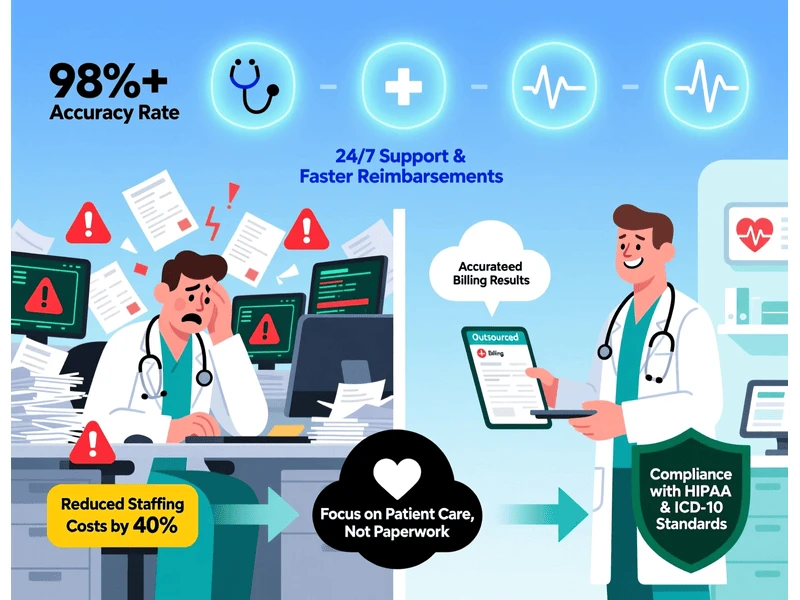
Introduction: The Rapid Rise of Outsourced Medical Billing Services
The healthcare industry is undergoing a major shift. With rising administrative complexity, tighter reimbursement rules, and increasing denial rates, medical practices are finding it more challenging to manage their billing processes internally. As a result, outsourcing medical billing services has become one of the fastest-growing trends helping healthcare providers enhance efficiency, reduce errors, and maximize revenue.
From small clinics to multi-location healthcare systems, outsourcing billing and coding is now considered a strategic decision rather than an operational one. This blog explains why outsourcing is transforming the industry and how it helps healthcare organizations achieve stronger financial performance.
Why Medical Billing Has Become More Complex Than Ever
A decade ago, billing was simpler. Today, the financial landscape of healthcare involves:
- Frequent changes in CPT, ICD-10, and HCPCS codes
- Payer-specific claim rules
- Increase in prior authorization requirements
- Expanding telehealth billing guidelines
- Heightened audit scrutiny
- Value-based care documentation rules
- Stricter compliance requirements from CMS and commercial payers
These evolving regulations require expertise, technology, and continuous training, making in-house billing teams overwhelmed and often under-resourced.
The Hidden Costs of Billing Errors
Billing mistakes can lead to:
- Loss of revenue
- Delayed reimbursements
- Higher denial rates
- Increased A/R aging
- Compliance risks and audit exposure
Industry data shows:
- Up to 30% of in-house claims contain errors
- 65% of denied claims are never reworked
- Practices lose thousands annually due to preventable mistakes
For many organizations, these challenges make outsourcing not just beneficial but essential.
Benefits of Outsourcing Medical Billing Services
Outsourcing has grown dramatically because it offers advantages that internal staff alone cannot provide.
1. Increased Revenue and Faster Payments
Outsourced billing teams use advanced RCM systems, experienced billing professionals, and automated claim scrubbing tools resulting in higher clean claim rates.
Benefits include:
- Fewer denied or rejected claims
- Faster claim processing
- Improved cash flow
- More predictable revenue cycles
Practices partnering with outsourced billing services report:
- 25–40% fewer denials
- 20–35% faster payments
2. Access to Certified Medical Coders
Accurate coding is the backbone of proper reimbursement. Coding mistakes whether due to undercoding, overcoding, or missing modifiers cause major revenue loss.
Outsourced providers employ certified medical coders (CPC, CCS, CIC) who:
- Stay updated with yearly ICD-10 and CPT changes
- Understand specialty-specific coding
- Prevent bundling/unbundling errors
- Ensure documentation supports coding
- Reduce compliance risks
With expert coders, practices significantly decrease coding-related denials.
3. Reduced Administrative Burden on Healthcare Staff
Physicians and clinical teams often feel overwhelmed by administrative tasks, especially billing-related paperwork.
Outsourcing helps by:
- Freeing staff from time-consuming billing duties
- Reducing interruptions during patient care
- Eliminating manual claim follow-up
- Minimizing phone calls with payers
- Decreasing stress and burnout
This allows providers to focus 100% on patient care, improving clinical outcomes and patient satisfaction.
4. Lower Operational Costs
Running an in-house billing department involves:
- Salaries and benefits
- Ongoing training
- Billing software expenses
- Claim scrubbing tools
- Clearinghouse fees
- Office space and equipment
Outsourcing removes these costs entirely. Practices pay only for the service they need often far less than maintaining full-time staff.
5. Greater Compliance and Fewer Audit Risks
Regulatory compliance grows more complicated each year. Outsourced billing companies stay updated with:
- CMS changes
- HIPAA guidelines
- Payer policy updates
- Local Coverage Determinations (LCDs)
- General and specialty-specific billing rules
Their expertise dramatically reduces risk of:
- Audit flags
- Incorrect billing patterns
- Coding violations
- Overpayment refunds
This ensures long-term financial stability and practice protection.
6. Enhanced Denial Management & A/R Follow-Up
A high rate of aging accounts receivable is a warning sign in many practices.
Outsourcing provides:
- Dedicated denial resolution teams
- Automated A/R tracking
- Frequent follow-up on unpaid claims
- Identification of root causes
- Prevention of repeated denials
Most outsourced billing partners bring A/R aging down by 40–60% within months.
7. Scalable Solutions for Growing Practices
As a practice expands new locations, higher patient volume, additional specialties billing demands grow too.
Outsourced billing providers offer:
- Flexible staffing
- Support for multiple specialties
- Ability to handle surges in claims
- Seamless integration with EHR/EMR systems
This scalability helps practices grow without worrying about administrative overload.
Why It's Is the Turning Point for Outsourcing
Three major shifts are driving the rapid move toward outsourced medical billing in 2025:
1. Staffing shortages and high turnover
Billing staff shortages have increased by 30% across the U.S.
2. Rising payer complexity
Payers update billing rules almost monthly, making internal management difficult.
3. Transition to AI-powered RCM technologies
Outsourced billing companies are investing in AI tools for:
- Predictive denial management
- Automated coding assistance
- Intelligent claim scrubbing
- Real-time revenue analytics
Internal teams usually cannot match these technological capabilities.
Conclusion: Outsourcing Is No Longer a Trend: It’s a Necessity
Outsourcing medical billing services is redefining how healthcare organizations operate. With expert teams, advanced RCM technologies, and specialty-specific coding capabilities, outsourced billing delivers the accuracy, efficiency, and financial performance that modern practices require.
In this year and beyond, healthcare providers that choose outsourced billing will gain:
- Higher revenue
- Fewer denials
- Stronger compliance
- Faster payments
- Greater operational efficiency
It’s not just a business decision, it's a strategic investment in the future of the practice.





























Sign in to leave a comment.