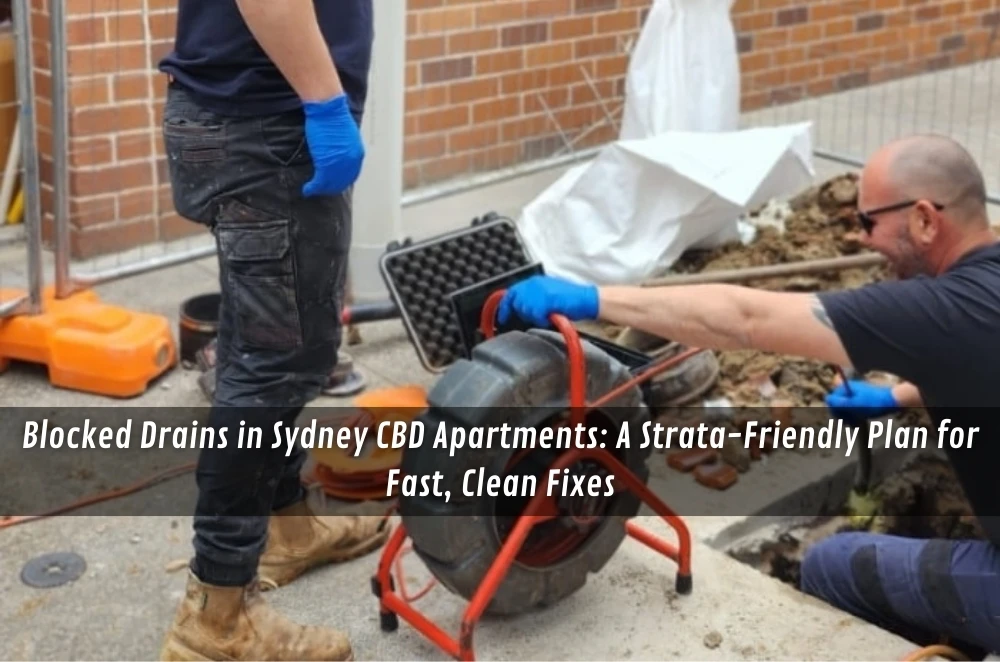

A blocked drain in a freestanding house is annoying.
A blocked drain in a Sydney CBD apartment building can become a building-wide problem—fast—because pipes are shared, access is constrained, and water damage doesn’t stay neatly contained to one unit, even if you’re also trying to line up local drain unblocking support across the Inner West Sydney.
This guide is a practical, strata-friendly way to respond to blocked drains and recurring drainage issues in CBD apartments and mixed-use buildings, with a focus on containment, coordination, and getting a proper fix (not just a temporary clear).
Why do CBD drain issues escalate so quickly
In high-density buildings, drainage isn’t “yours” in the simple sense.
Multiple units can feed into shared stacks, common lines run through risers and service cupboards, and a blockage in one location can surface somewhere completely different.
That’s why small warning signs deserve attention in apartments—because the downside risk is higher and the number of people affected can multiply quickly.
Access is also a real limiter.
If the fix requires entry to multiple units, plant rooms, or common areas, a straightforward job can turn into a coordination problem unless it’s handled methodically.
Early warning signs to take seriously
Most major overflows have a lead-up.
The signs are usually boring, but they’re worth acting on early.
Slow drains that come and go
Intermittent slow drainage often points to partial restriction, not a one-off “bit of hair.”
If multiple fixtures are slow at the same time (for example, shower and basin), that’s a stronger hint you’re dealing with something beyond a local trap.
Gurgling, bubbling, or bad smells
Odd noises and sewer smells can indicate airflow issues, partial blockages, or a line that’s not draining cleanly.
If smells appear after using a fixture, that’s information worth documenting—not something to mask with an air freshener.
Water is backing up in unusual places
Backflow into a shower, floor waste, or lower fixture is a red flag.
In strata buildings, this can also indicate a shared line issue rather than a single-unit problem.
Repeat “mini blocks” after quick clears
If a drain clears and then blocks again within weeks, the underlying cause probably wasn’t addressed.
Recurring issues are where the cost and disruption usually stack up—especially if each event triggers emergency call-outs.
What to do first: containment, documentation, and who to notify
When drains misbehave in apartments, the first response should be about reducing damage and making the problem easier to diagnose.
Contain the risk
Stop using the affected fixtures.
If there’s any sign of overflow risk, treat it seriously—water damage in apartments spreads quickly and can impact neighbours and common property.
Document what’s happening (without turning it into a drama)
Write down:
- Which fixtures are affected
- When it started
- Whether it’s intermittent or constant
- Any overflow, odour, or gurgling
- Whether neighbours are seeing similar signs
Photos or a short video can help, especially if the problem is “only sometimes” and disappears right before someone arrives.
Notify the right person early
In many buildings, the fastest resolution comes from notifying the building manager or strata contact early—particularly if there’s a chance the issue is on a shared line.
Even if the source ends up being internal to one unit, early notice reduces delays if access to common areas or other units becomes necessary.
Common mistakes that make blockages worse
Blocked drains are one of those problems where well-meaning actions can create extra mess, extra cost, or extra damage.
- Treating recurring blockages as “bad luck.” Recurrence usually points to an underlying cause.
- Delaying notification in a strata building. Shared lines mean delays can affect multiple units.
- Making multiple “quick fixes” in a row. Repeated partial clears can hide the real issue and waste time.
- Ignoring access planning. If a fix requires riser access or multiple entries, it needs coordination.
- Only focusing on the symptom fixture. The problem might be upstream or downstream of where it shows.
- No clear cleanup and restoration plan. In apartments, water damage risk is part of the job scope.
- No follow-up evidence. If there’s no record of what was done, the next incident starts from zero.
Decision factors: choosing a repair approach and comparing the scope
The goal isn’t just to “get it flowing.”
The goal is to understand what caused the problem and reduce the chance it repeats—especially in shared CBD buildings where downtime and mess are expensive.
What to confirm before booking
When comparing providers or approaches, confirm:
- What diagnostics are included (high-level)
- How access will be handled (unit entry, risers, plant rooms, common areas)
- What reporting you’ll receive (useful for strata records)
- What cleanup is included if there’s overflow
- What the plan is if the issue is on a shared line versus within the unit
- How the job will be documented for handover
If you need a simple reference for what a proper drain response should include in apartments and strata settings, the drainage repair help for Sydney CBD apartments and strata buildings can help you sanity-check the scope before booking.
Avoiding “clear today, blocked again next month”
A quick clear can be appropriate for a true one-off.
But if the issue is recurring, a better decision is to ask, “What would confirm the cause?” rather than “How fast can someone come out?”
In apartment buildings, reducing repeat incidents is usually the biggest cost saver.
Strata realities: records and responsibility
Even when you’re not sure who is responsible (unit vs common property), a clean record helps.
A clear written scope, what was observed, and what was done makes it easier for strata managers and committees to make decisions without re-litigating the same problem every time.
A simple 7–14 day plan to resolve recurring issues
This plan is designed for buildings where the issue isn’t a one-off, or where you want to reduce the risk of repeat disruptions.
Days 1–2: Capture symptoms and notify early
Document affected fixtures, timing, and any overflow or odour.
Notify building management/strata contact if there’s any chance it involves shared lines or common areas.
Days 3–5: Get clarity on access and scope
Confirm access needs: which unit(s), which common areas, which work windows.
Confirm what reporting is required for strata records and how the outcome will be communicated.
Days 6–9: Complete the repair with a “proof of fix” mindset
The goal is to finish with confidence, not just relief.
Ensure the job includes a clear handover note of what was found, what was done, and what to watch for next.
Days 10–14: Reduce recurrence
If the building has repeat issues, agree on the next action that reduces recurrence—whether that’s a maintenance cadence, a building-wide review of recurring problem zones, or a documented process for early reporting.
Operator Experience Moment
In CBD buildings, the plumbing work is often the easy part.
The hard part is coordinating access and aligning expectations across unit owners, managers, and strata contacts.
When the first response is organised—containment, documentation, and clear scope—the fix tends to be faster and the “repeat incident” rate drops.
Local SMB Mini-Walkthrough
A mixed-use CBD building has a café on the ground floor and apartments above, with recurring drainage issues during peak trading hours.
The building contact logs which fixtures are affected and when the issue peaks to spot patterns.
Access is booked for risers and plant areas outside peak foot traffic times.
The repair scope includes a clear cleanup plan so common areas aren’t left messy or unsafe.
A short report is provided for strata records, so the next incident doesn’t start from scratch.
A follow-up plan is set to reduce recurrence, focusing on early reporting and coordinated access windows.
Practical Opinions
If it’s recurring, treat it like a root-cause problem, not a nuisance.
In strata buildings, access planning is half the job.
A clean handover note saves money the next time something goes wrong.
Key Takeaways
- Blocked drains in CBD apartments escalate quickly because pipes and consequences are shared.
- Early containment and clear documentation reduce water damage risk and speed up diagnosis.
- Compare providers by scope: access plan, diagnostics approach, reporting, and cleanup—not just speed.
- A 7–14 day plan helps resolve recurring issues and reduces repeat disruptions.
Common questions we hear from Australian businesses
Q1) How do we know if the blockage is in our unit or in a shared line?
Usually, if multiple fixtures are affected or neighbouring units report similar symptoms, the chance of a shared-line issue increases. A practical next step is to document which fixtures are affected and ask building management if other reports have come in. In many Sydney CBD buildings, stacked plumbing means symptoms can appear in unexpected units.
Q2) What should we do immediately to reduce damage risk?
In most cases, the safest move is to stop using affected fixtures and contain any overflow risk early. A practical next step is to take quick photos/video and notify the strata/building contact if shared services may be involved. Usually, CBD apartments have tighter tolerances for water damage because neighbours and common property are close.
Q3) What should we ask for in a quote so it doesn’t blow out later?
Usually, you want clarity on access assumptions, reporting/records, cleanup if there’s overflow, and what happens if the cause is in a shared line. A practical next step is to request an itemised scope that mentions building coordination and a handover note of findings. In most Sydney CBD buildings, access bookings and work windows affect cost as much as the repair itself.
Q4) How do we reduce the chance of the same issue happening again?
It depends on the cause, but recurring problems usually need a documented process rather than repeat emergency calls. A practical next step is to keep a simple incident log (date, symptoms, affected fixtures, outcome) and use it to guide next actions. In most mixed-use CBD buildings, peak-usage patterns and shared stacks make early reporting especially valuable.





























Sign in to leave a comment.