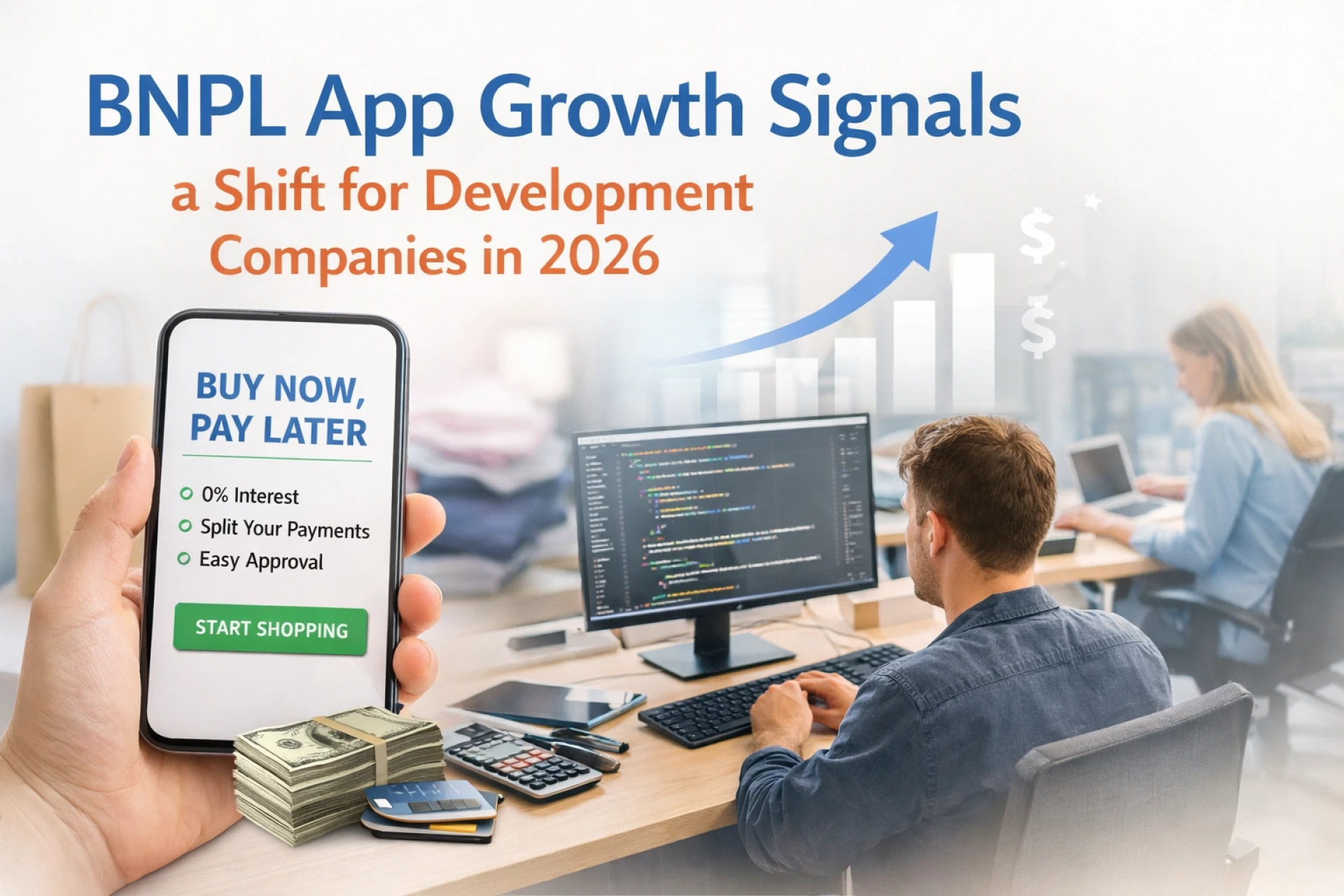

The global Buy Now Pay Later (BNPL) market has transitioned from a consumer convenience feature into a structured digital credit ecosystem. Over the last few years, installment-based payments have gained widespread acceptance due to changing consumer spending patterns, inflationary pressure and growing preference for short-term, interest-light credit models. By 2026, BNPL is projected to operate as a core component of digital commerce rather than an optional checkout add-on.
This growth is directly influencing development companies. As transaction volumes increase, BNPL platforms must handle higher concurrency, more complex credit logic and deeper integrations with merchants and financial institutions. Development firms are therefore being required to redesign their product strategies, shifting from basic fintech builds to regulated, credit-driven systems capable of operating at national and cross-border scale.
Structural Changes in Digital Payments
Digital payments are no longer limited to transaction processing. BNPL introduces deferred settlement, dynamic risk allocation and multi-party coordination between users, merchants, lenders and regulators. These structural changes have redefined payment architecture requirements.
BNPL platforms now operate at the intersection of lending, payments and identity verification. This has resulted in the replacement of monolithic payment gateways with event-driven, API-centric systems. Development companies supporting BNPL must manage real-time eligibility checks, payment scheduling, partial repayments, refunds and chargeback logic all within a single transaction lifecycle.
As a result, BNPL app development companies in 2026 are being evaluated not just on UI or performance, but on their ability to engineer resilient financial workflows that mirror institutional-grade payment systems.
Product Architecture Expectations in Modern BNPL Platforms
Modern BNPL applications are expected to support significantly more than installment calculation. Architecture now plays a decisive role in platform viability. Systems must be modular, scalable and adaptable to regulatory changes without requiring core code rewrites.
Key architectural expectations include microservices-based deployment, API-first design, event-driven processing and real-time data pipelines. BNPL platforms must also support merchant-specific configurations, dynamic repayment schedules and customer risk segmentation. These requirements have elevated BNPL app development 2026 trend toward highly configurable, policy-driven systems rather than static applications.
Development companies unable to design flexible architectures face limitations when onboarding new merchants, expanding regions, or adjusting credit models.
Regulatory & Compliance Pressure on BNPL Systems
Regulatory scrutiny is one of the most influential factors shaping BNPL development in 2026. Authorities across major economies are tightening controls around consumer credit disclosures, affordability checks, data privacy and reporting obligations. BNPL platforms are increasingly being classified alongside traditional credit products rather than treated as lightweight payment tools.
Compliance requirements now influence system design at the foundational level. BNPL platforms must integrate KYC verification, AML screening, transaction monitoring, dispute resolution mechanisms and audit-ready reporting. These requirements must operate seamlessly without degrading user experience.
For BNPL app development service providers for 2026, regulatory engineering has become a core competency. Compliance logic is no longer an external service layer; it is embedded directly into transaction flows and user journeys.
Technology Stack Evolution Supporting BNPL
The evolution of BNPL platforms is tightly coupled with advancements in cloud computing, artificial intelligence and data analytics. AI models are increasingly used for credit scoring, behavioral analysis and default prediction, enabling real-time lending decisions during checkout.
Cloud-native infrastructure supports elastic scaling during peak shopping periods, while distributed databases ensure transaction consistency across regions. Data engineering pipelines enable continuous monitoring of repayment behavior, fraud signals and merchant performance.
This technology evolution has pushed BNPL app development solutions for 2026 toward systems that are not only scalable but also intelligent and adaptive, capable of learning from user behavior and adjusting credit logic dynamically.
Commercial Demand Reshaping Vendor Capabilities
Merchants adopting BNPL expect measurable business outcomes, not just payment flexibility. Conversion rate optimization, reduced cart abandonment, higher average order value and customer retention are key commercial drivers behind BNPL adoption.
This demand has reshaped vendor capabilities. Development companies must now deliver analytics dashboards, merchant controls, settlement transparency and promotional financing tools. BNPL platforms are increasingly expected to function as revenue acceleration engines rather than passive payment tools.
Custom BNPL app development companies in 2026 are responding by building merchant-centric features such as campaign-based financing, category-level risk controls and performance reporting tied directly to sales metrics.
Industry-Wide Adoption Scenarios
BNPL adoption is no longer confined to retail eCommerce. Healthcare providers use BNPL to enable patient financing, educational institutions apply it for tuition flexibility and travel platforms integrate it for high-ticket bookings. Subscription-based services also leverage BNPL to reduce upfront cost barriers.
Each industry introduces distinct risk profiles, repayment behaviors and regulatory considerations. This has increased demand for vertical-specific BNPL frameworks rather than generic solutions. Development companies are required to understand sector-specific workflows and compliance requirements when designing platforms.
As adoption expands, BNPL app development providers for 2026 must support configurable industry logic without fragmenting platform stability.
Revenue Mechanics Embedded in BNPL Platforms
BNPL platforms generate revenue through multiple channels, extending beyond consumer interest fees. Merchant commissions remain a primary revenue stream, often structured as a percentage of transaction value. Additional revenue sources include late payment fees, premium merchant features, data insights and white-label licensing.
Some platforms also monetize through subscription-based merchant plans or value-added services such as fraud analytics and credit optimization tools. These revenue mechanics directly influence system architecture, requiring accurate tracking, reporting and settlement logic.
For development companies, monetization complexity translates into deeper backend requirements and long-term scalability considerations.
Solution Categories Emerging in BNPL Ecosystems
The BNPL ecosystem now includes a wide range of solution types. These include white-label BNPL engines, embedded SDKs for merchants, super-app financing modules and enterprise-grade lending platforms. Each category serves different market needs and operational models.
This diversification has driven demand for BNPL app development companies list for 2026 that can deliver configurable, future-proof solutions rather than rigid products. Development firms are increasingly positioning themselves as long-term platform partners rather than project-based vendors.
Strategic Importance of Specialized BNPL Vendors
BNPL development requires a blend of fintech engineering, regulatory knowledge, data science and scalable infrastructure design. Generic app development capabilities are no longer sufficient. Businesses now prioritize vendors with proven BNPL-specific expertise.
Leading BNPL app solutions provider 2026 are distinguished by their ability to anticipate regulatory changes, design adaptable credit logic and support rapid merchant onboarding. Specialization reduces compliance risk, shortens deployment cycles and improves platform resilience.
This strategic shift has elevated BNPL development from a niche offering to a core service line for forward-looking development companies.
BNPL App Development Companies for 2026
The following companies represent a data-driven selection of organizations actively shaping BNPL platforms through scalable architecture, regulatory alignment and fintech-grade engineering. Each company profile is presented in a consistent structure and depth, reflecting operational capacity rather than marketing positioning.
Suffescom Solutions
Founded: 2013
Locations: USA
Team Size: 250–500
Hourly Rate: $15–$30/hr
Suffescom Solutions operates as a multi-domain fintech and digital product engineering firm with a growing focus on BNPL platforms and embedded finance systems. The company builds end-to-end BNPL architectures that support installment logic, merchant onboarding, credit rule engines and repayment scheduling. Its development approach emphasizes modular system design, enabling businesses to adapt financing logic without restructuring core applications.
Suffescom's BNPL platforms are designed to integrate with payment gateways, identity verification services and analytics engines. The company’s delivery model supports both white-label BNPL engines and fully customized platforms tailored to sector-specific compliance and operational requirements. This positioning aligns closely with enterprise and mid-market demand for adaptable BNPL infrastructure heading into 2026.
Hyperlocal Cloud
Founded: 2015
Locations: USA
Team Size: 150–300
Hourly Rate: $25–$60/hr
Hyperlocal Cloud focuses on transaction-intensive platforms where real-time coordination between users, merchants and service providers is critical. In the BNPL domain, the company applies this expertise to installment-based payment systems, merchant settlement workflows and high-volume transaction processing.
Hyperlocal Cloud's BNPL solutions emphasize performance optimization, cloud scalability and rapid merchant integration. The company develops platforms capable of handling simultaneous transactions while maintaining compliance logic and repayment tracking. This operational strength positions it well for BNPL use cases tied to retail marketplaces, service platforms and multi-vendor ecosystems.
RisingMax Inc
Founded: 2011
Locations: USA
Team Size: 200+
Hourly Rate: $30–$75/hr
RisingMax Inc delivers fintech platforms with a strong emphasis on advanced analytics, automation and secure transaction flows. Its BNPL development capabilities focus on credit assessment models, dynamic repayment structures and enterprise-grade system security.
The company's BNPL platforms are designed to support omnichannel experiences, enabling installment payments across web, mobile and in-store digital touchpoints. RisingMax emphasizes system resilience, ensuring platforms remain stable under regulatory audits, traffic spikes and evolving credit policies. This makes the company suitable for businesses planning long-term BNPL expansion rather than short-term feature deployment.
AI Development Service
Founded: 2014
Locations: USA
Team Size: 100–250
Hourly Rate: $30–$65/hr
AI Development Service approaches BNPL development through a data-centric and automation-first lens. The company integrates machine learning models into BNPL systems to support credit scoring, repayment behavior analysis and risk forecasting. These capabilities enable platforms to adjust financing decisions dynamically based on user behavior and transaction history.
AI Development Service designs BNPL platforms with adaptive logic layers, allowing businesses to evolve credit strategies without rebuilding system architecture. Its focus on predictive analytics aligns with industry demand for proactive risk management and personalized financing experiences as BNPL adoption matures.
Development Lifecycle Patterns Observed Across Vendors
Across leading BNPL development firms, a consistent lifecycle pattern has emerged. Projects typically begin with regulatory mapping and financial modeling to define compliance boundaries and revenue structures. This phase is followed by system architecture design, where scalability, data flow and security requirements are established.
Subsequent stages include API integrations with payment processors, identity verification services and credit bureaus. Risk engines and repayment logic are implemented alongside merchant management modules. Before launch, platforms undergo extensive testing for transaction accuracy, edge cases and regulatory reporting readiness. Post-deployment, continuous monitoring and iteration are essential due to regulatory updates and evolving consumer credit behavior.
Cost Drivers Identified from Industry Analytics
Industry analytics indicate that BNPL development costs are influenced by several interdependent factors. Regulatory compliance requirements significantly impact development timelines and engineering complexity. Platforms operating across multiple regions require configurable compliance logic, increasing both build and maintenance costs.
Integration depth also plays a major role. BNPL systems that connect with multiple payment gateways, fraud detection tools and credit data providers incur higher development effort. AI-driven credit models, real-time analytics and high-availability infrastructure further contribute to cost variability.
Long-term operational expenses often exceed initial development costs, highlighting the importance of architectural decisions that minimize future refactoring and compliance rework.
Conclusion
BNPL growth represents a structural transformation in digital finance rather than a temporary payment trend. As installment-based credit becomes embedded across industries, development companies are being repositioned as builders of regulated financial infrastructure. The shift toward specialized BNPL platforms has elevated expectations around compliance, scalability and intelligence within application design.
The companies highlighted demonstrate how BNPL app development for 2026 is evolving toward modular, data-driven and regulation-ready systems. Businesses selecting development partners must prioritize domain expertise and long-term adaptability over short-term cost considerations.
FAQs
1. Which regions are actively driving BNPL adoption?
BNPL platforms are seeing accelerated adoption across the USA, EU, GCC, Singapore and Hong Kong due to high digital payment penetration and evolving consumer credit models.
2. Are BNPL platforms subject to financial regulations?
Yes, BNPL systems are increasingly regulated under consumer credit and financial compliance frameworks.
3. Does BNPL development require advanced backend architecture?
Modern BNPL platforms require scalable, event-driven backend systems to manage credit logic and repayments.
4. Can BNPL platforms support multiple industries?
Yes, BNPL systems are being adopted across retail, healthcare, education, travel and subscription services.
5. Is long-term maintenance significant for BNPL platforms?
Ongoing regulatory updates, risk management and system optimization make maintenance a critical factor.






























Sign in to leave a comment.