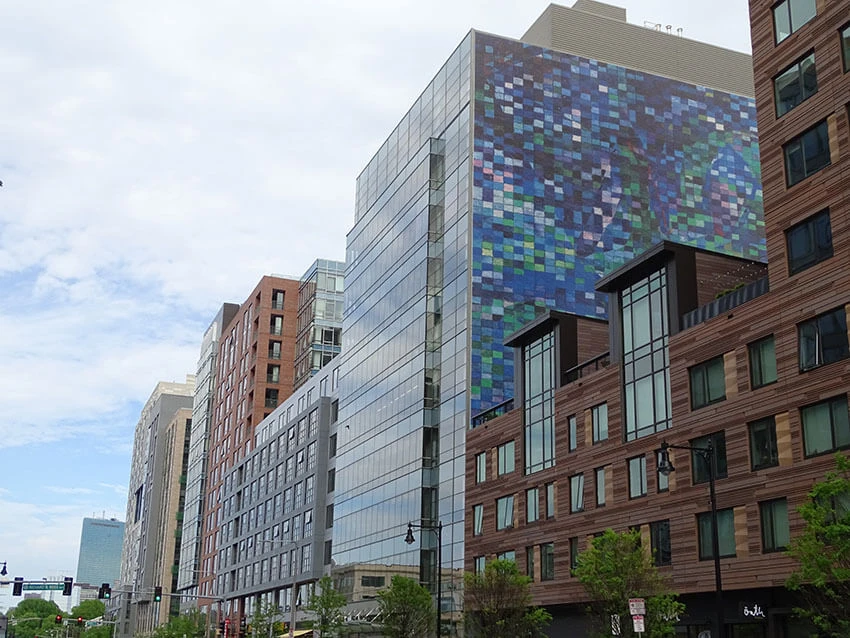

BOSTON — The Freedom Trail, a 2.5-mile red-lined path that connects 16 nationally significant historic sites, tells the story of not only the American Revolution, but also Boston's history. Around them, Boston apartments rise block after block, pressed against history that hasn’t moved in centuries.
Boston Common
Boston Common is the starting point. Set aside in 1634, it remains the oldest public park in the country. The lawns tilt down in uneven slopes, worn in places where paths cross at odd angles. Bronze statues stand fixed on stone bases. Fountains send water arcing into the air, spray falling back across the grass. The Common is bordered by trees that line both Tremont and Beacon Streets. Park Street Church rises just beyond the Common, its sharp white spire visible above the trees. The structure has stood since 1809, a brick-and-stone counterpoint to the park below.
The State House
Beacon Hill climbs behind it. At the crest, the State House commands the ridge, the gold dome flashing when the light hits. Completed in 1798, it carries broad granite steps, brick walls, and a front lined with tall columns. The dome, wrapped in gold leaf, flashes in full sun and dulls when the clouds return. Beacon Street runs across its front edge, busy with traffic. Behind it, narrow lanes twist down the hill. Red brick fronts stand close, shutters pulled tight, iron fences set in line. The original cobblestone streets and gas lamps provide Boston apartments with an additional layer of charm.
The Granary Burying Ground
The Granary Burying Ground lines Tremont Street, its stones covered in shade from old trees. Slate markers have filled it since 1660. Some crack, others sink. Heavy branches spread across the stones. A tall obelisk breaks the pattern at the center. The entire yard is bound by black iron fencing, thin and sharp. Around the outside, glass office towers reflect daylight down over the seventeenth-century stones. Modern apartments share the district, rising directly against the edges of the ground. The contrast is impossible to miss.
King’s Chapel
At Tremont and School streets, King’s Chapel holds the corner. Built of granite blocks stacked with precision, the walls stretch tall above the street. A row of columns forms the façade. Inside the tower hangs a bell crafted by Paul Revere in 1816. It still strikes the hour. The building sits tight against newer construction. Across the narrow street, shops fill the ground floor, with apartments above. Old granite and new brick face each other directly, one side centuries old, the other barely decades.
Faneuil Hall
The trail bends east and opens into Faneuil Hall. The red brick hall has stood since 1742, long and rectangular, with a white cupola set above the roof. For centuries it served as a marketplace. Today Quincy Market joins it, arcades lined with stalls that keep the area full. Outside, the square carries movement from morning until night. Towers of glass now stand behind it, but apartments rise inside the district as well, often above retail floors. Old brick, new glass, one beside the other.
The Old State House
On State Street, the Old State House stands its ground against the concrete and glass that surround it. Completed in 1713, the building shows a red brick façade cut with white trim. A balcony stretches above the street, while corner towers rise at each edge. At the base, a circle of bricks marks the Boston Massacre site. Around it, skyscrapers reach into the sky, cutting the sun from the smaller building. Apartments and office towers mix in the district, bringing residents into direct view of the colonial landmark.
The Paul Revere House
In the North End, the Paul Revere House presses close to the street. A steep roof cuts above its timber frame. Windows sit small in the dark walls, and a fence runs tight against the sidewalk. Beyond it stands the Old North Church, a tall brick structure with a spire visible across the harbor. The North End’s streets twist in tight patterns, brick walls and stone corners set close together. Boston apartments here are built into the same framework, their walls holding ground just as long as the landmarks around them.
The USS Constitution
The Navy Yard spreads out past the Charlestown Bridge. At the pier, the USS Constitution commands attention, hull dark with white bands cutting across it. Cannons still line the deck. Known as the oldest commissioned warship afloat, it stands within view of the museum on shore. Piers spread across the harbor edge, carrying crowds through the yard. Apartments line the waterfront, balconies and glass walls facing the ship and the water beyond.
The Bunker Hill Monument
The Bunker Hill Monument cuts straight into the sky. Granite blocks stack high, 221 feet in all, set in place back in 1843. Steps climb toward the base. Grass and trees surround the monument, filling the square below. Brick row houses and new apartments spread out on the surrounding streets. The obelisk stands above them all, visible from most blocks in Charlestown.
The Freedom Trail links Boston Common to Bunker Hill, tying centuries of history into one line. Boston apartments stand close on nearly every block, built between churches, markets, and monuments. The city keeps growing around them, but the landmarks stay fixed.




























Sign in to leave a comment.