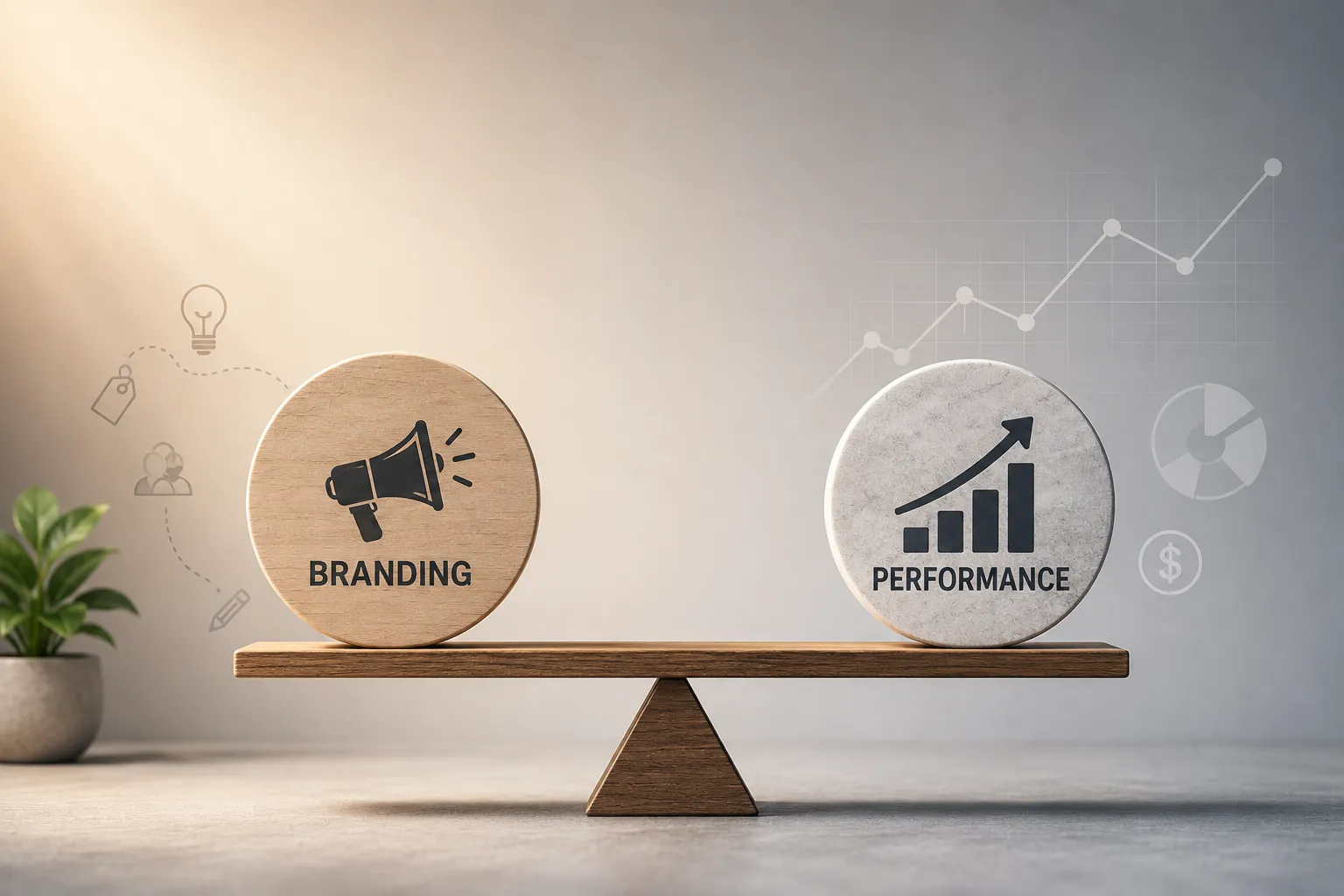

Branding vs Performance: The Debate That's Costing You Growth
Sit in on the meeting where next quarter's budget gets decided and you can almost set a timer for it. One person argues the company needs a brand people actually remember. Another fires back that brand does not pay salaries, and the money should chase leads this month. Both sound reasonable, both dig in, and the budget ends up split by whoever holds the room longest, not by what the business needs.
That is the real cost of the branding vs performance debate. It is dressed up as strategy, but most of the time it is a standoff that leaves a company with a brand nobody remembers and campaigns that stop working the moment spending pauses. These two were never supposed to fight. Set against each other, both lose. Lined up properly, each makes the other better. Understanding why the fight happens, and how to end it, is one of the cheapest growth upgrades a company will find.
Why the Fight Starts in the First Place
The split usually starts with how success gets measured. Performance marketing offers clean numbers: cost per click, cost per acquisition, return on ad spend. Anyone can look at a dashboard and see what happened. Branding works slowly and shows up in harder to track ways, such as trust, recall, and the willingness to pay a premium.
Because one side is easy to measure and the other is not, leadership leans toward the channel that reports fast wins, and budgets drift toward whatever produces an immediate return. This feels responsible, but it builds a business that can only grow while the ad account is on. When spending pauses, demand disappears.
Pick a Side and Something Quietly Breaks
A business that goes all in on performance often hits a ceiling it cannot explain. Audiences shrink, costs climb, and the same creative stops converting. Performance marketing captures existing demand, reaching people who already want the product, so without a brand feeding fresh interest into the market, that pool of ready buyers runs dry.
The opposite failure is just as real. A business that pours everything into brand awareness may build recognition without ever turning it into revenue. The campaigns win applause but not customers, and the audience knows the name yet feels no reason to act.
Both waste money, and growth stalls anyway.
What Decades of Data Say About the Split
This is not just theory. One of the most cited studies in marketing effectiveness, Les Binet and Peter Field's analysis of the IPA Databank, examined close to a thousand advertising case studies over decades. It found that brands see the strongest long-term results when roughly 60 percent of budget goes to brand building and 40 percent to short-term sales activation, a finding often called the 60/40 rule.
The important detail is that this was never a fixed law. The ratio flexes with brand size, category, and stage of growth, so newer businesses often lean harder into activation while established brands protect their long-term investment. What is clear is that businesses which starve brand building to chase short-term numbers usually pay later through rising acquisition costs and weaker pricing power.
When the Two Stop Competing, They Compound
The businesses that scale steadily treat these forces as one system: brand builds the demand, performance captures it, and each improves the other.
When a brand is well known and trusted, performance campaigns become cheaper and more effective. People recognise the name, so they click more, hesitate less, and convert at a lower cost, lifting every metric a performance team is chasing.
Performance, in turn, gives branding direction. Data from live campaigns reveals which messages resonate, which audiences respond, and which offers move people to act, sharpening the brand instead of guesswork.
Many of the shifts in Facebook Ads targeting in 2026 make this partnership even more important, because as targeting becomes broader and more automated, a recognisable brand is often what tips a cold audience toward action.
Forget the 50/50 Instinct
The common instinct is to divide spending down the middle, but a fixed split rarely fits reality. The right balance depends on the stage of the business, the length of the buying cycle, and how much demand already exists.
A young company with no recognition usually needs to lean harder into performance early on, simply to prove the offer and generate cash flow. As awareness grows, more investment can move toward brand building to widen the funnel and reduce acquisition costs. A mature business with strong recall can protect its brand while performance harvests the demand that brand creates.
The goal is not a perfect percentage but a budget that shifts as the business evolves, guided by evidence rather than preference.
How to Tell the Debate Is Draining You
The symptoms are clear when this tension goes unresolved. Acquisition costs keep rising even though campaigns are well run, the same audiences see the same ads until fatigue sets in, and sales become unpredictable, depending entirely on how much is spent that month.
On the branding side the warning signs look different. There is plenty of engagement but little revenue, awareness scores climb while the pipeline stays flat, and attention never turns into commitment. In both cases the problem is rarely the channel itself. It is the missing connection between them, and treating brand and performance as separate departments with separate goals almost guarantees it.
One Engine, Not Two Departments
The fix is structural as much as strategic. Brand and performance should share one objective, profitable growth, rather than defending their own metrics. That means planning campaigns together, agreeing on messaging that carries from awareness through to conversion, and measuring success across the whole journey rather than one step.
In practice, brand campaigns introduce the story and build familiarity, then performance campaigns convert the audiences branding has warmed up. Both use the same core message, so someone who sees an awareness ad recognises the follow up that asks them to buy.
A well structured paid marketing approach sits at the centre of this system, turning the demand a brand creates into measurable results without losing the consistency that makes the brand memorable.
Measure the Loop, Not the Links
Part of what keeps the debate alive is bad measurement. Judging brand activity by short term sales, or performance purely by clicks, hides the real picture. Better signals track how the two influence each other over time: whether branded search rises as awareness grows, whether performance costs fall as recognition improves, and whether customers from brand led journeys stay longer and spend more. Once measurement captures that loop, the argument about which side deserves the budget quietly fades.
Stop Picking Sides, Start Building the System
The branding vs performance debate persists because it feels like a real strategic choice. In practice it is a trap that forces businesses to under invest in half of their own growth engine. Brands that resolve it stop asking which side wins and start asking how the two strengthen each other.
Growth does not come from picking a side. It comes from a system where awareness creates demand, performance captures it, and every unit of budget works harder because the two finally pull the same way.
Frequently Asked Questions
Is branding or performance marketing more important for a new business?
Early on, performance often matters more because it proves the offer and brings in revenue quickly. As the business grows, brand investment becomes essential to lower acquisition costs and create demand that performance can convert.
Can a business rely on performance marketing alone?
It can for a while, but usually hits a ceiling. Performance captures existing demand, so without brand building to create fresh interest, audiences shrink and costs rise over time.
How should a budget be split between branding and performance?
There is no fixed ratio. Research points to a rough 60/40 balance in favour of brand building on average, but the right split depends on brand size, category, and stage of growth, so it should shift as the company evolves.
Why do branding and performance work better together?
A strong brand makes performance campaigns cheaper and more effective, while performance data reveals which messages resonate. Each one improves the results of the other when they share the same goal.
What are the signs this debate is hurting growth?
Rising acquisition costs, ad fatigue, and sales that depend entirely on monthly spend point to an over reliance on performance. High engagement with flat revenue points to a brand that is not converting.


























Sign in to leave a comment.