


You don't have to sell your current house before you buy the next one — and in Seattle's market, waiting can actually work against you.
Offers move fast here, and sellers don't reward whoever asks first. They reward whoever looks strongest on paper. Most homeowners assume the sale has to close before the purchase can start, but that assumption has a cost: the house you actually want can go to someone else while you're still waiting on your own closing, especially if your offer carries a home sale contingency.
There's a way around that. Some buyers turn to bridge loans. Others use programs designed specifically to strip the contingency out of the equation, so their offer reads the way a cash offer does.
This guide breaks down each path, what it takes to qualify for it, and how to think through it while making a decision on to buy a home before selling yours..
Why Buying Before You Sell Makes Sense In Seattle
Buy a home before you sell the one you're in, and you remove the single weakest point in most offers: the home sale contingency.
That contingency is a clause. It ties your purchase to selling your existing home first — if the sale doesn't happen in time, the deal can collapse. It protects the buyer, but it hands the risk straight to the seller.
Sellers in a fast-moving market don't want that risk, and Seattle qualifies as fast-moving. A home that draws several offers within days makes a contingent bid look shakier than a clean one, even when the dollar amount is identical. Given the choice, sellers gravitate toward the offer without conditions attached.
That's the entire appeal of a non-contingent offer: it signals you can close regardless of what happens with your current property. It puts you on equal footing with a cash buyer.
Delay isn't free, either. Sell your house first, then start shopping, and a buyer with a cleaner offer can beat you to the home you were actually after. Buying before you sell keeps you in the running for it.
The Main Ways To Buy Before Your Current Home Sells
Buying ahead of your sale means finding a way to fund the new purchase while the old one is still on the market. These are the routes homeowners typically use.
Bridge Loan
A bridge loan borrows against the equity already sitting in your current home. As the name implies, it covers the gap between closing on the new place and closing out the old one. Most bridge loans expect repayment within six to twelve months, and because they're short-term and riskier for the lender, they typically come with higher rates and added fees than a standard mortgage.
HELOC And Home Equity Loan
Both let you tap your home's existing value, but the mechanics differ.
HELOC
A home equity line of credit behaves like a credit card: you're given a limit, and interest only accrues on what you draw. The rate is usually variable, so payments can shift up or down over time.
Home Equity Loan
A home equity loan pays out as a single lump sum. The rate is fixed and so is the monthly payment, which keeps your cost predictable for the life of the loan.
Buy Now, Sell Later Programs
These programs exist specifically to let buyers move before their current home sells. Most work by lining up a backup buyer for the existing house, or by advancing funds against its equity, so the new offer doesn't need a sale contingency attached.
CrossCountry Mortgage runs a Buy Now, Sell Later option that lets buyers submit an offer before their existing home has sold. Orchard offers a comparable structure, backing the buyer's offer so the move doesn't wait on a sale. Homeward's version works the same way, giving buyers backing strong enough to make a competitive offer while their current listing is still active.
Rent-Back Agreement (Sale-Leaseback)
A rent-back agreement flips the order: you sell your current home first, then stay on as a tenant for an agreed stretch afterward. That buys time to find the next home without rushing the search, while the new owner of your old house waits out the agreed period before moving in.
Carrying Two Mortgages
Some homeowners simply take on both payments — the old mortgage and the new one — until the existing home sells. That means funding two monthly payments out of pocket in the meantime, and if the sale drags on longer than expected, that overlap in cash flow can get expensive fast.
How Contingency Buster Lets You Buy Before You Sell
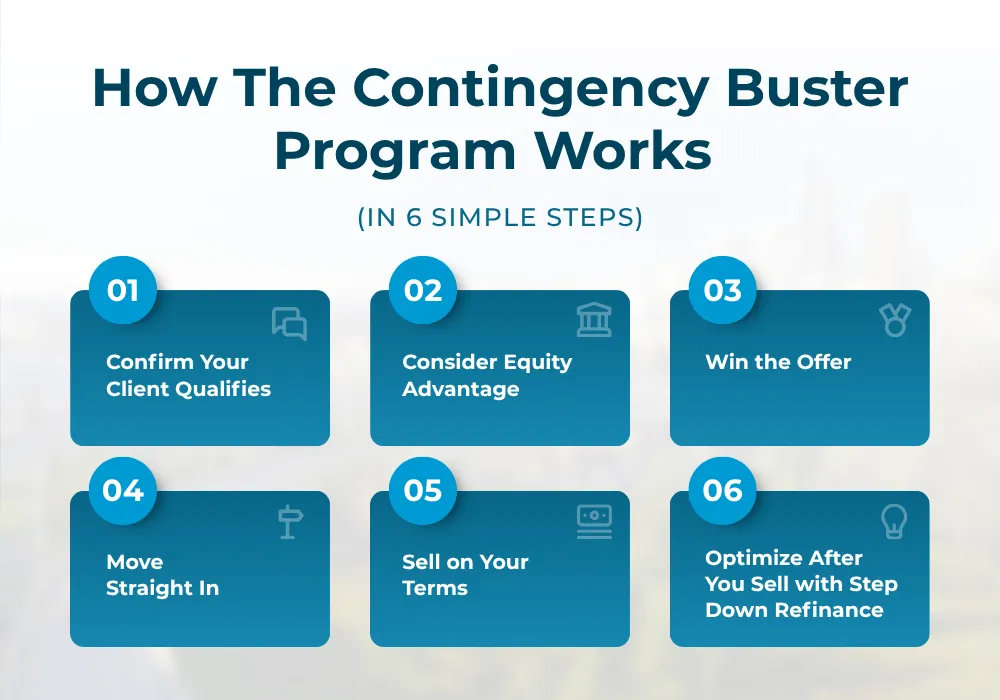
The Contingency Buster Program is built to let you buy ahead of your sale with the least exposure and the least hassle in the process. Here's how it plays out, step by step.
Step 1: Confirm You Qualify
Qualifying takes one thing: at least 22% equity in your current home. That threshold is what allows the sale contingency to come off your next offer entirely.
Step 2: Access Equity Advantage
Equity Advantage unlocks up to 75% of the loan-to-value equity in your current home before it ever sells. It isn't a loan — there's no interest charged and no monthly payment due. The advance is repaid in one lump sum through escrow once the current home closes.
Step 3: Submit A Non-Contingent Offer
Funding secured, your offer goes in backed by a guaranteed backup purchase contract on the home you're leaving. That's what erases the sale contingency. Seattle's Mortgage Broker moves quickly through this step, positioning your offer to compete directly against cash buyers.
Step 4: Move Into The New Home
Closing puts you straight into the new house. No storage unit, no temporary rental, no in-between housing to arrange. One move, done.
Step 5: Sell The Old Home On Your Terms
With the old property now vacant, you're free to stage it fully and list on whatever timeline suits you — before the move or after. According to the National Association of Realtors, a vacant, fully staged home can sell 33 to 50% faster and for 5 to 10% more than a comparable home that isn't staged.
Step 6: Apply Step Down Refinance
Once the old home sells, any equity left over can roll into your new mortgage through the Step Down Refinance program, reducing the principal balance on the home you just purchased.
What Buying Before You Sell Actually Requires
Before you buy a home before selling the current one, lenders and program administrators want a handful of numbers in order first.
Equity And Down Payment
Equity is simply the gap between what your home is worth and what's still owed on it. Lenders arrive at that figure by ordering a valuation and subtracting the loan balance, and the resulting equity can be converted into cash — through a loan, an advance, or the sale itself — and applied as the down payment on the next home.
Debt-To-Income Ratio And Preapproval
Your debt-to-income ratio, or DTI, measures monthly debt obligations against monthly income, and lenders lean on this figure to set how much you can borrow. Carry two mortgages at once, even briefly, and that DTI climbs — which can shift what you qualify for.
That's exactly why preapproval matters before house hunting starts. It tells you your real budget up front and signals to sellers that you're a buyer who's actually ready to close.
Closing Costs
A new purchase brings its own set of closing costs layered on top of the down payment: lender fees, title insurance, escrow fees, appraisal costs, and recording fees among them. Planning for these ahead of time keeps them from becoming a surprise at the closing table.
Buy First Or Sell First: How To Decide
The choice between buying before selling and selling first comes down to three things: how much equity you're sitting on, what your budget can absorb, and how much risk you're comfortable carrying.
Enough equity to avoid contingency risk, a second move, and having your cash tied up? Buying first is usually the stronger play. Thin equity or a tight budget? Selling first is likely the safer route, even with the trade-offs that come with it.
A real estate agent matters in either scenario. The right agent coordinates closing dates across the sale and the purchase, negotiates rent-back terms when a deal calls for one, and helps time the offer to whichever moment favors you in the local market. That coordination is frequently what separates a smooth transition from a stressful one.
Selling first still holds up in certain cases. Without the 22% equity threshold, or with a budget that can't absorb even a brief overlap in payments, selling first takes the pressure off. You trade away some negotiating leverage on the next offer, but you sidestep financial risk you're not positioned to carry comfortably.
Move First, Without The Wait

Buying before you sell means the home you actually want never slips away to a cleaner offer. Talk to Seattle's Mortgage Broker about whether you qualify for the Contingency Buster Program.
Frequently Asked Questions
Can You Close On A House Before Selling Your Current One?
Yes. Options like a bridge loan, a HELOC, a home equity loan, or a program such as Contingency Buster all allow you to close on a new home while the current one is still listed.
What If My House Doesn't Sell As Planned?
This is the core risk of buying before selling. Carrying two mortgages means every extra month on the market adds another double payment. Programs built around a guaranteed backup purchase contract remove this risk, since a committed buyer for the old home is already locked in before the next offer goes out.
How Does A Home Sale Contingency Work In A Competitive Market?
A home sale contingency ties the new purchase to selling the current home first. In a competitive market, sellers tend to pass on these offers because they introduce risk and delay. A non-contingent offer — backed by cash, a loan, or a backup purchase contract — competes far better.
What Happens If Your Home Sells Before You've Found A New One?
Selling ahead of finding the next home can mean scrambling for temporary housing or negotiating a rent-back agreement to stay put a little longer. It's one of the main reasons buyers often prefer to lock in the next home first.
Is It Better To Buy Or Sell First Financially?
It depends on equity and budget. Buying first hands you more control and a stronger offer, at the cost of potentially carrying two mortgages for a stretch. Selling first is the financially safer route when equity is limited, though it comes with less leverage on the purchase that follows.

























Sign in to leave a comment.