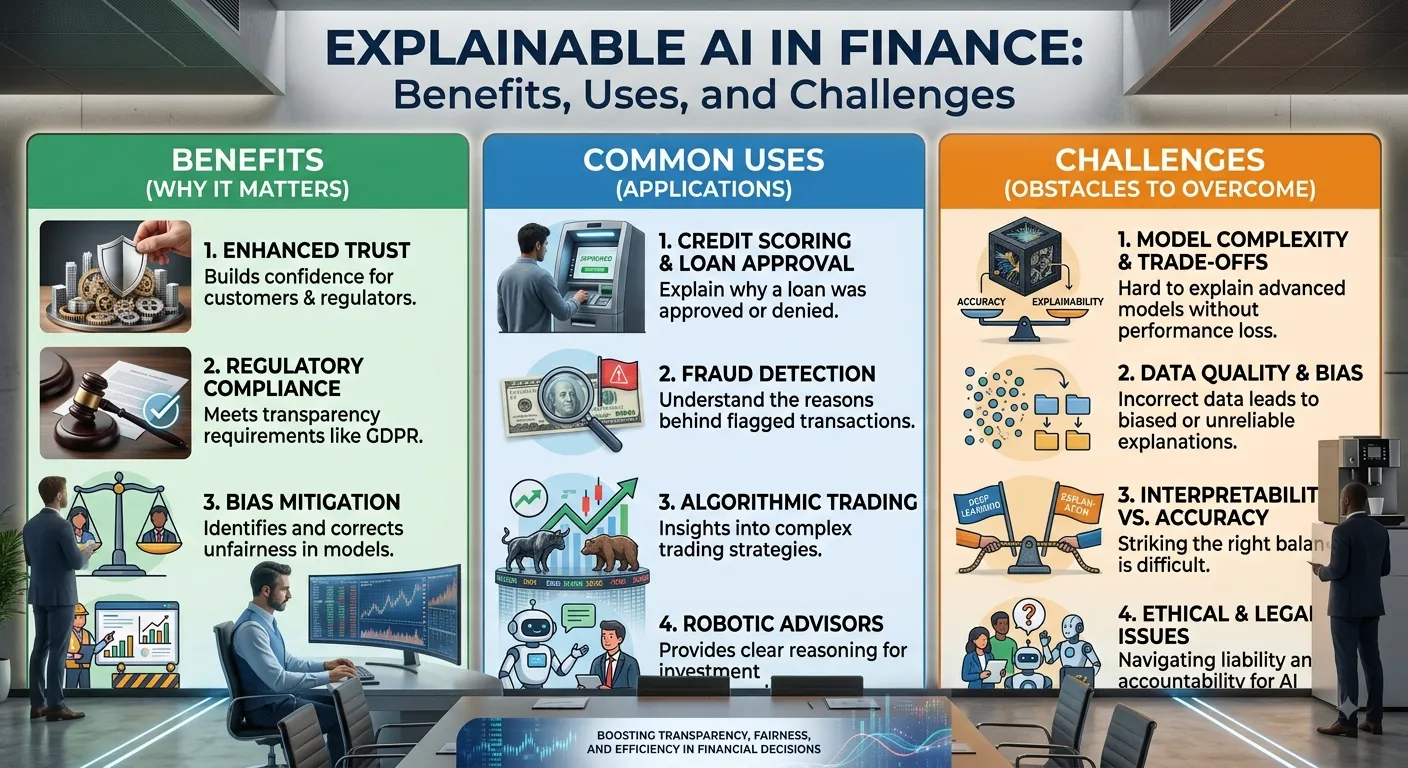

Artificial intelligence is changing the financial industry by helping organizations analyze large amounts of data, automate decisions, detect risks, and improve customer experiences. However, many advanced AI models operate like “black boxes,” making it difficult for users to understand how a particular decision was reached. This is where explainable AI in finance becomes important.
Explainable AI (XAI) focuses on making AI-generated decisions easier for people to understand. In financial services, where decisions can affect loans, investments, fraud investigations, insurance, and regulatory compliance, transparency is especially valuable. By providing understandable reasons behind automated decisions, financial organizations can build greater trust while maintaining the benefits of AI.
What Is Explainable AI in Finance?
Explainable AI in finance refers to the use of AI systems that can provide understandable explanations for their predictions, recommendations, or decisions. Instead of simply producing an outcome, an explainable model can show which factors influenced that result.
For example, a traditional AI lending system might reject a loan application without providing much information. An explainable system could indicate that income level, repayment history, existing debt, and credit utilization were important factors.
This transparency helps financial professionals evaluate whether an AI system is working as intended. It can also make it easier to identify errors, bias, or unusual patterns before they create larger problems.
Why Explainability Matters in Financial Services
Financial decisions often involve sensitive personal and business information. Customers want to know why they were denied credit, flagged for potential fraud, or given a particular financial recommendation.
Explainability can help organizations address these concerns by making automated decisions more understandable. It also supports communication between technical teams, financial professionals, regulators, and customers.
For businesses such as Capital troop, understanding transparent AI can be useful when evaluating technology-driven approaches to financial strategy, risk management, and business decision-making.
Benefits of Explainable AI in Finance
1. Builds Customer Trust
Trust is essential in banking and financial services. Customers are more likely to accept automated decisions when they understand the reasoning behind them.
Clear explanations can make AI-powered financial services feel less mysterious and more accountable. This is particularly important when a decision has a direct impact on a customer's finances.
2. Improves Risk Management
Financial institutions constantly assess credit, market, operational, and fraud risks. Explainable systems can help professionals understand which variables are influencing risk predictions.
When unusual factors strongly affect a prediction, analysts can investigate them and determine whether the result is reasonable. This can improve the overall quality of risk assessment.
3. Supports Regulatory Compliance
Financial organizations operate in highly regulated environments. Regulators may require institutions to demonstrate that automated systems are fair, accountable, and appropriately governed.
Explainable AI in Finance can provide useful documentation about how models reach certain outcomes. While explainability alone does not guarantee compliance, it can strengthen an organization's governance and audit processes.
4. Helps Detect Bias
AI models learn from historical data, which may contain hidden biases. If a model produces unexpected outcomes for certain groups, explanations can help analysts investigate the factors behind those results.
This makes it easier to identify potentially problematic data, variables, or model behavior and take corrective action.
5. Enables Better Human Oversight
AI is powerful, but financial decisions should not always be completely automated. Human experts may need to review complex or high-impact decisions.
Explainable models give professionals additional information for evaluating AI recommendations. This creates a more effective combination of machine intelligence and human judgment.
Common Uses of Explainable AI in Finance
Credit Scoring and Lending
Lenders use AI to evaluate whether applicants are likely to repay loans. Explainable systems can identify the factors contributing to a credit decision.
For instance, an explanation might show that repayment history, income stability, debt levels, and credit utilization influenced a particular result. This can help lenders communicate decisions more clearly.
Fraud Detection
Financial institutions process enormous numbers of transactions every day. AI can identify unusual activity that may indicate fraud.
Explainability allows investigators to understand why a transaction was flagged. Instead of reviewing an unexplained alert, analysts can examine relevant factors such as transaction amount, location, frequency, account behavior, or unusual spending patterns.
Investment and Portfolio Management
AI is increasingly used to analyze market information and support investment decisions. Explainable systems can help portfolio managers understand why an algorithm recommends a particular asset allocation or identifies a specific risk.
This does not eliminate investment uncertainty, but it provides greater visibility into the assumptions behind an AI-generated recommendation.
Insurance and Claims Processing
Financial organizations and insurers can use AI to assess applications and claims. Explainable approaches can show which information influenced an automated assessment.
This can make internal reviews easier and provide customers with clearer information about decisions.
Financial Forecasting
Businesses use predictive models to estimate revenue, expenses, cash flow, and other financial indicators. Explainable AI can highlight the variables that have the greatest influence on a forecast.
Financial teams can then compare model explanations with their own knowledge before making important business decisions.
Challenges of Explainable AI in Finance
Complexity of Advanced Models
Sophisticated machine learning systems can contain thousands or millions of parameters. Creating a simple explanation without losing important information can be difficult.
An explanation that is too technical may be useless to customers, while an explanation that is too simple may not accurately represent how the model works.
Balancing Accuracy and Interpretability
Some highly complex models may deliver strong predictive performance but be harder to explain. Simpler models can sometimes be easier to understand but may not perform as well for certain tasks.
Financial institutions must carefully evaluate whether the benefits of complexity justify the additional explainability challenges.
Data Quality Problems
AI systems depend heavily on the data used for training and prediction. Poor-quality, incomplete, outdated, or biased data can produce unreliable results.
Explainability can reveal some of these problems, but organizations still need strong data governance and validation processes.
Security and Privacy Concerns
Financial AI systems may process confidential customer and business information. Explanations must therefore be designed carefully so that they do not expose sensitive information.
Organizations need appropriate security controls, access restrictions, and privacy practices when implementing explainable systems.
Difficulty Standardizing Explanations
Different AI models may use different methods to explain their predictions. As a result, organizations can face challenges when comparing explanations across multiple systems.
Developing consistent internal standards for model documentation, testing, and reporting can help address this issue.
Best Practices for Implementing Explainable AI
Financial institutions should begin by identifying where explainability is most important. High-impact decisions such as lending, fraud investigations, and risk assessment often deserve greater transparency.
Organizations should also define who needs the explanation. A data scientist may need technical model information, while a customer may need a simple explanation in everyday language.
Regular testing is another important practice. Models should be monitored for accuracy, bias, unexpected behavior, and changes in performance. Documentation should be maintained so that organizations can understand how systems were developed and updated.
Human oversight should also remain part of important financial processes. AI should support responsible decision-making rather than automatically replace professional judgment in every situation.
The Future of Explainable AI in Finance
As AI adoption increases, explainability is likely to become an increasingly important part of responsible financial technology. Organizations will need AI systems that are not only accurate but also transparent, reliable, and accountable.
Future solutions may combine advanced predictive models with improved explanation techniques, stronger governance frameworks, and better monitoring tools. As customers and regulators demand greater transparency, financial organizations that prioritize understandable AI may be better positioned to build long-term confidence.
Capital troop can also explore the role of transparent AI as part of broader business and financial technology strategies, particularly where data-driven decisions influence organizational growth and risk management.
Conclusion
Explainable AI in Finance provides a practical approach to making artificial intelligence more transparent and understandable. Its applications range from credit scoring and fraud detection to investment analysis, forecasting, and insurance.
The technology offers several advantages, including improved trust, stronger risk management, better human oversight, and support for responsible AI governance. At the same time, organizations must address challenges involving model complexity, data quality, privacy, security, and the balance between accuracy and interpretability.
As financial services continue to adopt AI, explainability will remain an important consideration. The goal is not simply to create smarter algorithms but to develop AI systems whose decisions people can understand, evaluate, and trust.
FAQs
Q1. What is Explainable AI in Finance?
Explainable AI in finance refers to AI systems that provide understandable reasons for their predictions or decisions. It helps financial professionals and customers understand how factors influence an AI-generated outcome.
Q2. Why is explainability important in financial services?
Explainability improves transparency and trust. It can help financial organizations review decisions, identify potential bias, support governance, and communicate automated outcomes more effectively.
Q3. Where is explainable AI used in finance?
Common applications include credit scoring, loan approvals, fraud detection, investment analysis, risk management, insurance processing, and financial forecasting.
Q4. What are the main challenges of explainable AI?
Major challenges include the complexity of advanced AI models, balancing accuracy with interpretability, poor-quality data, privacy concerns, security risks, and difficulties in standardizing explanations.
Q5. Can explainable AI eliminate financial risk?
No. Explainability can help organizations understand and monitor AI-driven decisions, but it cannot eliminate financial risk. Effective risk management still requires quality data, appropriate controls, regular monitoring, and professional judgment.



























Sign in to leave a comment.