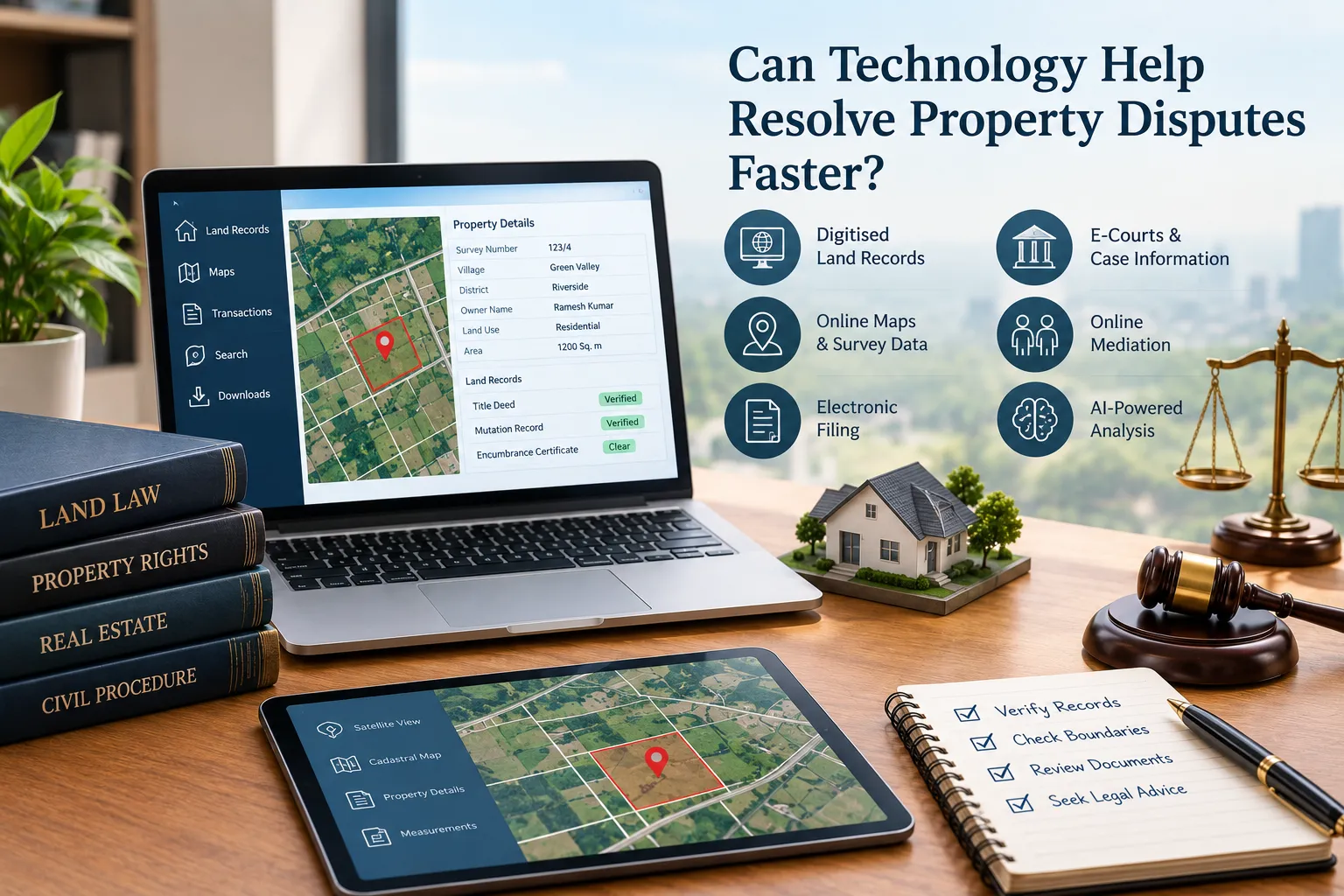

Property disputes can take considerable time to resolve. Questions about ownership, boundaries, possession, inheritance and property transactions often require several documents and different forms of evidence.
Technology is changing how some of this information is created, stored and accessed. Digitised land records, online court services, electronic filing, digital maps and online dispute resolution tools can make parts of the legal process more efficient. However, technology is not a substitute for legal reasoning or judicial decision making. Its real value lies in improving access to information, reducing administrative delays and helping parties and courts work with records more efficiently.
Why Property Disputes Often Take Time
A property dispute may involve documents created over several decades. Sale deeds, title documents, revenue records, survey maps, mutation entries and inheritance documents may all need to be examined. In some cases, records are held by different authorities. A party may also have only partial copies of important documents.
Physical records can create additional difficulties. Documents may be difficult to locate, older records may require verification and inconsistencies may exist between different sources. When basic information takes considerable time to collect, the legal process can become more complicated.
How Digitised Land Records Can Help
Digitisation can make property information easier to access and organise. India's Digital India Land Records Modernization Programme aims to create a more transparent and integrated land record management system. Its stated objectives include improving access to land information, reducing land disputes and checking fraudulent transactions.
Digital access can help property owners and prospective buyers conduct preliminary checks without relying entirely on physical visits to government offices. It can also help authorities maintain records in a more systematic manner. However, digitisation does not automatically make every record accurate or legally conclusive. Old errors can continue to exist after records are digitised. Proper verification remains important.
Digital Maps Can Help With Boundary Issues
Boundary disputes are often difficult because parties may rely on different descriptions of the same property. Digital cadastral maps and modern surveying technology can make land parcels easier to identify. When maps are connected with textual land records, it can become easier to compare the recorded information with the physical location of a parcel.
This can help identify possible inconsistencies at an earlier stage. For example, a difference between a recorded area and a physical measurement may be identified before a transaction is completed. Parties can then investigate the issue instead of discovering it after a dispute has developed.
Technology Can Improve Access to Court Information
Technology can also make the court process easier to follow. The eCourts system provides services such as case status, cause lists, court orders and judgments through online platforms. Case information can be searched using details such as the case number, party name or advocate name.
For property disputes, easier access to case information can be particularly useful. A party may be able to check whether proceedings have already been filed in relation to a property. This can also assist legal professionals when reviewing the history of litigation connected with a property.
Electronic Filing Can Reduce Administrative Delays
Electronic filing allows documents and pleadings to be submitted through digital systems where the relevant court provides the facility. The eCourts eFiling system is designed to allow filing from outside the court premises and provides features for uploading documents, making online payments and tracking cases.
For property disputes, electronic filing can reduce some of the administrative burden associated with physical submissions. It does not necessarily make the dispute itself shorter. Complex evidence still needs to be examined, and the court must still determine the legal issues. The benefit is mainly in making certain procedural steps more accessible and organised.
Linking Land Records With Court Systems
One of the more significant developments involves attempts to connect land records and registration information with court systems. The Department of Land Resources has identified linkage between land records, registration databases and eCourts as a way of providing courts with more direct access to relevant information concerning land disputes.
Such integration could reduce the need to obtain the same information separately from different offices. It may also help courts examine property related records more efficiently when the relevant databases are properly connected and updated.
Digital Records Can Help Identify Previous Litigation
A property may have a complicated legal history. There may have been earlier proceedings involving ownership, possession, inheritance or boundaries. A buyer who is unaware of such litigation could face significant problems after completing a transaction.
Online court databases can make it easier to conduct an initial search for cases involving relevant parties or properties. However, searches should not be treated as a complete substitute for legal due diligence. Names can be recorded differently, databases may have limitations and not every relevant dispute may be identified through a basic online search.
Online Mediation Can Offer Another Route
Technology is also relevant outside traditional court proceedings. The Mediation Act, 2023 recognises online mediation, including pre litigation mediation, subject to the requirements of the legislation. Online mediation can use electronic communication, secure digital platforms and video or audio conferencing.
This can be useful where parties are located in different cities or countries. Property disputes may involve family members, purchasers, developers, landlords or businesses located in different places. An online mediation process can make participation easier in suitable cases. The purpose is not to force every dispute into an online process. Rather, technology provides another method through which parties may attempt to reach a settlement.
Artificial Intelligence and Property Disputes
Artificial intelligence may also have a role in legal and property related work. AI based tools can assist with document organisation, information extraction, comparison of large volumes of records and identification of potentially relevant information.
For example, a large collection of property documents may contain repeated names, dates, survey numbers or transaction details. Technology can help organise such information for further human review. However, AI generated analysis should not automatically be treated as legal advice or proof of ownership. Property disputes often depend on context, authenticity, applicable law and the interpretation of evidence. Human legal judgement remains essential.
How Technology Can Help Legal Professionals
Legal professionals handling property disputes often need to examine substantial documentary material. Digital document management can make it easier to organise title documents, correspondence, maps, court orders and other evidence. Searchable documents can also help locate specific information more quickly.
For a party involved in litigation, civil lawyers for dispute matters may use digital records and online court systems as part of the broader process of reviewing evidence and understanding the procedural history of a dispute. Technology therefore works mainly as a support tool. It does not replace the legal assessment required to determine the strength of a claim.
Benefits for Commercial Property Disputes
Businesses may face property disputes involving offices, commercial premises, development land, leases or large transactions. Technology can assist with document management and due diligence. Digital records may make it easier to organise ownership documents, agreements, registration records and previous litigation.
Commercial disputes can also involve several contracts and parties. Maintaining a structured digital record can help businesses understand how a property issue connects with their wider contractual obligations. Where a dispute affects a company or commercial transaction, corporate lawyers for dispute resolution may need to examine both the property issue and its wider business consequences.
Technology Cannot Fix Incorrect Records
Digitisation has clear benefits, but it also has limitations. If an old record contains an incorrect name, measurement or ownership entry, converting it into a digital format does not automatically correct the error.
Similarly, a digital map may need to be compared with survey records and other evidence before a boundary issue can be resolved. Data quality is therefore as important as digital accessibility. Regular updating, proper verification and effective correction mechanisms are essential if technology is to provide reliable information.
Privacy and Data Security Also Matter
Property records can contain sensitive personal and financial information. Digital systems therefore need appropriate security measures. Unauthorised access, manipulation of records or misuse of personal information can create new risks.
The greater the number of systems connected to one another, the more important data security becomes. Technology should improve access without compromising the integrity and confidentiality of information.
Can Technology Actually Make Property Disputes Faster?
Technology can reduce certain types of delay, but it cannot guarantee faster resolution in every case. A straightforward dispute may benefit significantly from easily accessible documents and digital court services. A complicated title dispute involving several generations of ownership may still require extensive evidence and legal examination.
The biggest benefit may occur before litigation begins. If a buyer can identify an ownership problem early, the dispute may never arise. If parties can access reliable records before negotiating, they may be able to resolve a disagreement without approaching a court. Prevention can therefore be more valuable than simply speeding up litigation.
What Property Owners Should Do
Property owners can also benefit from using technology responsibly. Important documents should be securely scanned and organised. Owners should maintain copies of title documents, registration records, tax receipts, survey plans and relevant correspondence.
Before purchasing property, buyers should conduct appropriate due diligence using available government records and other reliable sources. If inconsistencies appear, they should be investigated before the transaction progresses. Digital records should support, rather than replace, proper legal verification.
The Future of Technology in Property Disputes
The future of property dispute resolution is likely to involve greater integration between land records, registration systems and court information. India's land record modernisation programme has continued to develop, with further operational guidelines issued for the next phase of the programme. Court technology is also expanding through online case services, electronic filing and digital access to judgments and orders.
These developments can make property information easier to access and legal processes more transparent. The effectiveness of such systems will ultimately depend on the accuracy of the underlying data, proper implementation and the ability of different government systems to work together.
Conclusion
Technology can help make property disputes easier to understand and, in suitable cases, faster to resolve. Digitised land records can improve access to ownership information. Digital maps can assist with boundary verification. Online court services can make case information easier to obtain. Electronic filing can simplify procedural steps, while online mediation can provide another route for resolving suitable disputes.
Yet technology cannot determine ownership by itself. It cannot correct every historical error, replace evidence or take the place of judicial decision making. Its greatest value may lie in preventing disputes before they become litigation. When accurate records, accessible technology and sound legal processes work together, parties can identify problems earlier, prepare better and potentially resolve property disagreements with less delay.




























Sign in to leave a comment.