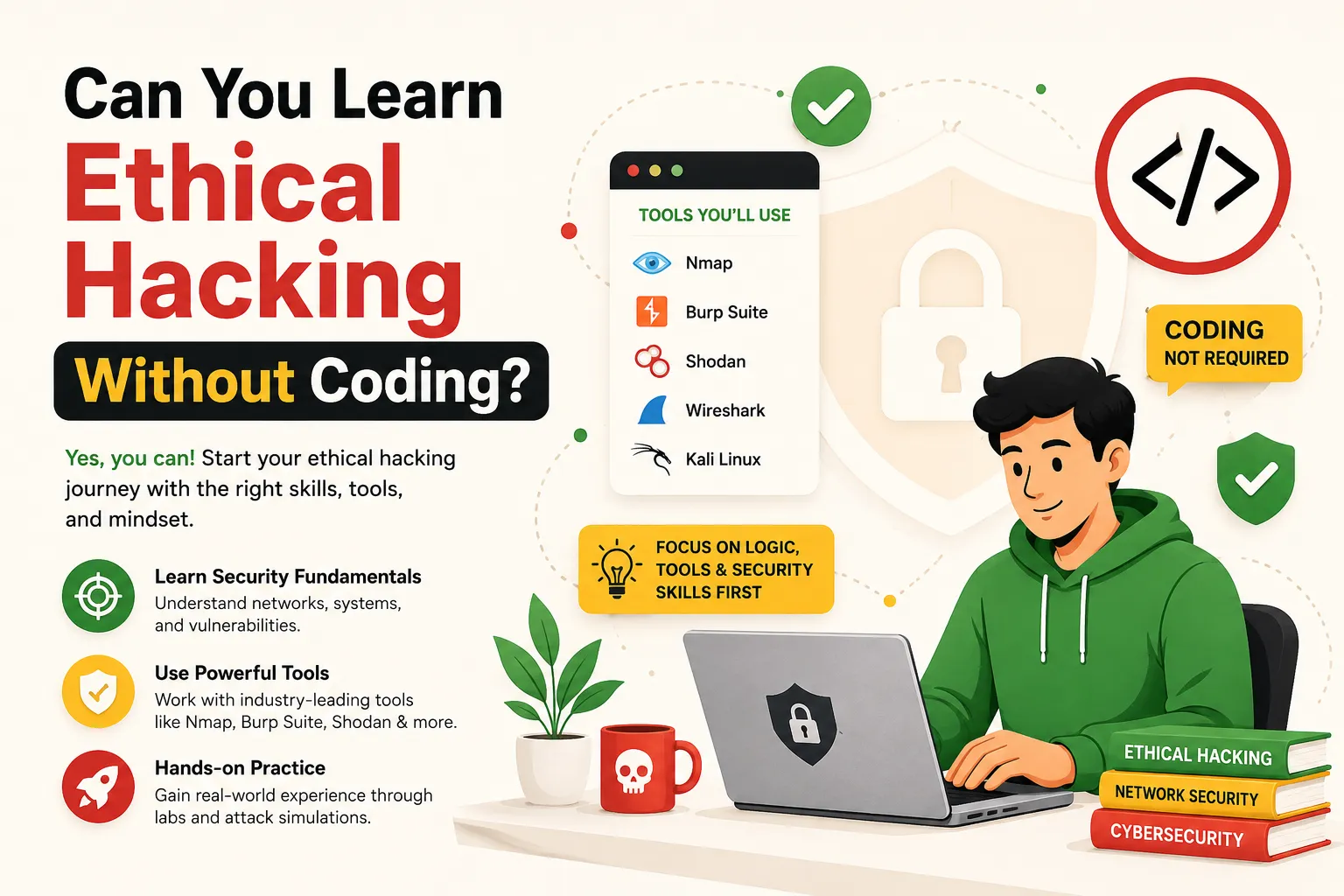

Yes, you can learn ethical hacking without knowing how to code, especially when you are starting out. Coding is useful in cybersecurity, but you do not need advanced programming skills to understand ethical hacking fundamentals, security tools, vulnerabilities, and common attack techniques.
The important distinction is between starting ethical hacking without coding and staying completely unfamiliar with programming throughout your career. You can build a strong foundation first and gradually add coding skills as your cybersecurity knowledge develops.
How Much Coding Do You Actually Need for Ethical Hacking?
For beginners, very little programming may be needed. Early ethical hacking learning often focuses on understanding networks, systems, vulnerabilities, reconnaissance, scanning, and security testing rather than building software from scratch.
There is also a difference between programming and scripting. Using an existing security tool is different from writing a program yourself. A beginner can learn how security tools work and interpret their results before learning how to automate those tasks with code.
As you move into more advanced areas, programming becomes more valuable. It can help with automation, custom security tools, web application testing, exploit development, malware analysis, and other specialized areas.
So, coding is better viewed as a skill you can develop along the way, rather than a requirement you must satisfy before you can begin.
What Can You Learn About Ethical Hacking Without Coding?
A surprising amount of ethical hacking can be understood without writing complex programs. You can learn how attackers gather information, discover weaknesses, and examine different systems while relying on established cybersecurity tools and controlled environments.
For example, reconnaissance teaches you how information about a target can be collected. Network scanning helps you understand what systems and services may be exposed, while vulnerability assessment focuses on identifying potential weaknesses.
You can also explore broader areas such as:
- Network and system security
- Web application security
- Password and authentication security
- Social engineering risks
- Wireless and mobile security
- Cloud, IoT, and endpoint security
- Cryptography and basic security concepts
These topics form an important part of Ethical Hacking Fundamentals because they help beginners understand the security process before moving into more advanced technical work.
Which Skills Matter More Than Coding for Beginners?
When you are new to ethical hacking, understanding how technology works is often more important than knowing how to program.
Networking is a good example. If you understand IP addresses, ports, protocols, devices, and basic network communication, it becomes easier to understand what a security scanning tool is showing you.
Operating system knowledge is also useful, particularly when learning how systems are configured and protected. Alongside this, you need curiosity and analytical thinking because ethical hacking involves asking questions about how a system could be exposed and how that weakness could be addressed.
Most importantly, beginners need to understand responsible security testing. Ethical hacking should only be performed on systems where you have permission to test.
Can You Learn Ethical Hacking Using Tools Instead of Coding?
Yes. Security professionals use specialized tools to perform many tasks that would otherwise take significant time to complete manually. Learning to use these tools can therefore be an important part of beginner ethical hacking training.
Tools such as Nmap can help with network discovery and scanning. Burp Suite is widely used for examining web applications, while Shodan can help with discovering publicly available information about internet-connected systems. Kali Linux provides a widely used environment containing numerous security tools.
The goal, however, should not be to memorize commands. A beginner gains more value by understanding what a tool is doing, why it is being used, and what its results mean.
This is one reason strong Ethical hacking foundations matter. Once you understand the underlying security concept, learning a new tool becomes much easier.
When Does Coding Become Important in Ethical Hacking?
Coding becomes more useful as your work becomes more specialized. If you want to automate repetitive security tasks, create custom scripts, analyze applications, or work on advanced security research, programming can make a significant difference.
For example, scripting can help automate repetitive activities instead of performing the same task manually. Programming can also help security professionals understand how applications behave and identify weaknesses that may not be obvious when using standard tools.
Advanced areas such as exploit development and malware analysis can require substantially deeper programming knowledge. However, these are not skills you need to master on your first day of learning ethical hacking.
The practical approach is to learn cybersecurity concepts first and introduce coding when you have a clear reason to use it.
Which Programming Languages Should You Learn Later?
If you decide to add programming to your cybersecurity skills, you do not need to learn several languages at once. Start with one language and understand how it can support your security work.
Python is a practical choice for many learners because it can be used for scripting, automation, and security-related tasks. You can gradually use it to automate repetitive activities and work with data.
SQL and JavaScript can also become useful, particularly if you want to understand web application security. The objective is not to become a professional software developer. Instead, learn enough programming to understand, analyze, and automate security-related tasks.
What Is the Best Way to Start Ethical Hacking Without Coding?
The best approach is to build your cybersecurity knowledge in stages instead of trying to learn everything at once.
Start with networking, operating systems, and basic security concepts. Then move into reconnaissance, scanning, vulnerability identification, and common security weaknesses. Once these ideas make sense, tools and practical exercises become much easier to understand.
Hands-on practice can make a major difference. A beginner-focused learning path may include guided demonstrations, controlled attack scenarios, and practical projects that allow learners to see how security concepts work in realistic situations.
You can then introduce basic scripting gradually. This creates a natural progression from understanding a security task → performing it with a tool → automating parts of it with code.
Is an Ethical Hacking Course Suitable for Beginners Without Coding Experience?
Yes, a beginner-oriented ethical hacking course can be suitable for someone who does not have a programming background. The important factor is how the learning experience is structured.
A good starting point should explain concepts before expecting learners to perform advanced technical tasks. It should also provide opportunities to see security techniques in practice rather than relying entirely on theory.
For beginners, useful elements include:
- Guided demonstrations and practical exercises
- Exposure to real-world cybersecurity tools
- A gradual introduction to different attack surfaces
- Controlled simulations and practice projects
- Coverage of systems, networks, web applications, cloud, mobile, and wireless security
A structured approach like this can help learners develop Ethical Hacking Essentials without feeling that they must first become programmers.
What Can You Do After Building Your Ethical Hacking Foundations?
Once you understand the fundamentals, you can decide which area of cybersecurity interests you most. Some learners may want to explore penetration testing, while others may prefer vulnerability assessment, network security, application security, or broader cybersecurity work.
The foundational knowledge also makes it easier to understand more advanced topics. You can gradually add Linux skills, scripting, programming, security frameworks, and specialized tools based on your career direction.
The key is not to rush into advanced techniques. A strong foundation can make later learning more effective because you understand the purpose behind the tools and techniques rather than simply following instructions.
Final Answer: Should You Learn Coding Before Ethical Hacking?
No, you do not need to learn coding before starting ethical hacking. You can begin with cybersecurity concepts, networking, reconnaissance, vulnerability assessment, security tools, and practical exercises.
However, coding is worth learning as you progress. It can expand what you are able to do, particularly in automation, application security, security research, and advanced penetration testing.
For beginners, the most sensible path is fundamentals first, practice second, and programming progressively alongside your growing cybersecurity skills. You do not need to wait until you become a programmer to start building your ethical hacking knowledge.
FAQs
1. Can I learn ethical hacking i f I don't know Python?
Yes. Python is useful for automation and advanced cybersecurity tasks, but you can begin learning ethical hacking without knowing Python. Start with networking, security concepts, reconnaissance, vulnerability assessment, and security tools.
2. Is coding necessary to become an ethical hacker?
Coding is not necessary to start learning ethical hacking, but it becomes increasingly useful as you move into advanced areas. Skills such as scripting, automation, application testing, exploit development, and malware analysis can benefit from programming knowledge.
3. What should I learn first before starting ethical hacking?
Start with networking, operating systems, basic cybersecurity concepts, and responsible security testing. Then learn reconnaissance, scanning, vulnerability identification, and commonly used security tools through safe, authorized practice environments.





























Sign in to leave a comment.