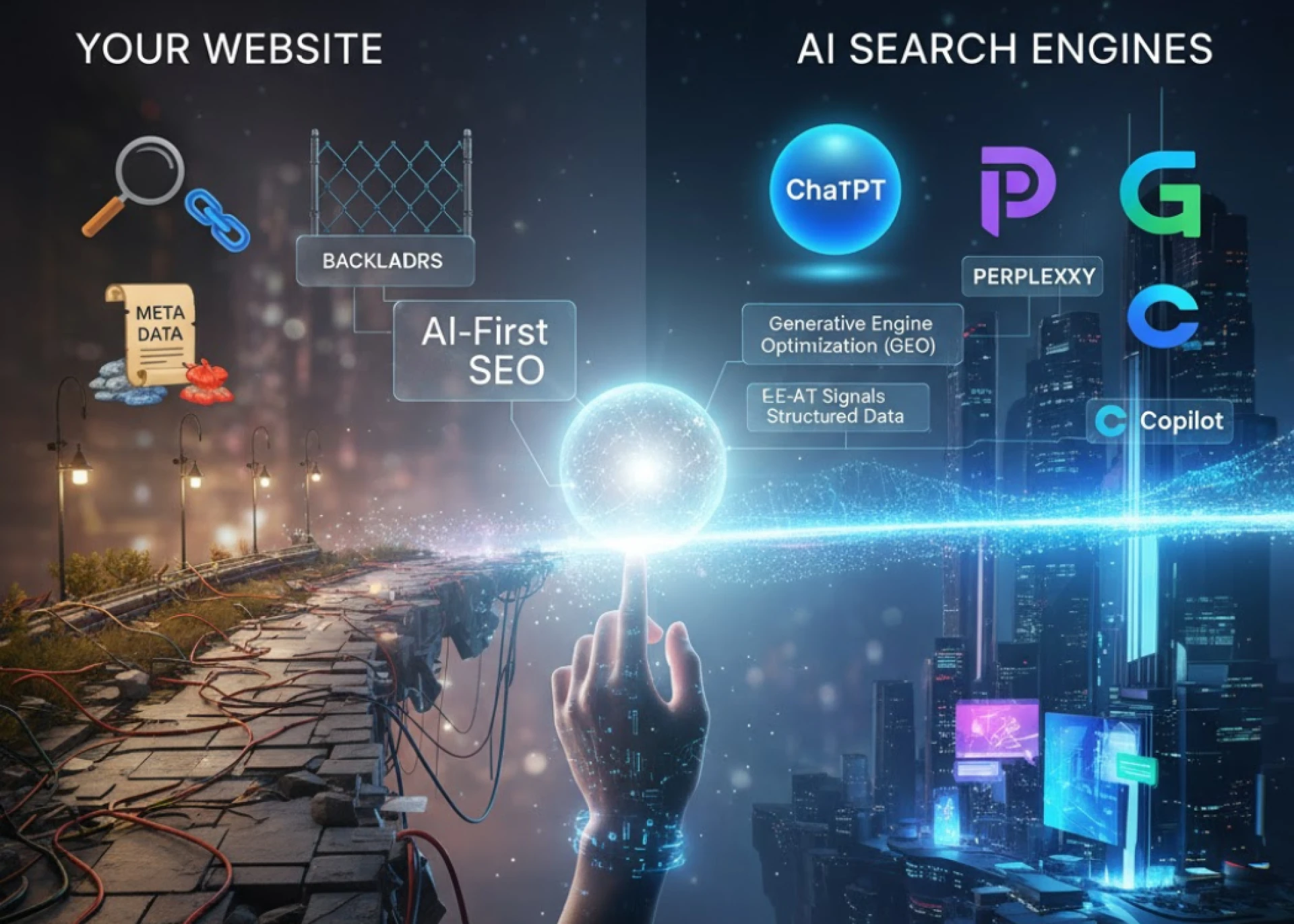

Artificial Intelligence is redefining the world of online search. With the rise of AI search engines such as ChatGPT, Perplexity, Gemini, and Copilot, the way users discover information is transforming faster than ever before. Traditional SEO techniques focused on keywords, backlinks, and metadata are no longer enough. The digital landscape is now shaped by AI-driven algorithms that interpret, summarize, and deliver answers in a conversational format.This shift raises a crucial question for businesses and marketers alike: Can your website actually rank in AI search engines like ChatGPT and Perplexity?
The short answer is yes , but it requires a strategic shift in how content is created, structured, and optimized. Let’s explore how.
Understanding How AI Search Engines Work
Unlike Google’s traditional web crawlers that primarily rely on keyword signals and link structures, AI search engines use large language models (LLMs) to read, understand, and summarize information semantically. These intelligent systems evaluate the meaning and relevance of content rather than just the frequency of keywords. Their primary goal is to deliver concise, accurate, and contextually appropriate answers directly to users.
When a user asks a question on ChatGPT or Perplexity, the AI scans millions of documents to find high-authority, factually correct, and well-structured content. It then summarizes this information into natural language responses and, in many cases, includes citations or source links. This means that rather than simply ranking higher on a results page, your website can become a trusted reference within an AI-generated answer.
Why Ranking in AI Search Matters
As AI-driven search continues to grow, user behavior is shifting dramatically. Instead of browsing through multiple search results, users are increasingly relying on instant answers from tools like ChatGPT and Perplexity. This new model favors content that is well-structured, clearly explained, and aligned with search intent.
Being cited or referenced by these platforms builds brand visibility, trust, and traffic — even without traditional clicks. For businesses, this is a huge opportunity to position themselves as authoritative sources in the AI-powered web.
Key Factors That Help Websites Rank in AI Search
To make your website visible and citable within AI-generated responses, you must optimize beyond conventional SEO tactics. Below are the critical pillars of AI-first SEO in 2025 and beyond.
1. Optimize for Generative Engine Optimization (GEO)
The newest evolution in SEO is Generative Engine Optimization (GEO) , a method designed specifically for AI-driven search platforms. GEO focuses on structuring content so that language models can easily interpret and summarize it.
To optimize for GEO:
- Write clear, factually supported content that answers specific user questions.
- Use semantic headings (H2s and H3s) and short paragraphs for better readability.
- Include relevant data, examples, and statistics.
- Avoid keyword stuffing; instead, use naturally flowing topic-based clusters.
The goal is to make your content not just readable for humans but also machine-understandable for AI models.
2. Strengthen E-E-A-T Signals (Experience, Expertise, Authoritativeness, Trustworthiness)
Search engines and AI systems prioritize trustworthy content. To gain that credibility:
- Provide expert-authored articles with detailed author bios and credentials.
- Link to authoritative sources and peer-reviewed data.
- Keep your content regularly updated to reflect the latest information.
- Maintain transparency with contact details, privacy policies, and citations.
AI systems like ChatGPT and Perplexity tend to favor content that demonstrates clear expertise and reliability. Websites that show human experience and trust signals often appear in cited references.
3. Leverage Structured Data and Schema Markup
Structured data plays a vital role in how search engines and AI tools interpret your website. Using schema markup such as FAQ, HowTo, Article, and Product schema makes your content easier for AI engines to identify, categorize, and display.
For example:
- Implement JSON-LD markup to define entities, products, or services clearly.
- Use FAQ schema for common questions to increase your visibility in AI overviews.
- Add Breadcrumb and Organization schema to improve context recognition.
Well-structured data enhances machine readability and helps your pages appear as featured snippets or direct citations in AI responses.
4. Focus on Technical SEO and Core Web Vitals
Even though AI engines emphasize meaning over mechanics, technical SEO still plays a crucial role. Websites with strong technical foundations perform better in AI-driven searches.
Key steps include:
- Optimizing Core Web Vitals (Largest Contentful Paint, Cumulative Layout Shift, Interaction to Next Paint).
- Ensuring mobile responsiveness and fast-loading pages.
- Using HTTPS security and fixing broken links or redirects.
- Keeping your XML sitemap clean and regularly updated.
Fast, well-structured, and secure websites provide a smoother user experience and better AI crawlability.
5. Write for Human Intent, Not Just Keywords
AI search engines prioritize semantic understanding over keyword density. This means that writing for user intent is now more valuable than ever.
Use natural language and question-based keywords like:
- “How can businesses optimize for ChatGPT search?”
- “What is Generative Engine Optimization?”
- “How to improve website visibility in AI search?”
These phrases align perfectly with AI-driven conversational searches, making your content more likely to be recognized and cited.
6. Build a Strong Topical and Internal Linking Structure
AI algorithms value context and depth. Organize your content into topical clusters, where a main pillar page covers a broad topic, supported by interlinked subtopics.
This structure:
- Helps AI systems understand the relationship between pages.
- Signals authority within a particular domain.
- Improves crawlability and user navigation.
For example, if your main page is about “AI SEO strategies,” subpages could cover “structured data optimization,” “GEO techniques,” and “AI keyword clustering.” This layered approach boosts topical authority and ranking potential.
7. Enhance Readability and Engagement
AI models evaluate user-friendly content as a measure of quality. Use simple, direct language with short paragraphs, bullet points, and visuals. Avoid jargon unless necessary, and ensure your article answers real user queries comprehensively.
Interactive content such as videos, infographics, and FAQs can further increase your chance of being cited in AI-generated answers.
How ChatGPT and Perplexity Select Content
Platforms like ChatGPT and Perplexity don’t “rank” sites in the traditional sense. Instead, they analyze web data for accuracy, clarity, and source reliability. When your content includes relevant keywords, structured markup, and a clear logical flow, AI engines identify it as high-quality reference material.
Citations from these systems are based on trustworthiness and contextual match, not just SEO metrics. Therefore, your focus should be on factual precision, strong data, and semantic depth rather than outdated ranking tactics.
Future of SEO in the Age of AI Search
The future of SEO is heading toward AI-first indexing and generative visibility. In the coming years, content will need to be AI-readable, semantically connected, and contextually justified.
Key trends shaping this future include:
- Wider adoption of GEO and AEO (Answer Engine Optimization).
- AI-assisted technical audits and automated content recommendations.
- Deeper integration between structured data and natural language processing.
- The emergence of AI Knowledge Graphs that link verified brands and authors to search credibility.
In short, ranking in the AI era means optimizing not only for search engines but also for intelligent systems that interpret meaning at a deeper level.
Final Thoughts
Yes, your website can rank in AI search engines like ChatGPT and Perplexity, but success depends on how well you adapt to this evolving search ecosystem. By embracing Generative Engine Optimization, strengthening E-E-A-T principles, and implementing structured data, your brand can earn citations, credibility, and sustainable online visibility.
The future of SEO isn’t about chasing algorithms. It’s about building trustworthy, machine-readable, and human-centered content that serves real intent. Those who master this balance will not just appear in AI search , they will become part of the digital conversation itself.



























Sign in to leave a comment.