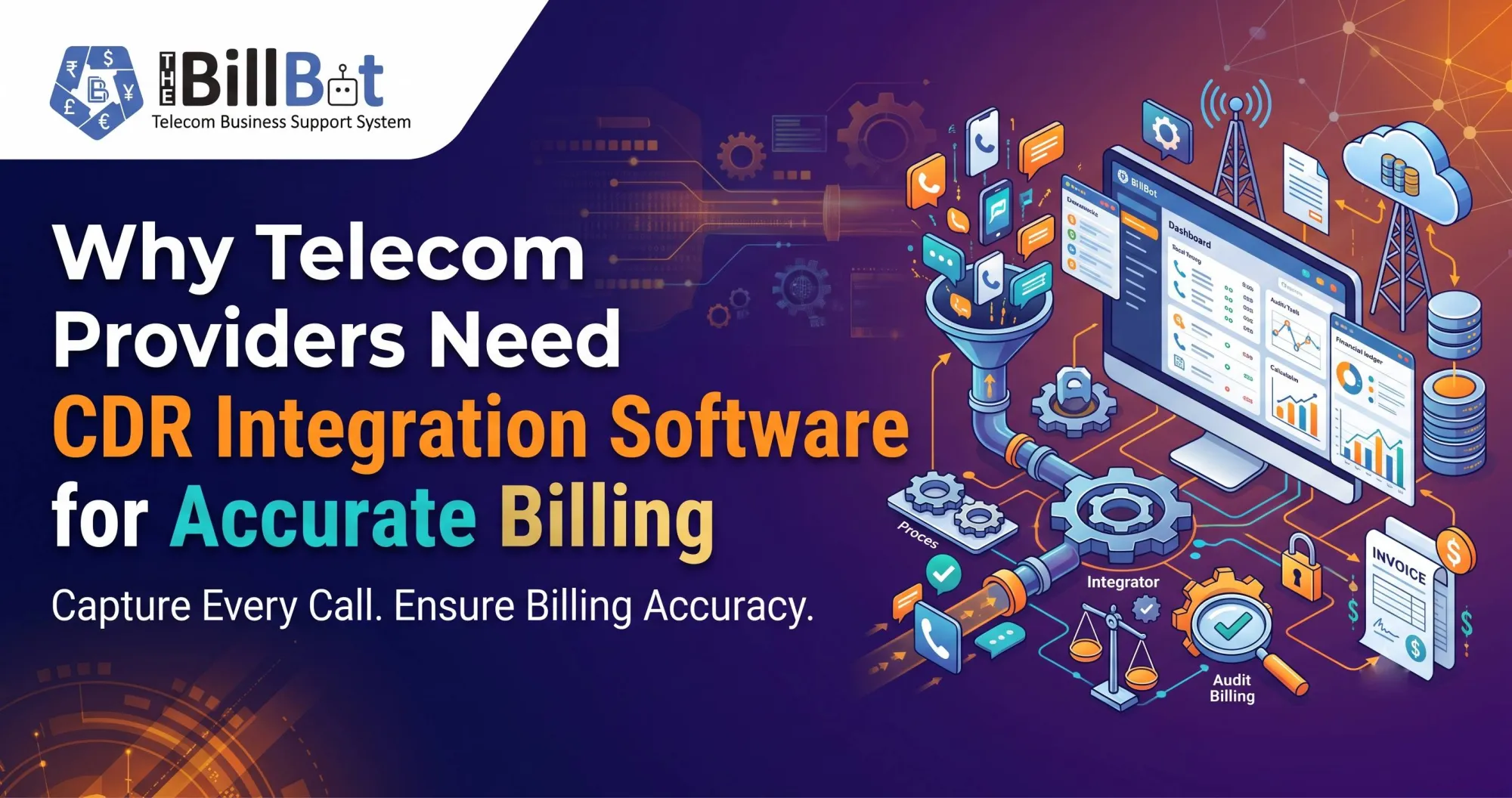

For telecom and VoIP providers, accurate billing depends on accurate usage data. Every call, message, connection, or billable activity can contribute to what a customer ultimately pays. When this usage information is handled manually or transferred between disconnected systems, even a small data issue can create billing discrepancies.
As telecom businesses grow, the volume of Call Detail Records (CDRs) can become substantial. Processing these records manually, moving them between systems, checking formats, applying rates, and connecting usage to customer accounts can become time-consuming and difficult to manage consistently.
This is where CDR Integration Software can make a significant difference.
CDR Integration Software helps telecom providers connect usage data from telecom platforms, PBX systems, carriers, and other sources with their billing environment. By creating a more automated flow of information, providers can reduce manual data handling, improve billing accuracy, and manage increasing usage volumes more efficiently.
For ITSPs, VoIP providers, MSPs, and telecom businesses, effective CDR integration can become an important part of building a reliable billing operation.
What Is CDR Integration Software?
CDR stands for Call Detail Record. A CDR contains information about a communication event, such as a telephone call. Depending on the source system, a record may include information such as the caller, destination, start time, duration, call type, and other usage details.
CDR Integration Software is designed to connect these usage records with other business systems, particularly billing platforms.
Instead of manually downloading, formatting, uploading, and processing CDR files, an integration solution can help automate the movement and processing of usage information.
A typical CDR integration workflow may involve:
- Receiving CDR data from a source system
- Importing or retrieving the records
- Validating the data
- Mapping fields between systems
- Processing and transforming records
- Connecting usage to customer accounts
- Sending data to the billing system
- Applying the relevant billing or rating rules
The exact workflow depends on the telecom environment, but the objective remains the same: make usage data available to the billing process accurately and efficiently.
Why Accurate CDR Data Matters for Telecom Billing
Billing accuracy begins with the underlying usage information.
If a provider receives incomplete, duplicated, incorrectly formatted, or mismatched CDR data, the billing result may also be incorrect.
For example, a provider could accidentally:
- Miss billable calls
- Charge for the same usage twice
- Apply the wrong customer account
- Use incorrect call duration
- Apply an incorrect rate
- Fail to process certain records
- Create invoices with incomplete usage
These issues can lead to invoice disputes, revenue leakage, additional support requests, and reduced customer confidence.
Accurate CDR integration helps create a stronger connection between actual usage and customer billing.
How CDR Integration Software Improves Billing Accuracy
1. Reduces Manual Data Entry
Manual data entry creates opportunities for mistakes.
When employees copy information from one system to another, errors can occur through incorrect values, missing fields, duplicate entries, or accidental changes.
CDR Integration Software reduces the need for manual data transfer by creating automated connections between systems.
When usage data moves through a defined integration workflow, providers can minimise unnecessary manual intervention and make the process more consistent.
2. Standardises Data From Different Sources
Telecom providers may receive CDRs from different platforms.
A provider could work with multiple PBX systems, carriers, gateways, switches, or other telecom platforms. These systems may not always produce CDRs in exactly the same format.
This can make manual processing complicated.
CDR integration can help map and transform data into a format that the billing system can understand.
This creates a more consistent flow of usage information, even when data originates from different sources.
3. Helps Prevent Missing Usage Records
Missing usage records can result in revenue leakage.
If a provider fails to process certain CDRs, billable activity may not appear on the customer's invoice.
Automated integration workflows can help providers establish more reliable processes for receiving and processing CDR data.
Depending on the system, businesses may also be able to identify records that failed processing and investigate them before billing is completed.
4. Reduces Duplicate Records
Duplicate CDRs can create another billing problem.
If the same usage record is processed more than once, the customer may be charged twice for the same activity.
A well-designed integration process can include validation and processing rules designed to identify or prevent duplicate records.
This helps protect billing accuracy and reduces the possibility of unnecessary customer disputes.
CDR Integration and Automated Rating
CDR processing and rating are closely connected.
Once usage data reaches the billing system, the appropriate charging rules need to be applied. These rules may depend on the destination, duration, service type, customer plan, rate structure, or other factors.
An integrated workflow can connect CDR processing with rating and billing.
For example, once a call record is successfully processed, the billing system can apply the appropriate rate based on the customer's configured pricing structure.
This can make usage-based billing more consistent and reduce the need for manual calculations.
How CDR Integration Supports Different Billing Models
Telecom providers do not always use a single billing model.
Customers may be charged through:
- Usage-based pricing
- Recurring subscriptions
- Call packages
- Bundled services
- Custom customer rates
- Wholesale and retail pricing
- Additional usage charges
CDR data can play an important role in calculating usage-based charges within these models.
By connecting CDR processing with billing rules, CDR Integration Software can help providers manage different charging requirements more efficiently.
This flexibility is particularly useful for ITSPs and VoIP providers serving customers with different service configurations.
Improving Billing Efficiency as Telecom Businesses Grow
CDR volumes can increase rapidly as a telecom provider grows.
More customers generally mean more calls, more usage records, and more billing activity.
A manual process that works for a small business may become difficult when usage increases significantly.
CDR Integration Software can help providers handle larger volumes without increasing manual processing at the same rate.
Automation allows teams to focus less on moving and checking individual records and more on exception handling, customer support, financial analysis, and business development.
This makes CDR integration an important part of scalable telecom billing operations.
CDR Integration Improves Customer Experience
Billing accuracy is not only a finance issue. It directly affects the customer experience.
Customers expect invoices to be clear, accurate, and consistent.
When customers receive incorrect charges, they may contact support to dispute invoices. Frequent billing issues can reduce trust and create unnecessary pressure on customer service teams.
Accurate CDR integration helps providers create more reliable billing processes.
When usage is correctly captured and connected to the appropriate account, customers are more likely to receive invoices that accurately reflect their service usage.
Better Visibility Into Telecom Usage
CDR integration can also improve visibility into usage data.
Once CDR information is connected with billing and reporting systems, providers can analyse usage more effectively.
Businesses may be able to understand:
- Call volumes
- Usage trends
- Customer activity
- Service usage
- Revenue generated from usage
- Billing performance
- Potential anomalies
This information can help providers make better decisions about pricing, services, customer plans, and business performance.
CDR Integration With Other Business Systems
CDR data does not always need to remain within the billing environment.
Telecom providers may also use CRM platforms, accounting systems, reporting tools, customer portals, and other business applications.
Integrating CDR data with these systems can create a more connected operational environment.
For example, usage information can support billing, billing can update customer account information, and financial systems can receive relevant invoice or revenue information.
The more connected these processes become, the less providers need to rely on repetitive manual data movement.
What Should Telecom Providers Look for in CDR Integration Software?
Choosing the right solution requires more than checking whether it can import CDRs.
Telecom providers should consider several capabilities.
Multi-Source CDR Support
The software should ideally support CDR data from relevant PBX systems, carriers, gateways, or other telecom sources.
Data Mapping and Transformation
Different systems may use different fields and formats. Mapping capabilities can help standardise information before it reaches billing.
Automated Processing
Automation can reduce manual file handling and repetitive data processing.
Validation and Error Handling
The system should provide ways to identify invalid, incomplete, or failed records.
Duplicate Detection
Duplicate handling can help prevent the same usage from being processed multiple times.
Billing Integration
CDR data should be able to flow into the billing process efficiently so usage can be rated and charged correctly.
Reporting and Monitoring
Visibility into processed, failed, or rejected records can help teams identify problems quickly.
Scalability
The solution should be capable of handling increasing CDR volumes as the telecom business grows.
Final Thoughts
Accurate telecom billing starts with reliable usage data. When CDRs are manually processed or transferred between disconnected systems, the risk of errors, missing records, duplicates, and billing delays can increase.
CDR Integration Software provides a more structured and automated way to connect telecom usage data with billing systems.
By reducing manual data entry, standardising records, supporting automated processing, improving visibility, and connecting usage with billing rules, CDR integration can help telecom providers create more accurate and efficient billing operations.
For ITSPs, VoIP providers, and growing telecom businesses, investing in reliable CDR integration is not simply about processing call records faster. It is about creating a billing foundation that can support accuracy, customer trust, operational efficiency, and long-term growth.
Frequently Asked Questions
1. What is CDR Integration Software?
CDR Integration Software connects Call Detail Records from telecom systems with billing and other business platforms, helping providers automate the transfer, processing, and use of telecom usage data.
2. Why is CDR integration important for accurate billing?
CDR integration helps ensure that usage information is transferred and processed consistently, reducing the risk of missing, duplicate, incorrectly mapped, or manually entered usage data.
3. Can CDR Integration Software work with multiple telecom systems?
Many CDR integration solutions can connect with multiple sources, such as PBX systems, carriers, gateways, and other telecom platforms, depending on their integration capabilities.
4. Does CDR Integration Software support usage-based billing?
Yes. CDR data can be connected to billing systems where usage is processed and rated according to configured customer pricing and billing rules.
5. How does CDR integration reduce billing errors?
It reduces manual data entry, standardises data, supports validation, and creates automated workflows that can help minimise common processing errors.
6. Can CDR Integration Software detect duplicate records?
Depending on the solution, duplicate detection and validation rules can help identify or prevent duplicate CDRs from being processed and billed more than once.
7. Is CDR integration useful for VoIP providers?
Yes. VoIP providers rely heavily on call usage data, making efficient CDR processing and integration particularly important for accurate usage-based billing.
8. How does CDR integration help growing telecom businesses?
It allows providers to process increasing volumes of usage data without relying on the same level of manual effort, making billing operations easier to scale.
9. Can CDR data be used for reporting and analytics?
Yes. Once CDR data is integrated with appropriate systems, providers can use it to analyse usage, customer activity, call volumes, billing, and other business metrics.
10. What should providers consider when choosing CDR Integration Software?
Providers should consider data-source compatibility, mapping and transformation, automation, validation, duplicate handling, billing integration, monitoring, reporting, and scalability.

























Sign in to leave a comment.