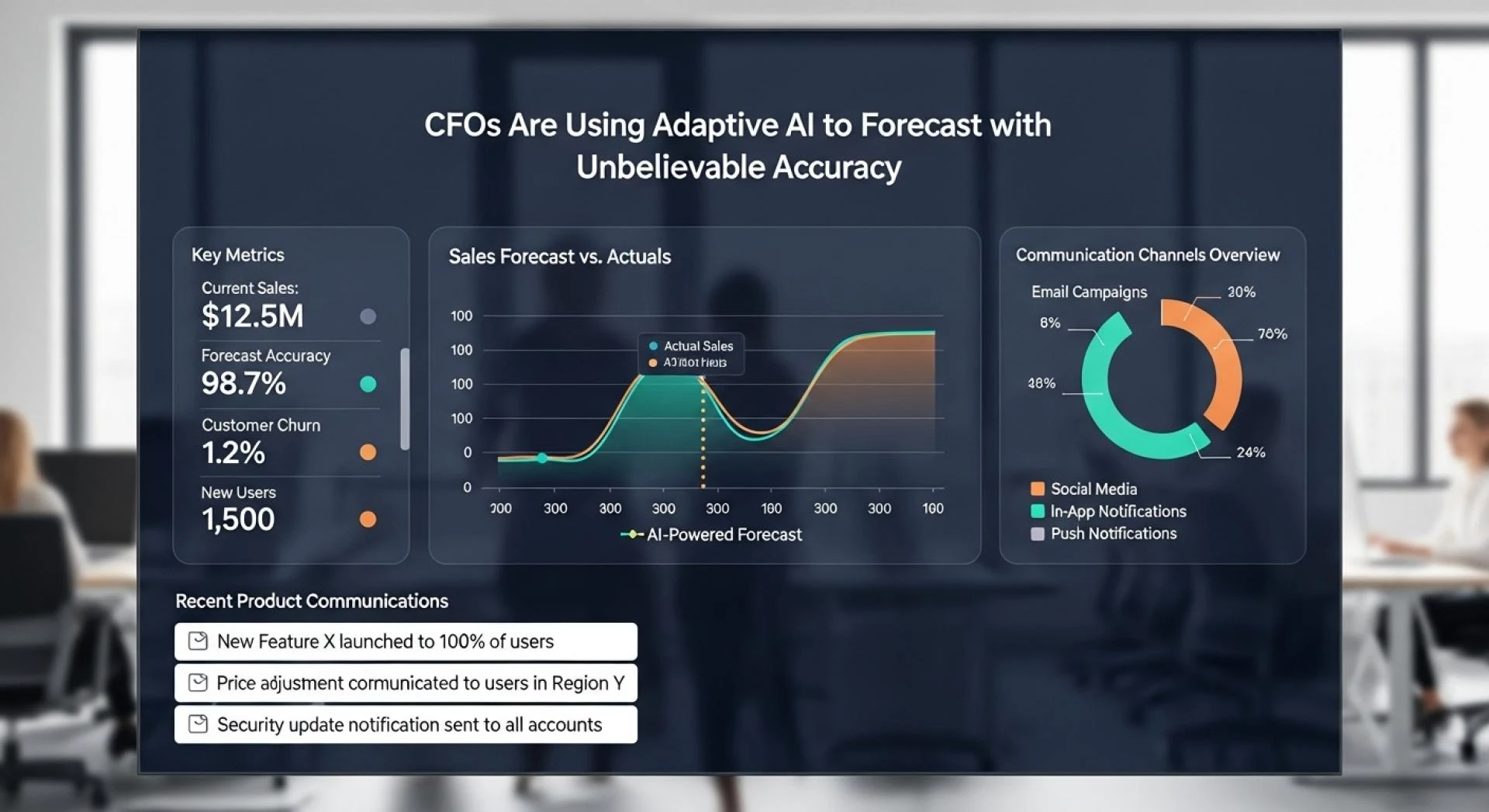

Introduction
In today’s fast-evolving business environment, financial forecasting has become more challenging than ever. Market volatility, changing consumer behavior, supply chain disruptions, and unpredictable economic conditions make traditional forecasting methods increasingly unreliable. Relying solely on historical data, static spreadsheets, or manual calculations can leave CFOs exposed to unexpected risks, missed opportunities, and inefficient resource allocation.
Enter adaptive AI — a transformative technology that enables CFOs to forecast with remarkable precision by continuously learning from real-time financial and operational data. Unlike conventional models, adaptive AI dynamically updates its predictions as new information becomes available, allowing finance leaders to anticipate trends, make informed decisions, and act proactively.
By collaborating with an adaptive AI development company or leveraging adaptive AI development services, organizations can implement predictive systems that not only forecast outcomes but also recommend actionable strategies. This approach transforms forecasting from a reactive exercise into a forward-looking, strategic advantage.
What Is Adaptive AI in Financial Forecasting?
Adaptive AI is an advanced form of artificial intelligence that evolves as it interacts with data. Traditional AI relies on fixed models that must be retrained periodically, whereas adaptive AI continuously adjusts its predictions based on new inputs. In the context of financial forecasting, this means that forecasts are constantly refined as market conditions, operational data, and historical trends change.
Key capabilities of adaptive AI in finance include:
- Dynamic Learning: Models update in real time as new transactions, market signals, or operational metrics become available.
- Predictive Accuracy: The system identifies complex patterns and correlations that humans or static models may overlook.
- Scenario Analysis: Adaptive AI can simulate multiple potential outcomes, enabling CFOs to assess risks and plan contingencies.
- Actionable Insights: Beyond predictions, the system can suggest strategies for budgeting, investment, and operational optimization.
When integrated across finance functions, adaptive AI provides CFOs with a comprehensive, predictive view of their organization’s financial health, enabling them to act faster and with greater confidence.
Why CFOs Need Adaptive AI
The modern CFO operates in an environment where speed, accuracy, and insight are critical. Traditional forecasting approaches often fall short because:
- Market Volatility Is Increasing: Rapid changes in interest rates, commodity prices, and consumer demand require models that adjust in real time.
- Data Overload: Organizations generate massive volumes of financial and operational data daily. Manual analysis cannot keep pace.
- Complexity of Business Operations: Global supply chains, multi-product portfolios, and cross-functional dependencies make accurate predictions challenging.
- High Stakes: Misjudged forecasts can result in under- or over-investment, cash flow issues, or missed growth opportunities.
Adaptive AI addresses these challenges by continuously learning from multiple data sources and generating precise forecasts that empower CFOs to make informed strategic decisions.
Benefits of Adaptive AI for CFOs
1. Unmatched Forecast Accuracy
Adaptive AI improves forecast reliability by identifying subtle correlations and trends within vast datasets. For instance, it can detect early indicators of revenue growth, anticipate expense fluctuations, or recognize potential cash flow issues before they manifest. CFOs can rely on these insights to make proactive, data-driven decisions.
2. Real-Time Financial Visibility
With adaptive AI, CFOs no longer wait for end-of-month reports to understand performance. Continuous learning models provide real-time insights into revenue, expenses, profitability, and liquidity, enabling immediate responses to emerging opportunities or risks.
3. Enhanced Risk Management
Predictive capabilities allow CFOs to foresee financial risks, such as cash flow shortages, late receivables, or market volatility. By acting on AI-driven insights, finance leaders can mitigate risks, optimize reserve allocations, and maintain operational stability.
4. Optimized Resource Allocation
By predicting revenue and expense trends with precision, CFOs can allocate budgets, staff, and investments more effectively. This leads to improved ROI, better capital utilization, and reduced financial waste.
5. Strategic Planning Support
Adaptive AI generates scenario analyses and predictive insights that support high-level decision-making. CFOs can evaluate the potential impact of new investments, pricing strategies, or expansion plans, making strategic decisions with confidence rather than relying on guesswork.
How Adaptive AI Works in Practice
Data Integration and Processing
Adaptive AI collects and integrates data from multiple sources: ERP systems, accounting software, sales and operations metrics, market indices, and external economic indicators. This unified data environment allows the AI to understand the complete financial picture and generate more accurate predictions.
Predictive Modeling
The AI applies machine learning algorithms to analyze historical patterns and current trends. It identifies correlations between revenue drivers, cost variables, and market conditions, producing forecasts that account for both typical business cycles and unusual events.
Continuous Learning and Adaptation
As new data flows in, adaptive AI adjusts its models dynamically. This ensures forecasts remain accurate even in rapidly changing environments, unlike static models that quickly become outdated.
Actionable Insights
Beyond providing predictions, adaptive AI can suggest financial actions, such as optimizing cash reserves, adjusting procurement strategies, or reallocating budget to high-performing units. This integration of predictive intelligence into decision-making is what sets adaptive AI apart from traditional forecasting tools.
Implementation Strategies
CFOs seeking to adopt adaptive AI should consider the following best practices:
- Start with Clear Objectives
- Identify high-impact areas for predictive forecasting, such as cash flow management, revenue projections, or budgeting.
- Ensure Data Quality
- Consolidate data from all relevant sources and maintain accuracy, completeness, and consistency.
- Partner with Experts
- Engage an adaptive AI development company or leverage adaptive AI development services to design robust, scalable, and secure models tailored to your organization.
- Iterative Deployment
- Begin with pilot projects to validate predictions and refine models before scaling across the organization.
- Align Teams and Processes
- Finance teams, operational leaders, and executive decision-makers should understand and trust AI insights, ensuring seamless adoption.
- Monitor and Update Models
- Regularly assess prediction accuracy and retrain models as new data or conditions emerge to maintain performance.
Challenges and How to Overcome Them
Data Silos
Integrating financial, operational, and market data can be challenging. CFOs must ensure cross-departmental data flow to maximize predictive accuracy.
Changing Business Conditions
Rapid market shifts can reduce forecast reliability. Adaptive AI mitigates this by continuously learning from real-time data and updating predictions dynamically.
Resistance to Change
Finance teams may distrust AI forecasts initially. Transparent reporting, explainable AI models, and human oversight help build confidence in the system.
Compliance and Privacy
AI systems must comply with financial regulations and privacy standards. Implementing secure, auditable models ensures ethical and legal compliance.
Industry Applications
- Retail & E-Commerce: Predicting seasonal revenue fluctuations and optimizing inventory allocation.
- Manufacturing: Forecasting production costs and demand to reduce overproduction and waste.
- Financial Services: Anticipating loan defaults, cash flow risks, or investment returns.
- Technology & SaaS: Projecting subscription renewals, revenue growth, and churn rates.
- Healthcare: Forecasting patient billing, operational costs, and funding needs for services.
In each case, adaptive AI allows CFOs to move beyond historical analysis and make predictive, data-driven financial decisions.
Metrics to Track Success
CFOs can measure the effectiveness of adaptive AI forecasting by monitoring:
- Forecast Accuracy: Comparing predicted vs. actual outcomes.
- Cash Flow Optimization: Improvement in liquidity and working capital efficiency.
- Budget Variance Reduction: Reduced discrepancies between planned and actual expenditures.
- Decision-Making Speed: Reduction in time taken to adjust strategies based on AI insights.
- Risk Mitigation Effectiveness: Reduced losses due to early detection of financial risks.
Tracking these metrics ensures AI investments deliver tangible business value.
Future Trends
- Hyper-Personalized Forecasting: Predicting outcomes at granular levels such as individual business units or product lines.
- Scenario Planning at Scale: Simulating multiple economic and operational scenarios for informed decision-making.
- Integration with AI-Driven Operations: Finance forecasts directly influencing automated operational and supply chain decisions.
- Cross-Functional AI Insights: Linking sales, marketing, and finance to create holistic predictive intelligence.
- Continuous Self-Optimization: AI models refining themselves without manual intervention for sustained accuracy.
Conclusion
Adaptive AI is transforming financial forecasting from a reactive, error-prone process into a predictive, data-driven strategic advantage. CFOs leveraging adaptive AI development services or engaging with an adaptive AI development company can forecast with unprecedented accuracy, optimize resource allocation, mitigate risk, and make strategic decisions confidently.
By integrating adaptive AI into financial planning, organizations gain a forward-looking perspective that allows them to act proactively, adapt quickly to changing market conditions, and maintain a competitive edge. In an era where precision, agility, and insight define success, adaptive AI is no longer optional — it is the CFO’s secret weapon for financial excellence.




























Sign in to leave a comment.