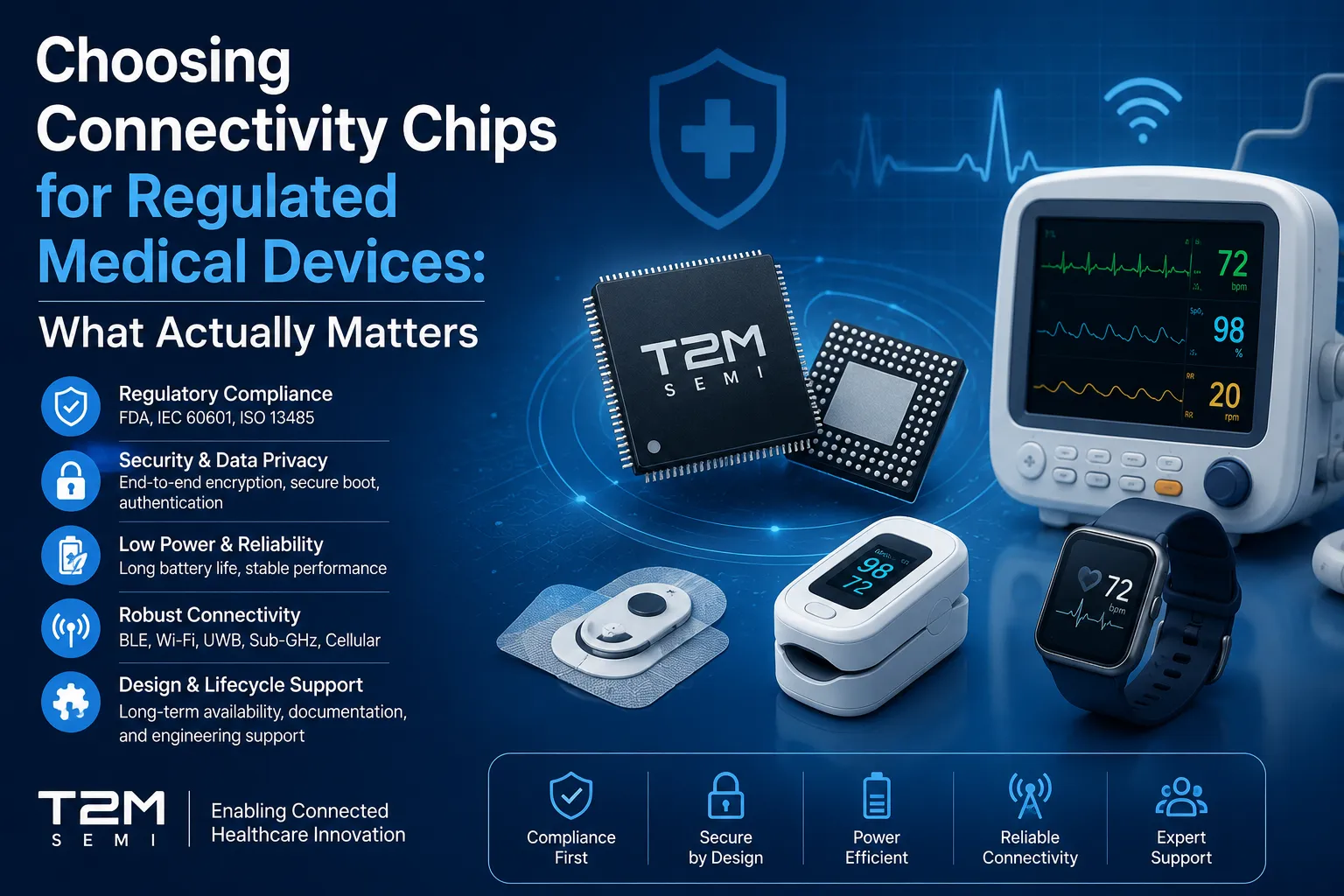

Medical device SoCs manufacturers face a version of the wireless SoC selection problem that most consumer product teams never encounter: the chip choice isn't just an engineering decision, it's a regulatory one. A connectivity failure in a smart speaker is an inconvenience. A connectivity failure in a continuous glucose monitor or a clinical-grade wearable can be a patient safety issue. That difference shapes every part of how connectivity silicon should be evaluated for this category.
Why Medical Device Connectivity Is a Different Evaluation Problem
Regulatory classification changes what "reliable" means. Class I, II, and III medical devices (under FDA classification, with similar tiers under other regulatory regimes) carry different risk levels and correspondingly different expectations for connectivity reliability, data integrity, and failure handling. A chip evaluation that's perfectly adequate for a consumer fitness tracker may not meet the bar for a Class II or III clinical device, where connectivity failures have direct implications for patient monitoring or treatment.
Data security isn't optional — it's a compliance requirement. Regulations like HIPAA (in the US) and equivalent health data protection frameworks elsewhere mean that any device transmitting patient data needs genuine, verifiable security — not just "good enough for consumer IoT" security. This shifts hardware security features from a nice-to-have differentiator to a baseline requirement.
Long product lifecycles demand long-term component availability. Medical devices often stay in service — and in regulatory approval — for many years longer than consumer electronics. A wireless SoC that gets discontinued after two years creates a real problem for a manufacturer whose product is approved and deployed for a decade. Component longevity and manufacturer stability become genuine evaluation criteria, not afterthoughts.
Power efficiency has direct clinical implications. For wearable or implantable monitoring devices, battery life isn't just a user convenience metric — a device that needs frequent recharging or battery replacement creates real gaps in patient monitoring continuity.
What to Actually Evaluate in a Connectivity SoC for This Category
Hardware security architecture. Secure Boot, hardware-accelerated encryption (AES), secure key storage, and authenticated firmware update mechanisms matter more here than in almost any other IoT category, since patient data confidentiality and device integrity are both regulatory and safety concerns simultaneously.
True Random Number Generation (TRNG). Cryptographic security depends on genuinely unpredictable random number generation for key generation — a detail easy to overlook on a datasheet but foundational to whether the encryption built on top of it is actually secure.
Low-power BLE as the typical foundation. Bluetooth Low Energy remains the dominant connectivity choice for wearable and portable medical devices specifically because of its battery efficiency — a continuous monitoring device that needs daily recharging is a meaningfully worse clinical tool than one that runs for a week or more between charges.
Reliable, low-latency data transmission. For devices monitoring real-time physiological data, connection reliability and consistent latency matter more than raw throughput — an SoC with a strong track record for stable BLE connections, not just a high headline data rate, is the right evaluation focus.
Interference resilience. Hospital and clinical environments are often RF-dense — many devices, many wireless signals, in close proximity. A connectivity chip's ability to maintain a stable link in a crowded RF environment is a genuine, practical evaluation point for anything deployed in clinical settings specifically, distinct from home-use wearables.
Certification and documentation support. Beyond the chip's own technical qualification (Bluetooth SIG, FCC/CE), medical device manufacturers benefit significantly from a chip vendor able to support the broader regulatory documentation process — technical file support, quality documentation, and a track record of the chip being used in other regulated medical products.
Common Architecture Patterns in Medical and Wellness Devices
Continuous monitoring wearables (glucose monitors, heart rate/ECG patches, activity trackers with clinical features) typically rely on BLE for its power efficiency, paired with robust encryption for the patient data being transmitted to a companion app or clinical system.
Connected diagnostic and point-of-care devices often combine BLE SoCs for patient-facing connectivity with Wi-Fi SoCs for direct integration into clinical IT systems and electronic health record platforms, similar to the BLE-for-setup, Wi-Fi-for-data-throughput pattern common across other IoT categories, but with substantially higher security requirements layered on top.
Implantable and long-term wearable devices place an even higher premium on power efficiency and hardware security, given both the extended deployment duration and the elevated consequence of any security compromise.
The Practical Takeaway
Selecting connectivity silicon for a regulated medical device isn't fundamentally a different technical exercise than selecting a chip for any other battery-powered wireless product — the same core questions about power, protocol fit, and range still apply. What changes is the weight given to security architecture, component longevity, and interference resilience, and the necessity of choosing a chip vendor who understands that a datasheet spec sheet is only part of what a medical device manufacturer needs to move confidently through both engineering validation and regulatory approval.
For product teams early in the design process, the practical starting point is the same regardless of device classification: map out the specific data sensitivity, required battery life, and clinical deployment environment for the actual product, then evaluate connectivity silicon against those specific requirements rather than defaulting to whatever chip powered the last consumer product the team worked on.





























Sign in to leave a comment.