
Businesses entering the blockchain ecosystem often face an early technical decision: use a pre-built token solution or develop a token specifically for their requirements. Ready-made token platforms can reduce the initial development effort, but they also impose limits on functionality, control, integrations, and long-term adaptability.
Custom token development takes a different approach. Instead of adapting a standard template to a business model, the token architecture is designed around the project's purpose, economic structure, blockchain environment, and future requirements. This distinction becomes increasingly important when a token is expected to support more than basic transfers.
At Blockchain App Factory, custom token development focuses on aligning token functionality with the broader business and Web3 ecosystem. Understanding the differences between these two approaches can help businesses make a more informed technology decision.
What Are Pre-Built Token Solutions?
Pre-built token solutions are generally based on existing templates, frameworks, or token-generation platforms. Users can configure basic parameters such as the token name, symbol, supply, decimals, and sometimes additional features before deploying the contract.
For straightforward use cases, this approach can be practical. A project that needs a basic fungible token with standard transfer functionality may not require extensive customization.
The limitation appears when the token becomes an important component of a larger product. Businesses may need specific access controls, distribution mechanisms, governance functions, vesting schedules, reward systems, or integrations that a standard template does not support.
In such situations, adding features after deployment can become complicated. The project may need another contract, a separate application layer, or even a replacement token.
What Makes Custom Token Development Different?
Custom token development starts with the business requirements rather than a fixed contract template.
The development team can determine the appropriate blockchain, token standard, supply mechanism, administrative structure, security model, and integrations based on the project's intended use.
For example, a business launching a loyalty ecosystem could design a token around customer rewards and controlled redemption. A gaming company could implement token mechanics connected to in-game assets. A governance-focused platform could integrate voting functionality and delegated participation.
The token becomes part of the product architecture instead of functioning as an isolated digital asset.
Greater Control Over Token Functionality
Control is one of the strongest reasons businesses choose custom development.
A pre-built token normally offers a predefined set of functions. Custom development allows the project to determine exactly which functions are required and how they should operate.
Depending on the use case, custom functionality can include:
- Controlled minting and burning
- Role-based permissions
- Token vesting
- Automated distribution
- Transaction restrictions
- Pausing mechanisms
- Staking and reward logic
- Governance integration
- Whitelisting
- Custom transfer rules
This flexibility matters when token behavior is directly connected to business operations.
Consider a platform that wants to reward users based on verified activity. A basic token contract may not provide the necessary mechanisms to manage those rewards. A custom architecture can connect token issuance to the platform's existing rules and infrastructure.
Tokenomics Can Be Built Around the Business Model
Tokenomics is another area where pre-built solutions can become restrictive.
A business may need a specific supply model, allocation structure, vesting schedule, emission rate, or incentive mechanism. These economic decisions can influence how the token behaves in the market and how users interact with the ecosystem.
Imagine a Web3 platform issuing 500 million tokens. The project could reserve portions for ecosystem rewards, treasury management, team incentives, investors, partnerships, and liquidity. Each allocation may follow different release schedules.
A custom token contract can incorporate those requirements into the broader token infrastructure.
This becomes especially important for projects that plan long-term token distribution. A generic contract may create the token itself, but the surrounding economic infrastructure often requires additional customization.
Better Integration With Existing Business Systems
Businesses rarely operate their tokens in isolation.
A token may need to interact with a website, mobile application, payment system, wallet infrastructure, exchange, staking platform, governance application, or decentralized application.
Custom development allows the token's architecture to be designed with these integrations in mind.
For example, an online platform could use token ownership as an access condition. Users holding a defined amount of tokens could unlock premium features. The application's backend or smart contracts can verify balances and apply access rules.
A pre-built token can still be integrated into applications, but the project may need to work around the limitations of its contract design.
Security and Access Controls Can Be Designed Specifically
Security should be treated as an architectural requirement rather than a final-stage feature.
Standard token templates can benefit from established implementations, but businesses still need to understand what permissions and functions exist in the deployed contract.
Custom development allows security controls to be designed around the project's threat model.
For example, a business may restrict minting authority to a specific role, separate administrative permissions, implement multisignature control, or introduce emergency mechanisms. The exact configuration depends on the project's requirements.
Security testing can then focus on the actual functionality being deployed.
The broader Web3 environment reinforces the importance of this approach. Chainalysis reported that more than $2.2 billion in cryptocurrency was stolen through hacking incidents in 2024, highlighting the continued security risks facing blockchain ecosystems.
Custom development does not automatically make a token secure. Its advantage is that the security architecture can be deliberately designed, tested, and audited around the project's specific implementation.
Scalability and Future Expansion
A token that works for a small pilot may not meet the requirements of a growing ecosystem.
Businesses should consider how the token will evolve as user numbers, transaction volumes, integrations, and product features increase.
Custom development provides more control over future architecture. Depending on the blockchain and contract design, developers can build modular components that support future functionality.
This does not mean every possible feature should be added at launch. Overengineering can create unnecessary complexity. A better approach is to identify realistic future requirements and design an architecture that can accommodate them without compromising security or usability.
Blockchain Choice Becomes More Strategic
Pre-built token platforms often support a limited selection of networks. Custom development gives businesses greater freedom to evaluate blockchain environments according to their requirements.
Ethereum provides established token standards and a large application ecosystem. ERC-20, for example, defines common functions for fungible tokens and helps applications interact with tokens through a standardized interface.
Other networks offer different combinations of transaction costs, throughput, developer tooling, and ecosystem support.
Choosing the blockchain first and designing the token around that environment can provide a better foundation than selecting a token template and then building the business around its limitations.
When Pre-Built Tokens Can Still Make Sense
Custom development is not automatically the right choice for every project.
A pre-built token can be suitable when a business needs:
- A basic fungible token
- Standard transfer functionality
- A limited proof-of-concept
- A short-term experimental project
- Minimal customization
For these scenarios, the lower development effort can be valuable.
The decision becomes different when the token represents a core component of a commercial product, requires unique functionality, or needs to integrate deeply with an existing ecosystem.
Custom vs Pre-Built: Making the Decision
The choice should ultimately depend on the token's role.
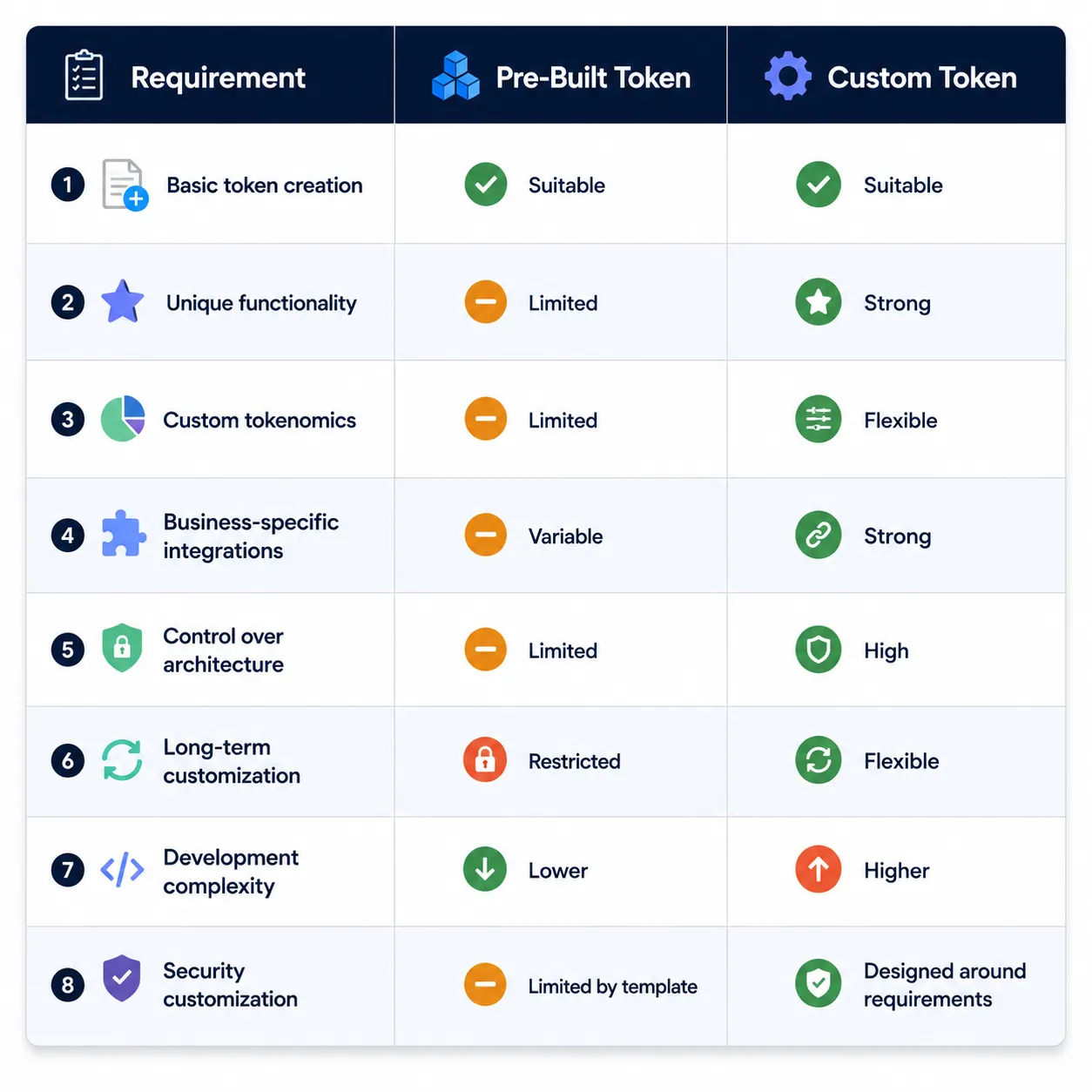
The key question is not simply “Which option costs less?” It is “How important is the token to the business model?”
If the token is only an experimental asset, a pre-built solution may be sufficient. If it is expected to power payments, rewards, governance, ownership, fundraising, or a broader Web3 ecosystem, custom development can provide greater control over the underlying infrastructure.
Conclusion
Choosing between custom token development and a pre-built token solution requires a clear understanding of the project's long-term objectives. Ready-made solutions offer simplicity and speed for basic requirements, but their fixed architecture can become restrictive as business needs become more complex.
Custom development provides greater control over token functionality, tokenomics, security, blockchain selection, integrations, and future expansion. It also allows the token to be designed as part of the wider product rather than as a standalone contract.
At Blockchain App Factory, custom token development can be structured around a project's specific use case, technical requirements, economic model, and deployment strategy. For businesses treating their token as a core part of a long-term blockchain ecosystem, that level of control can be more valuable than the initial convenience of a pre-built solution.





























Sign in to leave a comment.