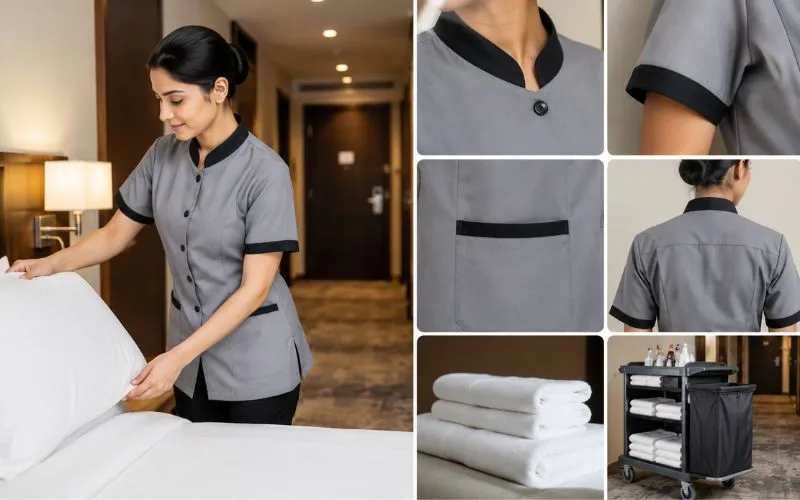

When businesses invest in uniforms, fabric selection often receives less attention than design, branding, or pricing. That decision can create problems later, especially in the UAE.
The reality is simple. A fabric that performs well in Europe, North America, or cooler regions may not perform well in the UAE's climate. High temperatures, humidity, direct sunlight, and demanding work environments place unique demands on workwear.
As a Uniform Manufacturer, we've seen many businesses focus heavily on appearance while overlooking how fabrics perform during daily operations. Most businesses only realize this after employee complaints start.
Workers spend entire shifts wearing these garments. If the fabric is uncomfortable, heavy, poorly ventilated, or difficult to maintain, the problems quickly become noticeable across the workforce.
Choosing the right fabric is not just about comfort. It affects productivity, durability, safety, replacement costs, and the overall success of a uniform program.
Why Fabric Choice Matters More in the UAE
The UAE climate creates challenges that businesses cannot ignore.
Outdoor workers often face temperatures exceeding 40°C during large parts of the year. Even employees who spend time indoors frequently move between air-conditioned environments and outdoor spaces throughout the day.
Construction crews, logistics teams, transportation staff, security personnel, maintenance technicians, hospitality workers, and delivery drivers all experience these conditions differently.
Many companies overlook this.
They select fabrics based on appearance or initial cost without considering how employees actually use the uniforms.
A fabric that traps heat can lead to discomfort, fatigue, and reduced productivity. Employees may become distracted, frustrated, or less willing to wear uniforms correctly.
A small detail like this can have a big impact on daily operations.

Cotton Remains a Popular Choice
Cotton continues to be one of the most widely used fabrics for workwear in the UAE.
There is a good reason for that.
Cotton offers excellent breathability and feels comfortable against the skin. It allows air circulation, helping employees stay cooler during long shifts.
This makes it particularly suitable for industries such as hospitality, healthcare, retail, and corporate offices where comfort plays a significant role in employee satisfaction.
The Limitation of Pure Cotton
Pure cotton is not always the perfect solution.
While comfortable, it can absorb moisture and take longer to dry. Employees working outdoors may find heavily soaked cotton uniforms uncomfortable during humid conditions.
Cotton can also shrink or lose shape if not properly maintained.
This is where fabric selection becomes more nuanced. Businesses should evaluate both comfort and long-term performance rather than focusing on a single benefit.
Polyester-Cotton Blends Offer Balance
For many businesses, polyester-cotton blends provide one of the most practical solutions.
These fabrics combine the comfort of cotton with the durability of polyester.
The result is a garment that holds its shape better, resists wrinkles, and typically lasts longer through repeated washing cycles.
This is especially useful in industries where uniforms face heavy daily use.
Logistics companies, transportation businesses, warehouse operations, and manufacturing facilities often benefit from these blended fabrics because they offer a balance between comfort and durability.
Lower Maintenance Requirements
Uniform maintenance is often overlooked during purchasing decisions.
This is where uniform purchasing often becomes expensive.
A lower-cost fabric may require more frequent replacements, specialized cleaning, or additional maintenance over time.
Polyester-cotton blends generally require less ironing, dry faster, and maintain a professional appearance longer than many alternatives.
For organizations managing hundreds of uniforms, these savings can become significant.
Moisture-Wicking Fabrics for Active Roles
Some jobs require employees to remain physically active throughout their shifts.
Delivery personnel. Security teams. Warehouse staff. Field technicians. Transportation workers.
In these environments, moisture management becomes important.
Modern moisture-wicking fabrics are designed to move sweat away from the body and promote faster evaporation. Employees stay drier and more comfortable throughout the day.
Most businesses only realize this after employee complaints start.
Workers who spend hours moving between indoor and outdoor environments quickly notice when uniforms trap moisture and heat.
Comfort directly influences employee acceptance of uniform policies.
Fabric Durability Should Match the Job
Not every employee needs the same type of fabric.
This is a common mistake.
Some companies attempt to use a single fabric across all departments because it simplifies purchasing.
In practice, different roles create different demands.
Construction and Industrial Environments
Construction sites and industrial facilities require fabrics capable of handling constant wear and tear.
Workers frequently kneel, lift equipment, move materials, and work around rough surfaces.
Lightweight fabrics may feel comfortable initially but wear out quickly under these conditions.
Durability becomes a major factor in controlling long-term replacement costs.
Healthcare and Hospitality Environments
Healthcare professionals and hospitality staff have different priorities.
These environments often require garments that maintain a clean, professional appearance while remaining comfortable during long shifts.
Frequent laundering becomes part of daily operations.
Fabric selection should focus on maintaining color, shape, and appearance after repeated washing.
Safety Compliance Cannot Be Ignored
In some industries, fabric selection goes beyond comfort and appearance.
Safety requirements become mandatory.
Manufacturing facilities, construction companies, utility providers, transportation operators, and industrial operations may require specialized workwear materials.
Flame-resistant fabrics, high-visibility garments, reflective materials, and protective textiles may be necessary depending on workplace conditions.
Many businesses focus heavily on branding discussions while giving less attention to compliance requirements.
That approach creates unnecessary risk.
The best-looking uniform provides little value if it fails to meet workplace safety standards.
Color Retention and Brand Consistency
Brand consistency is often discussed during uniform design meetings.
The fabric itself plays a major role in maintaining that consistency.
Poor-quality fabrics tend to fade faster under strong sunlight and repeated washing.
The UAE climate accelerates this process, particularly for employees who spend substantial time outdoors.
A faded logo or inconsistent color may seem like a minor issue.
Over time, however, it affects brand presentation.
Customers notice these details.
Businesses should evaluate how fabrics perform after extended exposure to sunlight, frequent washing, and daily use.
Consider Long-Term Cost Rather Than Purchase Price
One of the biggest mistakes businesses make is evaluating fabrics based only on initial pricing.
The cheapest fabric is rarely the cheapest option over time.
A uniform that requires frequent replacement generates additional purchasing costs, administrative effort, and operational disruption.
Many procurement teams discover this after the first year of a uniform program.
Higher-quality fabrics often remain in service significantly longer, reducing replacement frequency and improving overall value.
When evaluating fabric options, businesses should consider:
- Expected garment lifespan
- Maintenance requirements
- Employee comfort
- Replacement frequency
- Workplace suitability
- Brand appearance retention
Looking beyond purchase price usually leads to better decisions.
Testing Before Full Deployment
One practice that consistently produces better results is fabric testing.
Before placing a large order, provide sample garments to employees in different departments.
Allow them to wear the uniforms during normal work activities.
Feedback from real users often reveals issues that are difficult to identify during supplier presentations.
Employees can quickly identify problems related to comfort, flexibility, heat retention, durability, and fit.
The feedback gathered during this stage often prevents costly mistakes later.
Final Thoughts
Selecting workwear fabrics for the UAE climate requires more than choosing materials that look professional. Comfort, durability, safety, maintenance requirements, and climate suitability all play important roles in how uniforms perform over time.
Cotton remains a strong option for many environments, while polyester-cotton blends often provide a practical balance between comfort and durability. Moisture-wicking materials can improve employee comfort in physically demanding roles, and specialized fabrics may be necessary where safety compliance is required.
The most successful uniform programs usually begin with a simple question: how will these garments perform during a normal workday? Businesses that focus on real working conditions rather than appearance alone tend to achieve better employee satisfaction, stronger brand presentation, lower replacement costs, and a more reliable long-term uniform investment.

























Sign in to leave a comment.