
Modern software users expect frequent updates, faster feature releases, and reliable application performance. However, manual code integration and deployment often lead to delays, deployment failures, and inconsistent software quality. As software development teams grow and release cycles become shorter, these challenges can slow innovation and increase operational risks.
A CI/CD pipeline addresses these issues by automating the process of integrating, testing, and deploying code changes. It enables development teams to deliver software updates more quickly, detect issues earlier, and maintain a consistent release process. Many businesses also partner with a DevOps services company to implement and optimize CI/CD pipelines that align with their development and deployment goals. In this guide, you'll learn what a CI/CD pipeline is, how it works, the difference between Continuous Integration, Continuous Delivery, and Continuous Deployment, and why it has become an essential practice in modern software development.
What Is a CI/CD Pipeline?
A CI/CD pipeline is an automated process that integrates code changes, runs automated tests, and deploys applications efficiently. It helps teams release software faster, improve quality, and reduce deployment risks. According to Google Cloud's DORA research, elite software delivery teams deploy code 973 times more frequently than low-performing teams while achieving significantly faster recovery from failures.
CI/CD consists of three key practices:
- Continuous Integration (CI): Developers regularly merge code into a shared repository, where automated builds and tests detect issues early.
- Continuous Delivery (CD): Validated code is always deployment-ready, with production releases requiring manual approval.
- Continuous Deployment: Successfully tested code is automatically deployed to production without manual intervention.
Together, these practices streamline software delivery, enabling faster, more reliable, and consistent releases.
How Does a CI/CD Pipeline Work?
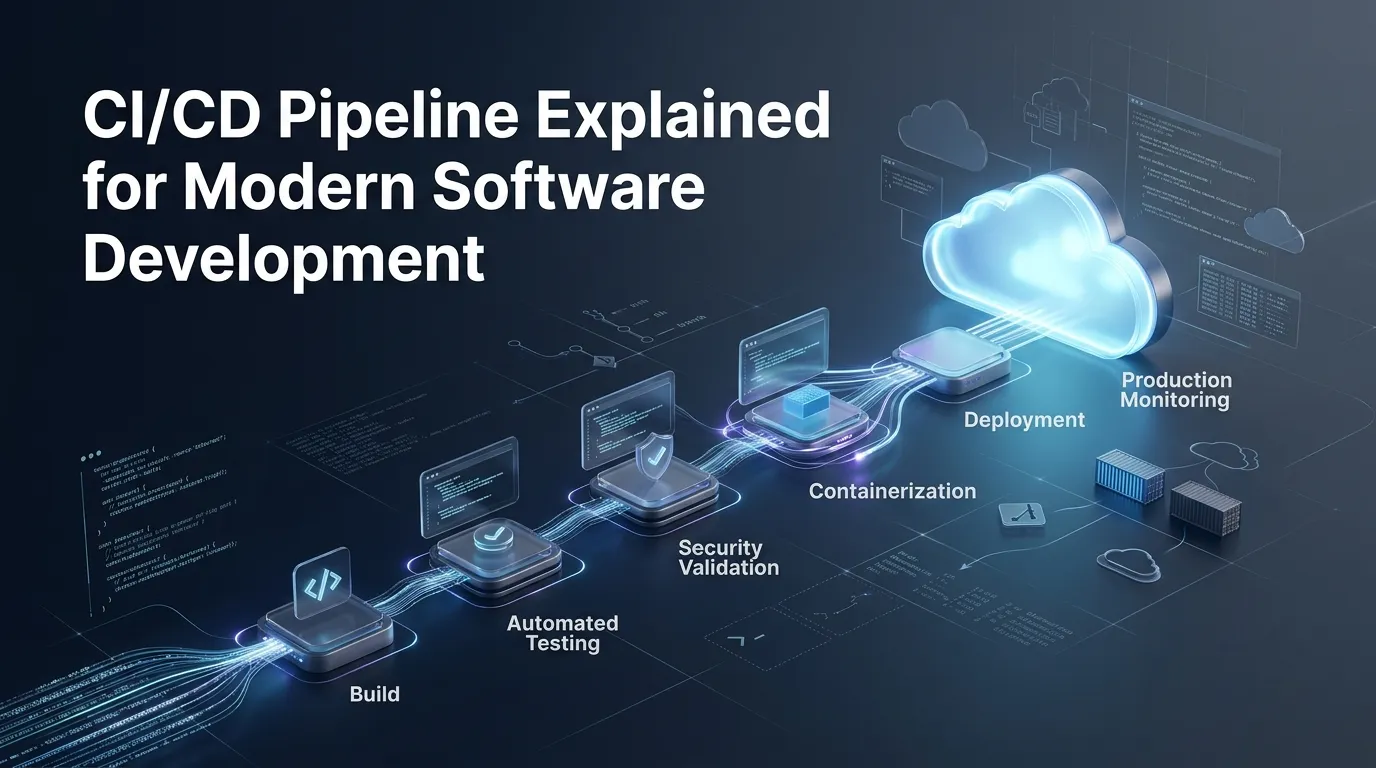
A CI/CD pipeline follows a sequence of automated stages that validate, test, and deploy every code change. Each stage ensures that only reliable and production-ready code moves to the next step.
- Code Development: Developers write new features, enhancements, or bug fixes and commit the code to a version control system, automatically triggering the pipeline.
- Automated Build: The pipeline compiles the code, installs dependencies, and creates a deployable application package while immediately reporting any build failures.
- Automated Testing: Unit, integration, functional, and regression tests run automatically to detect defects early and ensure application quality.
- Security and Quality Validation: Automated security scans and code quality checks identify vulnerabilities, dependency risks, and coding issues before deployment.
- Deployment: After successful validation, the application is deployed to staging or production. Continuous Delivery requires manual approval, while Continuous Deployment releases updates automatically.
Benefits of a CI/CD Pipeline For Software Development
A CI/CD pipeline goes beyond automating software delivery. It helps businesses release applications faster, improve software quality, and reduce operational risks. Google Cloud's DORA research identifies deployment frequency, lead time for changes, change failure rate, and time to restore service as the industry-standard metrics for measuring DevOps performance.
- Faster Software Releases: Automating build, testing, and deployment accelerates release cycles, enabling teams to deliver new features and updates more quickly.
- Improved Software Quality: Automated testing validates every code change, helping identify defects early and ensuring more reliable software releases.
- Reduced Deployment Risks: Standardized deployment workflows minimize human errors and improve the consistency of software releases.
- Faster Bug Resolution: Continuous integration makes it easier to detect, isolate, and fix issues before they affect end users.
- Higher Team Productivity: Automation reduces repetitive manual tasks, allowing development teams to focus on building valuable product features.
- Better Scalability: CI/CD pipelines support growing applications and larger development teams by streamlining software delivery at scale.
Common CI/CD Tools
The right CI/CD tool depends on your technology stack, cloud environment, and deployment requirements. The following platforms are among the most widely used in modern software development.
| Tool | Best For | Key Strength |
| Jenkins | Enterprise applications | Highly customizable with extensive plugin support |
| GitHub Actions | GitHub-based projects | Native integration with GitHub repositories |
| GitLab CI/CD | End-to-end DevOps | Built-in CI/CD, source control, and security features |
| CircleCI | Cloud-native applications | Fast cloud-based build and deployment automation |
| Azure DevOps | Microsoft ecosystem | Integrated development, testing, and deployment services |
Best Practices for Building an Effective CI/CD Pipeline
Implementing a CI/CD pipeline requires more than selecting the right tools. Following these best practices helps ensure secure, reliable, and efficient software delivery.
- Automate Testing: Run unit, integration, and regression tests with intelligent automation to detect issues early, improve software quality, and accelerate release cycles.
- Secure Secrets and Credentials: Store API keys, passwords, and access tokens in secure secret management solutions instead of embedding them in source code.
- Keep Deployments Small and Frequent: Release smaller updates regularly to simplify testing, reduce deployment risks, and enable faster rollbacks.
- Monitor Every Deployment: Continuously track application performance, system health, and error rates to quickly identify and resolve issues.
- Implement Rollback Strategies: Use automated rollback mechanisms to restore a stable version if a deployment causes unexpected problems.
- Standardize Infrastructure: Adopt Infrastructure as Code (IaC) to maintain consistent environments and minimize configuration-related deployment errors.
Conclusion
A CI/CD pipeline has become a fundamental part of modern software development. By automating code integration, testing, and deployment, it enables teams to deliver high-quality software faster while reducing manual effort and deployment risks.
Whether you're building a new digital product or modernizing an existing application, adopting CI/CD helps improve release consistency, accelerate innovation, and support long-term business growth. At RipenApps, we help businesses implement modern development practices and scalable software solutions that streamline delivery, improve operational efficiency, and accelerate digital transformation.
Frequently Asked Questions
1. What is the purpose of a CI/CD pipeline?
A CI/CD pipeline automates code integration, testing, and deployment, enabling teams to deliver software updates faster, improve quality, and reduce deployment errors.
2. What is the difference between Continuous Delivery and Continuous Deployment?
Continuous Delivery prepares software for release but requires manual approval before deployment. Continuous Deployment automatically releases validated code to production without manual intervention.
3. Which tools are commonly used for CI/CD?
Popular CI/CD tools include Jenkins, GitHub Actions, GitLab CI/CD, CircleCI, and Azure DevOps. The right choice depends on your development environment and deployment requirements.
4. Why is CI/CD important for modern software development?
CI/CD improves development speed, enhances software quality, reduces deployment risks, and enables organizations to release features and updates more frequently.
5. Can small businesses benefit from implementing a CI/CD pipeline?
Yes. Even small development teams can use CI/CD to automate repetitive tasks, improve collaboration, accelerate software releases, and maintain consistent deployment processes as their applications grow.




























Sign in to leave a comment.