RAG vs Fine-Tuning: Which AI Approach Delivers Better Results?

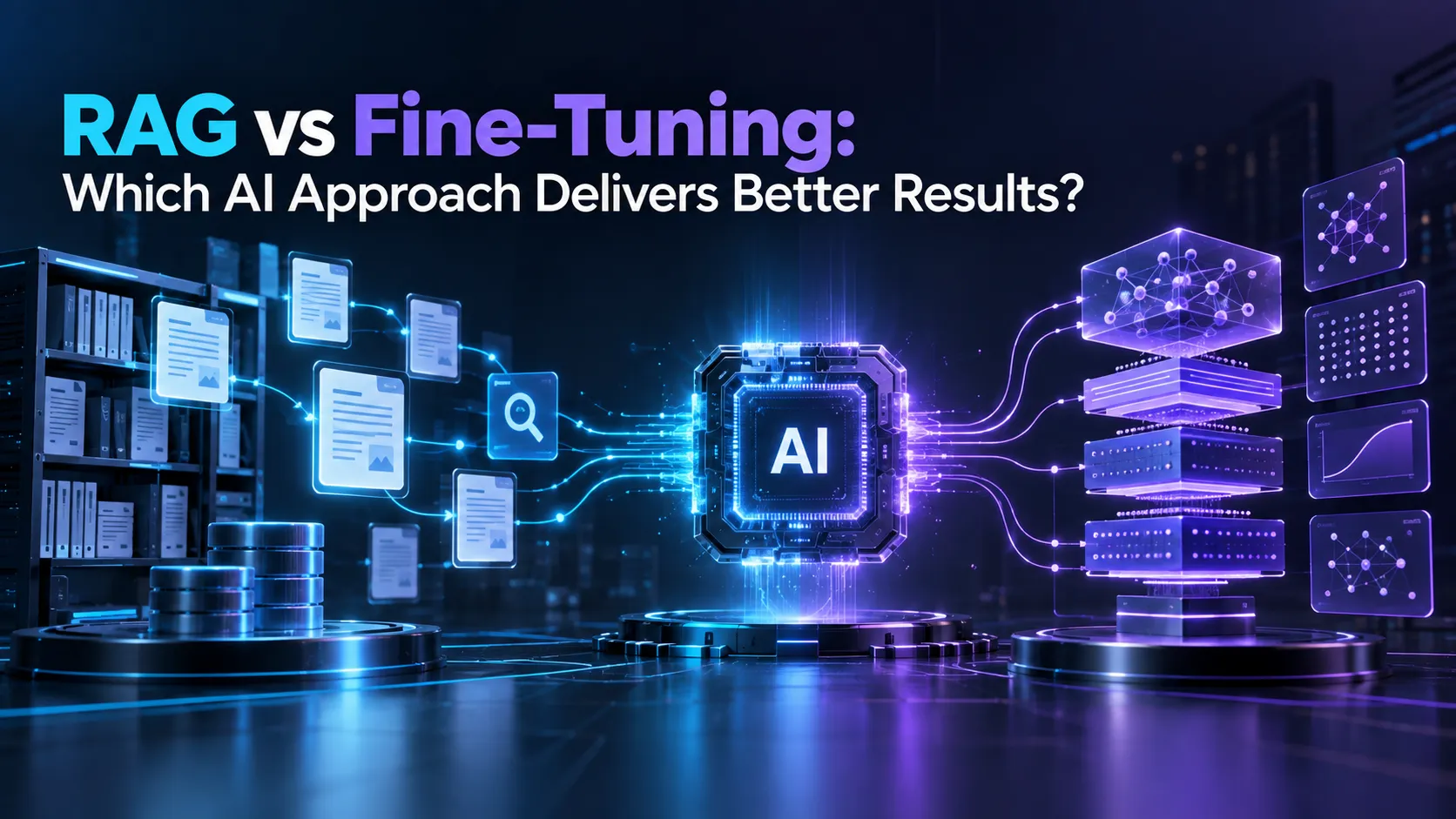
Building an AI-powered application often raises an important question: Should you use Retrieval-Augmented Generation (RAG) or fine-tune an AI model? Both approaches can improve AI performance, but they solve different problems. Choosing the right one depends on your data, use case, accuracy requirements, budget, and how frequently your information changes.
RAG allows an AI application to retrieve relevant information from external sources before generating a response. Fine-tuning, on the other hand, further trains an existing AI model on a specialized dataset to influence how it behaves and responds. In some cases, businesses may even combine both approaches to create a more capable AI solution.
What is RAG?
Retrieval-Augmented Generation, commonly called RAG, connects a generative AI model with an external knowledge source. Instead of relying entirely on information learned during its original training, the model retrieves relevant information from a connected database, document collection, knowledge base, or other data source and uses that information to generate a response.
This approach is particularly useful for businesses that need AI to work with private or frequently changing information. For example, an enterprise chatbot could retrieve information from internal company policies before answering an employee's question. If those policies change, the knowledge base can be updated without retraining the underlying AI model.
RAG can therefore make AI applications more grounded in specific business information while providing a practical way to manage changing knowledge.
What is Fine-Tuning?
Fine-tuning involves taking a pre-trained AI model and training it further using a specialized dataset. Rather than simply giving the model access to additional information at the time of generating a response, fine-tuning changes the model's learned behavior based on the examples provided during training.
Businesses can use fine-tuning when they want an AI system to consistently follow a particular communication style, output structure, terminology, or task-specific pattern. For instance, a company could fine-tune a model to generate responses in a particular brand voice or consistently classify customer requests according to predefined categories.
The important distinction is that fine-tuning primarily changes how the model behaves, while RAG primarily changes what information the model can access.
RAG vs Fine-Tuning: Understanding the Difference
RAG and fine-tuning are often discussed as competing approaches, but they address different challenges. RAG is primarily concerned with providing relevant and up-to-date context to a model. Fine-tuning is focused on adapting the model itself to perform a particular task or follow specific behavioral patterns.
RAG is especially useful when information changes regularly because businesses can update the connected knowledge source without retraining the model. Fine-tuning is less suitable for this purpose because new information generally requires additional training if the goal is to incorporate it into the model's learned behavior.
RAG can also be a strong option when an AI application needs to work with proprietary business information. Fine-tuning, meanwhile, becomes more useful when the primary requirement is consistent output, specialized behavior, or task performance.
When Should You Choose RAG?
RAG is a strong choice when an AI application needs access to information that is external to the model and may change over time. This could include product information, company policies, technical documentation, customer records, internal knowledge bases, or frequently updated databases.
Consider an ecommerce application where an AI assistant answers questions about products. Prices, availability, specifications, and inventory can change frequently. Training these changes into an AI model would not be practical. With RAG, the application can retrieve the latest information from its data source and provide that context to the model before generating an answer.
RAG is also useful for enterprise applications that need to work with private documents. Instead of expecting the model to already know a company's internal information, the application can retrieve relevant content from authorized sources when a user asks a question.
This makes RAG particularly suitable for knowledge-based assistants, customer support applications, document analysis platforms, internal search systems, and other applications where factual grounding is important.
When Should You Choose Fine-Tuning?
Fine-tuning is more appropriate when the challenge is not simply providing the model with information but teaching it to respond in a particular way.
For example, a business may want an AI system to consistently produce responses in a specific format. It may also need the model to follow specialized terminology or perform a repetitive classification or generation task. A carefully prepared fine-tuning dataset can help the model learn these patterns.
Fine-tuning can also be useful when a business has a large collection of high-quality examples demonstrating exactly how the model should behave. Instead of repeatedly explaining the desired behavior through prompts, fine-tuning can make those patterns part of the model's learned behavior. Choosing the right partner can also help businesses determine whether fine-tuning is the right approach and how to implement it effectively.
However, fine-tuning should not automatically be considered a replacement for a knowledge retrieval system. If the application's information changes frequently, RAG may still be necessary to provide access to current information.
How to Choose the Right AI Approach
The right choice starts with identifying the actual problem your AI application needs to solve. If the main challenge is giving the model access to current, private, or domain-specific information, RAG is likely to be the more suitable approach. If the challenge is getting the model to consistently follow a specific style, format, task pattern, or behavior, fine-tuning may provide greater value.
In some applications, the best architecture may involve both. RAG can handle dynamic knowledge while fine-tuning handles specialized behavior. The decision should ultimately be based on factors such as data quality, information freshness, application complexity, expected usage, response accuracy, scalability, and long-term maintenance requirements.
Conclusion
RAG and fine-tuning are not simply two competing ways to improve AI applications. They solve different problems and can work independently or together. RAG is generally better suited for applications that need access to dynamic, private, or frequently updated information, while fine-tuning is more appropriate when businesses need to customize model behavior, style, formatting, or task performance.
For many knowledge-intensive applications, RAG can provide a practical starting point because businesses can update their information without retraining the underlying model. Fine-tuning can then be introduced when the application requires deeper behavioral customization.
The best approach ultimately depends on the application's goals, data, users, and technical requirements. Working with an experienced team offering generative AI development services can help businesses evaluate these factors and build an AI architecture that balances accuracy, scalability, performance, and cost.
FAQs
1. Is RAG better than fine-tuning?
Neither approach is universally better. RAG is generally better when an AI application needs access to current or proprietary information, while fine-tuning is more suitable for specialized behavior, formatting, and task-specific performance.
2. Does RAG reduce AI hallucinations?
RAG can help reduce hallucinations by providing the model with relevant information from trusted sources before it generates a response. However, the quality of retrieval and the overall system design strongly influence the final result.
3. Is fine-tuning more expensive than RAG?
The cost depends on the application's requirements. Fine-tuning involves training and model-management costs, while RAG requires retrieval infrastructure and ongoing knowledge-base management. Businesses should compare the total cost of implementing and maintaining each approach.
4. Can RAG and fine-tuning be used together?
Yes. RAG can provide current and proprietary information, while fine-tuning can help the model follow specific behavioral, formatting, or communication patterns. Combining them can be useful for complex enterprise AI applications.
5. Which approach should a business implement first?
For many knowledge-intensive applications, RAG is a practical starting point because information can be updated without retraining the model. Fine-tuning can be considered later if the application requires more specialized behavior or consistent task performance.








Sign in to leave a comment.