
Introduction
Healthcare establishments play a crucial role in providing quality medical services to patients. To maintain transparency, standardisation, and accountability in healthcare services, the Government of India introduced the Clinical Establishments (Registration and Regulation) Act, 2010.
Under this Act, hospitals, clinics, diagnostic centres, nursing homes, and other healthcare facilities may require registration with the concerned authority to legally operate and ensure compliance with prescribed standards.
If you are planning to start a healthcare facility or already running one, obtaining a Clinical Establishment Registration Certificate helps establish credibility and ensures regulatory compliance.
What is Clinical Establishment Registration
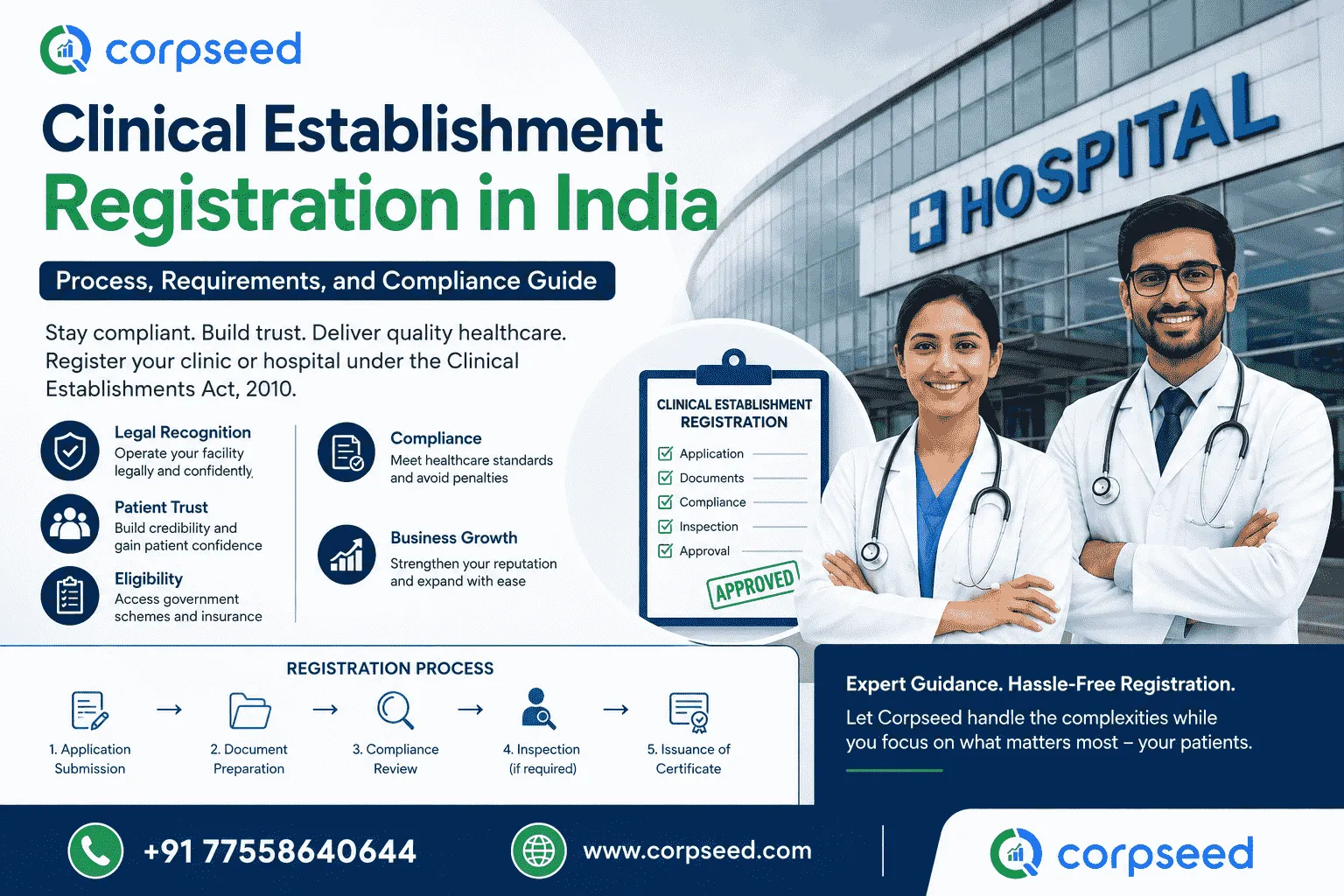
The Clinical Establishment Registration is a compulsory requirement for eligible healthcare providers per the Clinical Establishments (Registration and Regulation) Act of 2010.
The process of registration allows government authorities to keep track of healthcare establishments and ensure compliance with the minimum standard regarding infrastructure, service, equipment, and patient care.
Once registered as a clinical establishment, the provider will receive a Clinical Establishment Certificate that serves as proof of successful registration completion by the facility.
Why is Clinical Establishment Registration Required
Healthcare services directly impact public health, making regulatory compliance extremely important.
Clinical Establishment Registration helps:
1. Guarantees High Standards of Medical Care
Registration confirms the compliance of medical institutions with the required norms concerning:
* Infrastructure
* Equipment
* Specialists
* Patient safety
2. Earning Patients’ Confidence
Availability of a Clinical Establishment Certificate gives patients peace of mind as it indicates that the medical facility is operating according to the legislation.
3. Legal Status of the Medical Institution
Being registered allows hospitals, clinics, and diagnostic centers operating according to the existing legislation to enjoy legal existence.
4. Prevention of Legal Problems
Delivering medical services without registration can bring about penalties and compliance issues according to the state regulations.
Who Needs Clinical Establishment Registration
Clinical Establishment Registration may apply to different types of healthcare facilities, including:
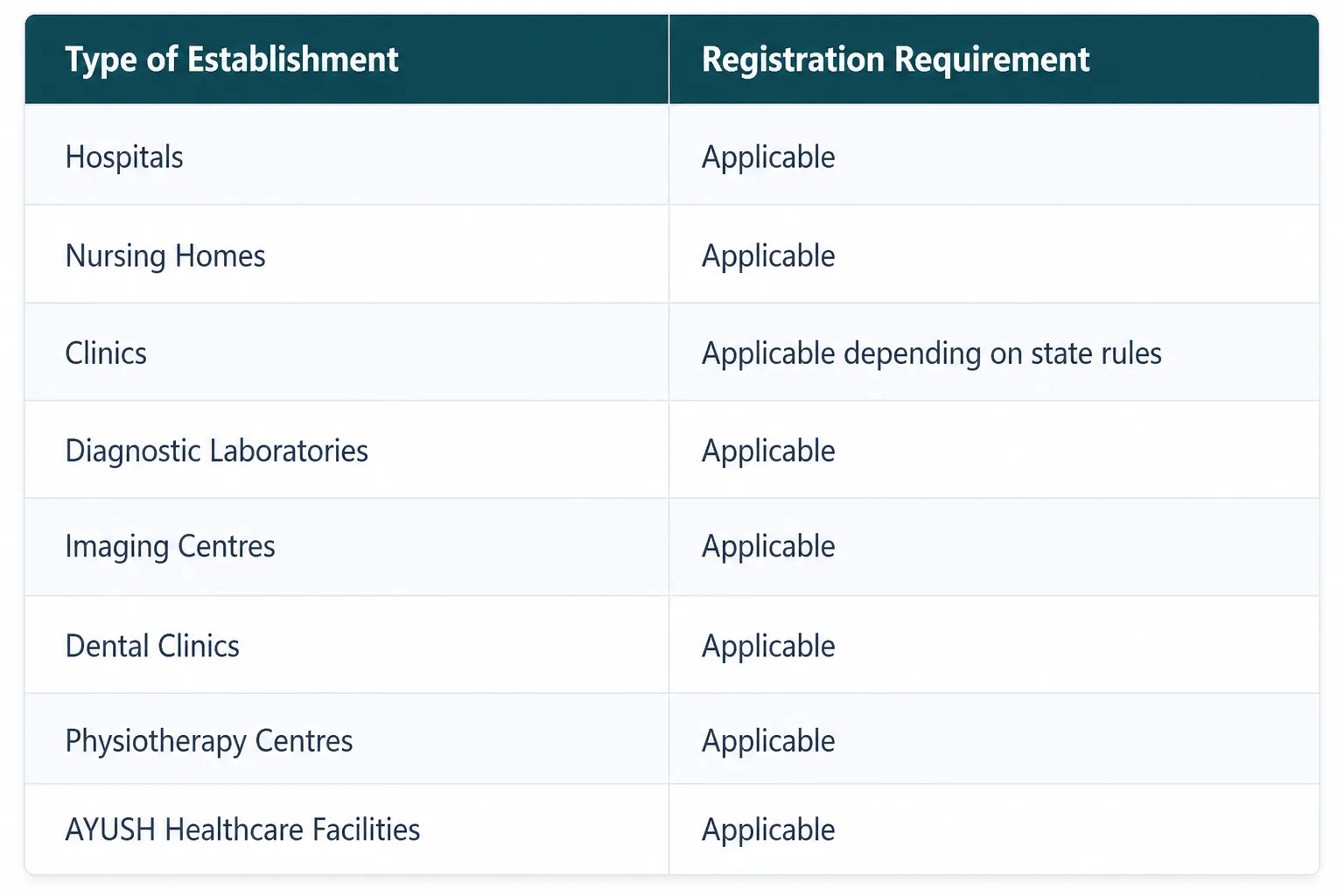
The applicability depends on whether the state has adopted and implemented the Clinical Establishments Act or follows separate healthcare establishment regulations.
Clinical Establishment Registration Process Online
The steps involved in acquiring the Clinical Establishment Certificate are as follows:
Step 1: Check Eligibility Requirements
The applicant must ascertain whether the healthcare institution falls in the category for which registration is mandatory.
The applicant should check the following:
- Type of healthcare institution
- Applicable state laws
- Minimum facility requirements
- Service to be provided
Step 2: Arrange Necessary Documents
The applicant must arrange all relevant documents in respect of:
- Establishment details
- Ownership information
- Healthcare professionals
- Infrastructure
- Medical services provided
Step 3: File Online Application
The application for registration is submitted through relevant state health authority or Clinical Establishments portal.
The applicant should submit complete and correct information regarding:
- Facility details
- Medical services
- Staff information
- Contact details
Step 4: Verification and Inspection
The concerned authority may verify the information submitted and inspect the establishment in order to check whether it is conforming to the required standards.
Step 5: Receive Clinical Establishment Certificate
Upon successful verification and approval, the concerned authority issues the Clinical Establishment Registration Certificate.
Documents Required for Clinical Establishment Registration
The documents required may vary depending on the state and type of healthcare facility. Commonly required documents include:
Basic Documents
- PAN Card of applicant/entity
- Aadhaar Card or identity proof
- Address proof of establishment
- Ownership proof or rent agreement
- Registration certificate of business entity
Healthcare Facility Documents
- Details of healthcare services provided
- Infrastructure details
- List of medical equipment
- Details of doctors and healthcare professionals
- Qualification certificates of medical staff
Additional Compliance Documents
- Biomedical Waste Management Authorization
- Fire Safety Certificate (if applicable)
- Local authority approvals
- Electricity and water connection details
Validity and Renewal of Clinical Establishment Certificate
The validity period of a Clinical Establishment Certificate depends on the applicable state rules and registration category.
Healthcare establishments must ensure timely renewal to continue operations without compliance issues.
Late renewal or failure to maintain registration may lead to penalties or restrictions.
Difference Between Clinical Establishment Registration and Other Healthcare Licenses
Many healthcare providers confuse Clinical Establishment Registration with other approvals.
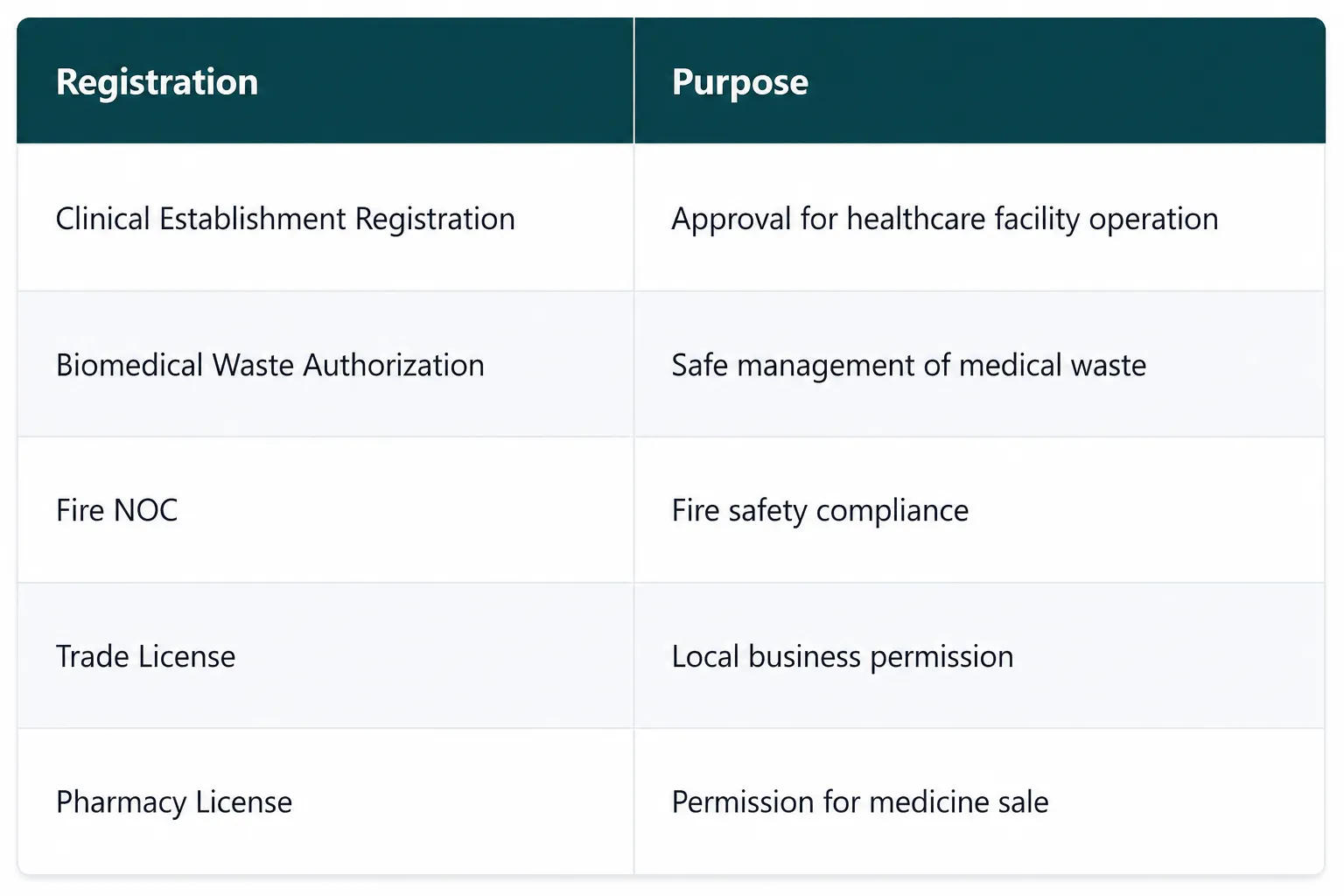
Healthcare facilities may require multiple approvals depending on their activities.
Frequently Asked Questions
1. What is Clinical Establishment Registration?
A document like Clinical Establishment Registration acts as a license that is issued by the regulatory body to only those health facilities which are allowed/fit to function and maintain a certain level of health care standards.
2. Is Clinical Establishment Registration mandatory in India?
It's only applicable to healthcare providers who meet the qualifications that are determined by the Clinical Establishments Act and that have been enforced (or that are subject to similar regulations) in the states of India.
3. Who needs a Clinical Establishment Certificate?
The list might include hospitals clinics, diagnostic labs/nuclear medicine departments or departments such as radiology, etc. laboratories nursing homes, etc. and other healthcare providers.
4. How can I apply for Clinical Establishment Registration online?
The applicants can apply via the pertinent state portal or Clinical Establishments portal by providing necessary details and documents.
5. What documents are required for Clinical Establishment Registration?
These common documents include identity proof, establishment address proof, ownership proof, healthcare professional's information, infrastructure information, and supporting compliance documents.
6. How long does Clinical Establishment Registration take?
Registration takes time given the quality of documents, government verification, inspection requirements, and state procedures
3. How do I renew a clinical establishment certificate?
Log into your state health department's portal before expiry, update any changed documents, and pay the renewal fee to receive an updated certificate.
4. What is the Clinical Establishment Act registration in Tamil Nadu?
It's Tamil Nadu's state-administered version of the central Act, requiring hospitals and clinics to register and renew through the state health department's online portal.
5. How does Tamil Nadu clinical establishment renewal online work?
Log into the Tamil Nadu health portal, verify existing registration details, submit updated documents, and pay the renewal fee before the certificate expires.
6. How does hospital registration renewal online work in UP?
Renewal is done through Uttar Pradesh's state health department portal, with close verification of bio-medical waste and facility compliance documents.
7. What is medical establishment registration in UP?
It's the mandatory state-level registration for hospitals and clinics operating in Uttar Pradesh under the Clinical Establishments Act framework.
8. How can I track my clinical establishment application?
Most state portals provide a login using your application reference number to check real-time status, from document review to final approval.
9. What is the clinical establishment license process in West Bengal?
West Bengal registers and renews clinical establishments through its own state health authority portal, with active enforcement against unregistered facilities.
10. What is the Clinical Establishment Act in Kerala?
Kerala enforces the Act on hospitals, clinics, and diagnostic labs through its state health department, with close scrutiny on staff qualifications and facility standards.
Conclusion
Clinical Establishment Registration is one of the compliance requirements that healthcare facilities must meet to run their operations transparently and also meet the regulations.
To build trust, avoid fines, and have your operations run smoothly, it is necessary for all the operators, be it a hospital, the clinic, diagnostic labs, or any other healthcare establishments, to go through the registration process.
Corpseed is a company that helps healthcare professionals carry out the Clinical Establishment Registration Online process with expert help, support for documentation, and guidance that will ensure that all necessary compliance standards are met.



























Sign in to leave a comment.