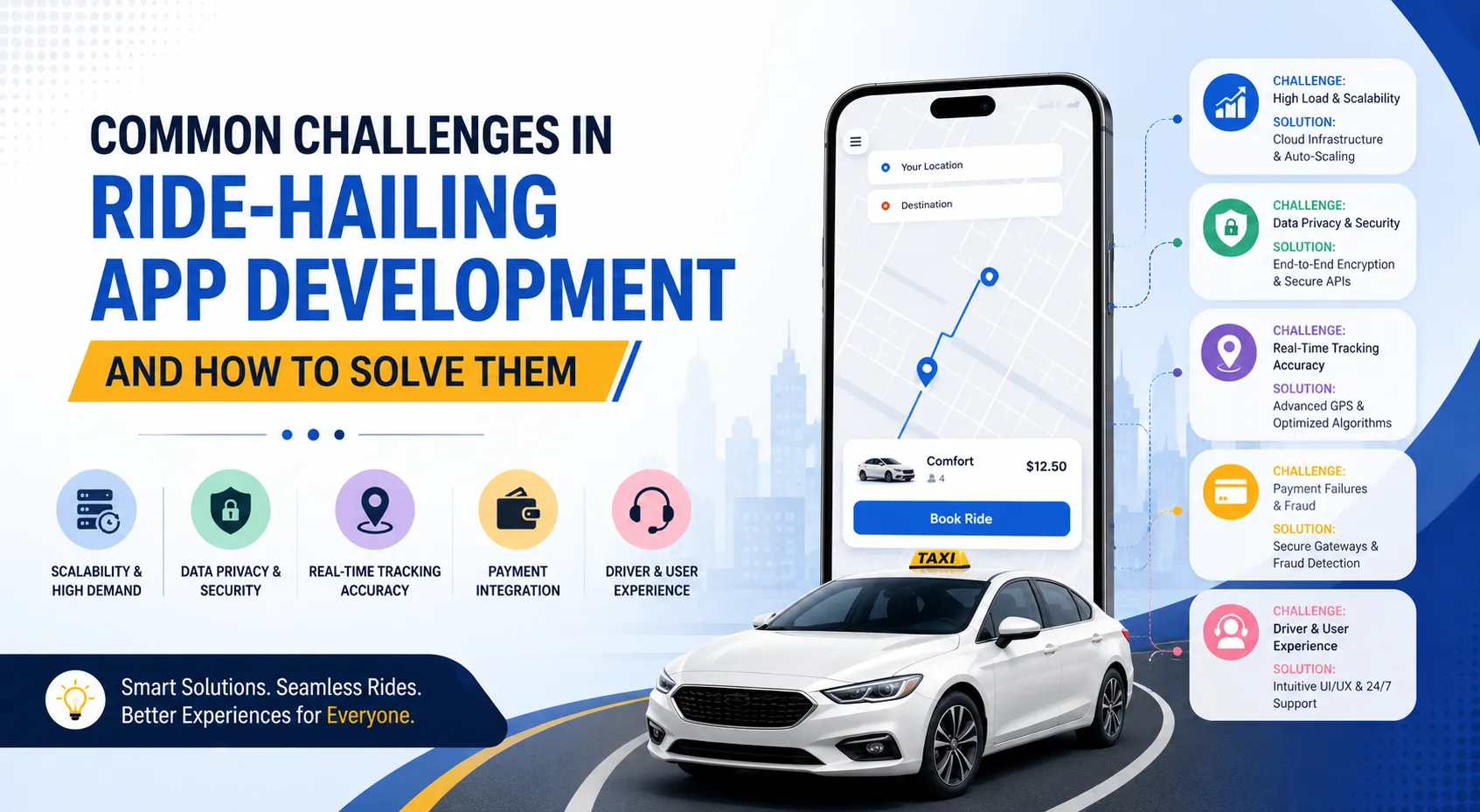

Every founder who's built a ride-hailing platform will tell you the same thing: the idea is the easy part. The hard part is everything that happens between "let's build this" and a platform that actually works reliably at scale. The challenges in ride-hailing app development aren't obvious until you're in them. And by the time most teams discover them, they've already made decisions that are expensive to undo. Here's what to expect and how to handle it before it handles you.
Understanding the Challenges of Ride-Hailing App Development
Ride-hailing platforms are operationally complex in a way most apps aren't. You're not just serving users — you're coordinating two sides of a live marketplace in real time, across moving vehicles, variable demand, multiple payment methods, and regulatory environments that differ city by city.
Each of those dimensions introduces failure points. The teams that build successful on-demand transportation platforms are the ones who identified those failure points early and engineered around them, rather than discovering them after launch.
Real-Time Location Tracking Issues
Live GPS tracking sounds straightforward. In practice, it's one of the hardest engineering problems on the platform. Every active driver is sending continuous location pings to your server. At 500 concurrent drivers, that's thousands of data points per minute flowing through your system, being processed, stored, and rendered on rider screens in near real time. Any lag in that pipeline — server processing delay, weak WebSocket connection, inefficient geospatial query shows up as a frozen map or an incorrect ETA. Users notice immediately.
The fix starts at the architecture level. WebSocket connections for continuous location streaming rather than repeated HTTP polling. Geospatial databases like PostGIS optimized for location queries. Server-side filtering so only relevant location updates are pushed to each rider. Battery optimization on the driver app so GPS accuracy doesn't degrade when the device throttles background processes.
Building a reliable real-time ride tracking system is an engineering achievement, not a default outcome. It's also one of the core reasons businesses choose a proven ride-hailing app development partner over starting from scratch.
Managing High User Traffic and Scalability
Ride-hailing demand doesn't arrive evenly. It spikes — hard — during morning commutes, evening rush hours, rain, concerts, and local events. Your taxi booking platform needs to handle ten times normal load without degrading, and then scale back down without waste.
Monolithic architectures fail here. When everything is one system, one overloaded component takes down the whole platform.
Microservices architecture solves this by allowing individual components — dispatch, payments, notifications, tracking to scale independently. Cloud auto-scaling on AWS or Google Cloud handles the infrastructure side automatically. Load testing before launch is non-negotiable. Simulate peak traffic conditions before real users experience them. Discover where the system buckles in a test environment, not in production at 8 AM on a Monday.
Ensuring Data Security and User Privacy
Ride-hailing platforms collect genuinely sensitive data. Home addresses, workplace locations, movement history, payment details, phone numbers — this is the kind of data that makes a breach seriously damaging, legally and reputationally. AES-256 encryption for stored data. SSL/TLS for everything in transit. JWT authentication with short-lived tokens. Role-based access controls so internal teams only access what they need. Regular security audits and penetration testing.
Number masking for in-app calls between riders and drivers is also a data protection measure, not just a privacy feature — it prevents personal contact details from being exchanged outside the ride-sharing application.
The cost of getting security right is a fraction of the cost of getting it wrong.
Integrating Secure Payment Systems
Payment failure at the end of a trip is the worst possible moment for your on-demand mobility platform to let a user down. They're tired, they're in a hurry, and a failed transaction is the last thing they want to deal with.
Reliable payment integration means more than just connecting a gateway. It means handling network timeouts gracefully, building fallback payment method prompts, managing partial payment edge cases, and ensuring instant confirmation receipts regardless of which payment method was used.
PCI DSS compliance is mandatory for any platform handling card data. Tokenized payment storage means your servers never hold raw card numbers. Fraud detection at the transaction level catches suspicious payment patterns before they become chargebacks.
Driver and Rider Matching Challenges
Matching sounds like a simple proximity calculation. It isn't. Assigning the nearest driver ignores acceptance rate, current trip load, service category preference, historical performance, and estimated arrival time given actual traffic — not straight-line distance.
Poor matching logic creates a compounding problem inside any ride dispatch software. Drivers get assigned rides they're likely to cancel. Riders wait longer than necessary. Cancellation rates go up, ratings go down, and user trust erodes gradually. ML-based matching algorithms that factor in behavioral data alongside location produce measurably better outcomes and lower cancellation rates.
Maintaining App Performance and Reliability
A 99.9% uptime SLA sounds like a marketing number until you calculate what 0.1% downtime actually means roughly 8 hours of unavailability per year. For a transportation app processing rides during peak hours, even 20 minutes of downtime has direct revenue impact.
Performance monitoring needs to be continuous, not reactive. Real-time dashboards tracking server response times, error rates, and API latency let your team catch degradation before users feel it. Automated alerting means on-call engineers respond to incidents in minutes, not hours.
Scheduled maintenance during verified low-traffic windows. Blue-green deployments so updates roll out without downtime. Circuit breakers that isolate failing services rather than allowing cascade failures across the system.
Reducing Ride Cancellations and Fraud
Cancellations hurt both sides. Riders lose time. Drivers lose income. The cab booking app loses trust and revenue. High cancellation rates are often a matching problem drivers assigned to rides too far away, or riders who book impulsively without genuine intent.
Reducing cancellations means better matching, clearer pre-booking information — fare, driver ETA, vehicle type and cancellation penalties applied fairly and transparently after a grace period.
Fraud is a separate but equally serious problem. GPS spoofing — drivers faking their location to manipulate fares or surge pricing. Fake trip completions. Payment fraud through stolen card credentials. These require active detection systems, not just terms of service.
ML-based fraud detection that flags anomalous patterns in real time, combined with manual review workflows for edge cases, is the operational standard for any ride-hailing business that takes integrity seriously.
Meeting Regulatory and Compliance Requirements
Regulations for ride-hailing app solutions vary significantly by city and country driver licensing requirements, vehicle safety standards, insurance mandates, data localization laws, and consumer protection rules. What's compliant in one market may require significant platform changes in another.
Building compliance in as an afterthought is expensive. Designing for it from the start flexible driver document management, configurable insurance verification workflows, regional pricing rule engines, data residency options means entering new markets without rebuilding core systems.
Legal counsel familiar with transportation regulations in each target market is not optional. Regulatory violations carry fines, platform bans, and reputational damage that development quality alone cannot fix.
Best Practices to Overcome Development Challenges
Start with architecture, not features. Every major challenge above — scalability, real-time performance, security, matching quality is significantly harder to solve after the architecture is set. Get the foundation right before adding features.
Test under realistic conditions before launch. Load testing, security audits, payment failure simulations, and GPS edge case testing should happen in staging, not production. Choose a ride-hailing app development company that has solved these problems before. Building a custom taxi app from scratch takes six months minimum and requires deep expertise in distributed systems, geospatial engineering, and mobile performance optimization. A production-ready platform with proven architecture eliminates most of that risk. Build monitoring in from day one. You can't fix problems you can't see.
Conclusion
The challenges in ride-hailing app development are real, technical, and consequential. But none of them are unsolvable. They're well-understood problems with well-established solutions if you know they're coming.
The platforms that succeed aren't the ones that avoided hard problems. They're the ones that anticipated them, engineered around them, and launched with the infrastructure to handle growth without drama.
→ Build on a platform engineered for these challenges from day one. Explore AppDrives' ride-hailing app development services.

























Sign in to leave a comment.