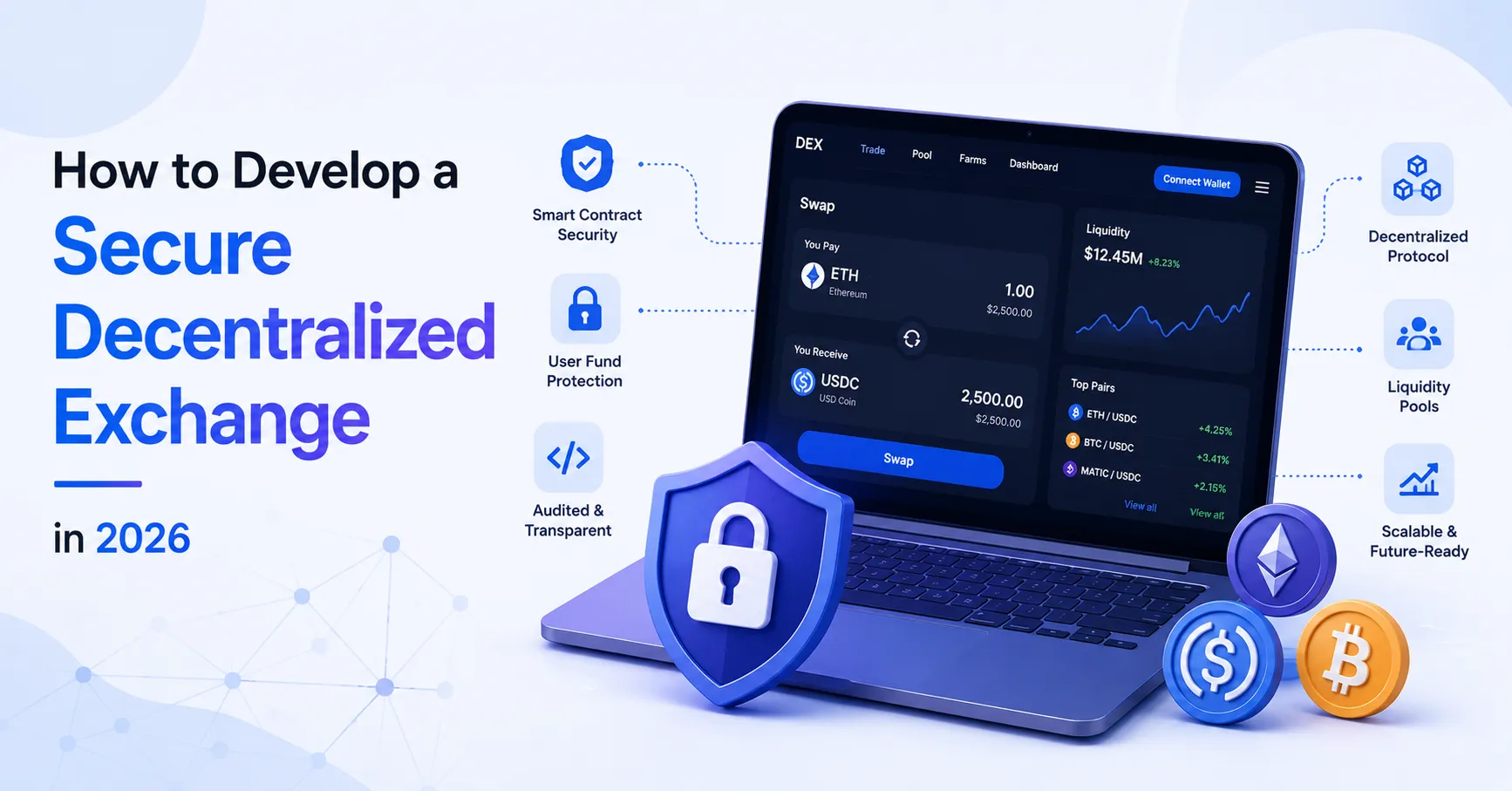

The decentralized exchange (DEX) landscape has matured dramatically. What started as experimental DeFi infrastructure is now a multi-billion-dollar ecosystem powering millions of daily transactions across blockchain networks worldwide.
But as DEX platforms grow, so do the threats targeting them. In 2026, building a secure decentralized exchange is not just a technical challenge it is a business critical responsibility.
Smart contract exploits, flash loan attacks, oracle manipulation, and front-running have collectively cost the DeFi industry hundreds of millions in losses.
If you are planning to enter the market, security must be engineered into every layer of your platform from day one not added as an afterthought.
What Is a Decentralized Exchange (DEX)?
A decentralized exchange is a blockchain-powered trading platform where users swap cryptocurrencies directly from their wallets using smart contracts no central authority, no custodial fund management, no registration required. Unlike centralized exchanges (CEX), DEX platforms operate transparently on-chain, offering trustless, permissionless trading to anyone with a compatible wallet.
Platforms like Uniswap, PancakeSwap, and Curve Finance have demonstrated that the DEX model can rival centralized exchanges in volume, liquidity, and user engagement when built correctly and securely.
Key Security Challenges in DEX Development
Understanding the threat landscape is the first step in building a resilient platform. The most critical DEX security challenges in 2026 include smart contract vulnerabilities, which remain the leading cause of DeFi exploits. Reentrancy attacks allow malicious contracts to drain funds before state updates are finalized. Flash loan exploits manipulate price feeds within a single transaction block. Front-running and MEV (Miner Extractable Value) attacks allow bad actors to profit by reordering transactions in the mempool. Sybil attacks and liquidity pool manipulation further threaten platform integrity.
Each of these requires targeted, proactive mitigation — not generic fixes.
Choosing the Right Blockchain Network
Your blockchain selection directly impacts your platform's security, speed, and scalability. In 2026, the most popular networks for DEX development include Ethereum (security-first, highest ecosystem maturity), BNB Chain (speed and low fees), Polygon (Layer 2 scalability), Avalanche (high throughput), and Arbitrum or Optimism for gas-optimized Layer 2 DEX deployment. Each network carries different validator models, consensus mechanisms, and smart contract security standards making this one of the most consequential architectural decisions you will make.
Smart Contract Development Best Practices
Secure smart contract development is the foundation of a trustworthy DEX. Best practices for 2026 include writing modular, minimal-complexity code to reduce attack surface, using battle-tested audited libraries like OpenZeppelin, implementing upgradeable contract patterns (proxy architecture) to patch vulnerabilities post-launch, applying strict input validation, and enforcing role-based access controls and multi-signature wallet authorization for all admin-level functions.
The code your smart contracts execute is law on the blockchain there is no rollback button.
Smart Contract Auditing, Bug Bounties & Penetration Testing
No smart contract should go live without a comprehensive security audit. In 2026, leading DEX projects combine manual code review by certified blockchain security firms with automated vulnerability scanning tools like Slither, MythX, and Echidna. Launching a bug bounty program through platforms like Immunefi creates a community-driven safety net, incentivizing white-hat hackers to report vulnerabilities before bad actors exploit them. Penetration testing simulates real-world attack vectors to stress-test your entire platform architecture.
Liquidity Pool Security & Oracle Protection
Liquidity pool security requires protecting against pool manipulation, impermanent loss exploitation, and price feed attacks. Integrating decentralized oracle solutions like Chainlink ensures your platform receives tamper-proof, real-time price data — a critical defense against oracle manipulation attacks that have plagued poorly designed DeFi protocols. Time-weighted average pricing (TWAP) adds another layer of manipulation resistance for on-chain price feeds.
Layer 2 Scaling, UI Security & Monitoring
Layer 2 solutions such as Arbitrum, Optimism, and zkSync dramatically reduce gas fees while maintaining Ethereum-level security guarantees — making your DEX accessible and cost-efficient for everyday traders.
On the frontend, anti-phishing design patterns, HTTPS enforcement, and secure wallet interaction flows prevent UI-layer attacks that trick users into signing malicious transactions.
Real-time monitoring and logging tools including on-chain analytics dashboards and automated anomaly detection allow your team to identify suspicious activity and trigger emergency shutdown mechanisms before damage escalates. Regular smart contract upgrades and patch management cycles keep your platform ahead of evolving threats.
Cost, Compliance & Future Trends
The cost of developing a secure DEX in 2026 varies based on blockchain network, feature complexity, audit requirements, and team expertise typically ranging from $50,000 to $300,000+ for a production-ready platform. KYC and AML compliance, while optional in pure decentralization models, may be required depending on your jurisdiction and target market.
Looking forward, AI-driven smart contract security, zero-knowledge proof technology, and cross-chain interoperability protocols are shaping the next generation of secure decentralized exchanges offering faster transactions, stronger privacy, and multi-network liquidity access in a single platform.
Conclusion
Developing a secure decentralized exchange in 2026 demands a security-first mindset at every stage from blockchain selection and smart contract architecture to oracle integration, audit cycles, and real-time monitoring. The platforms that earn user trust will be the ones that treat security not as a feature but as a foundation.
Ready to build a DEX that's engineered for security, scalability, and performance? Partner with an experienced decentralized exchange development service that delivers audit-ready smart contracts, multi-chain deployment, and enterprise-grade DeFi exchange architecture tailored to your business goals.






















Sign in to leave a comment.