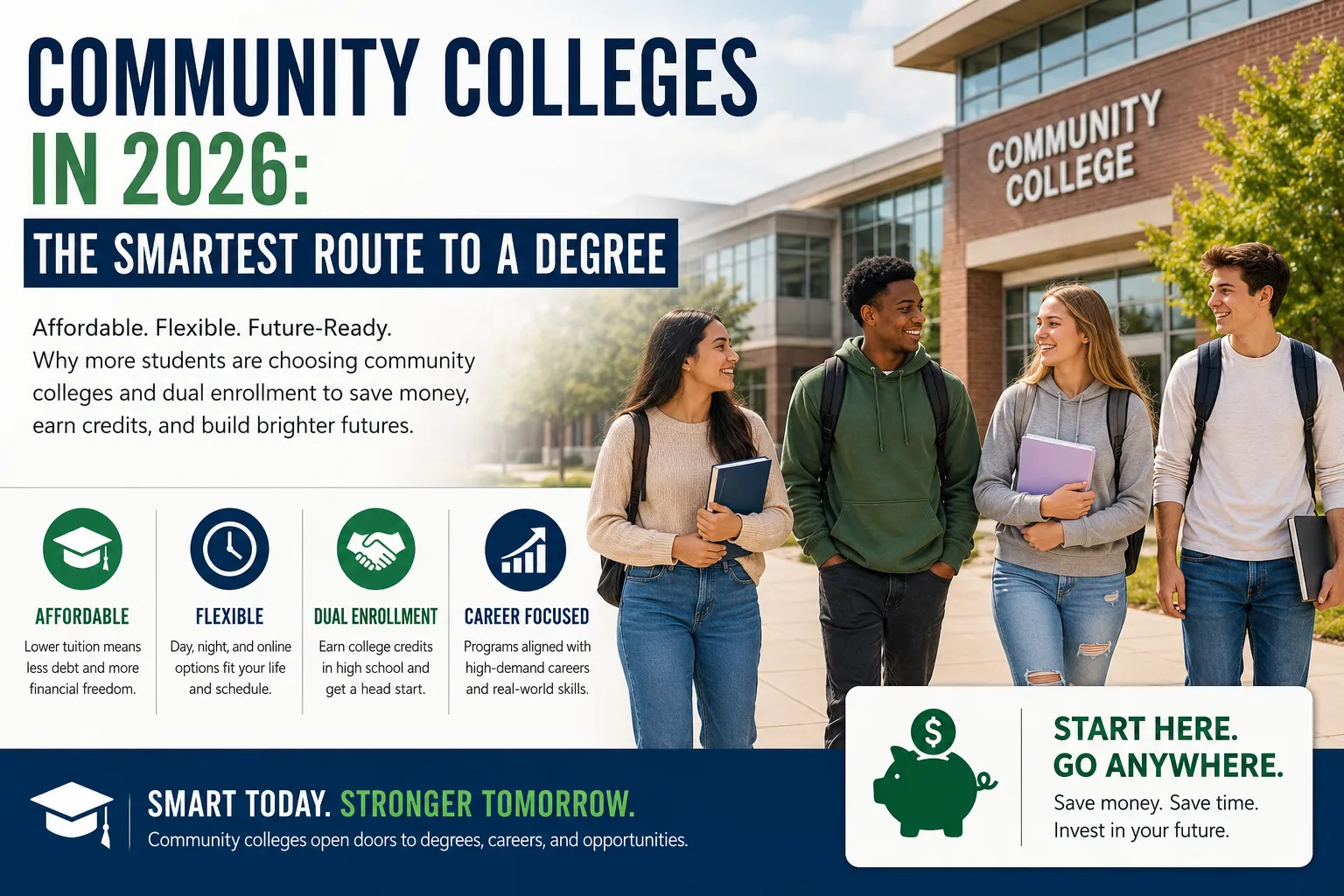

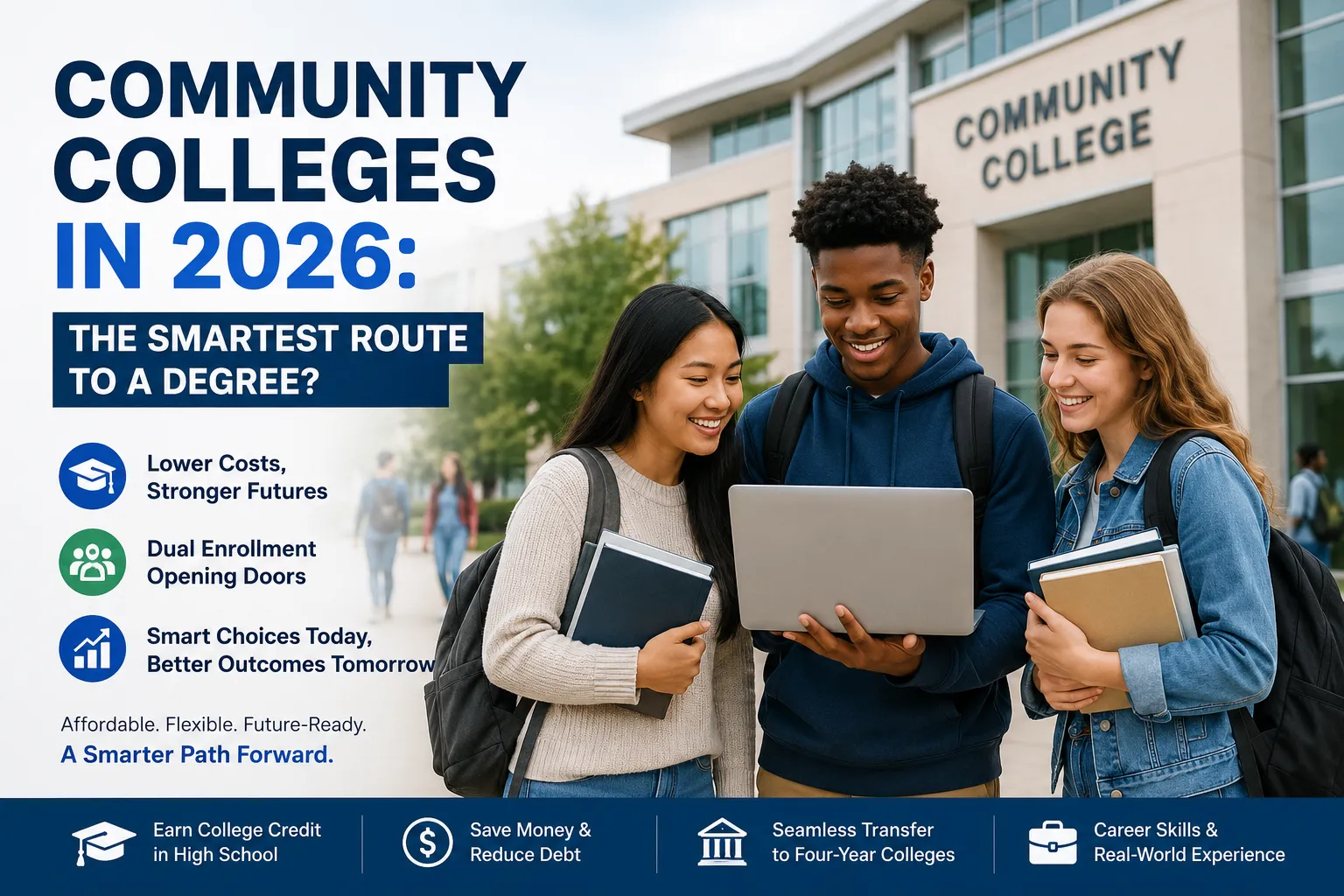
The conversation around higher education is changing fast. Rising tuition costs, growing concerns about student debt, and shifting workforce demands are pushing families to rethink the traditional four-year college path. As a result, community colleges are experiencing a remarkable comeback in 2026, attracting students who want affordable, flexible, and career-focused education options.
Recent enrollment trends show that community colleges are growing faster than many other sectors of higher education. At the same time, dual enrollment programs are helping millions of high school students earn college credits before graduation, reducing both the cost and time needed to earn a degree.
Why Community Colleges Are Growing Again
Community colleges have recovered strongly from the enrollment declines that followed the pandemic. Students are returning for several reasons: affordability, flexible schedules, workforce-focused programs, and clear transfer pathways to universities.
Unlike many four-year institutions, community colleges serve a broad range of learners. Recent high school graduates share classrooms with working adults, career changers, military veterans, and international students. This diversity creates learning environments that are practical and closely connected to real-world career goals.
The appeal is simple. Students can complete foundational coursework at a significantly lower cost before deciding whether to transfer to a university or enter the workforce directly. For many families, that strategy makes more financial sense than committing immediately to four years of university tuition.
Dual Enrollment Is Changing the Game
One of the biggest drivers of community college growth is dual enrollment. These programs allow high school students to take college-level courses that count toward both their high school diploma and a future college degree.
Today, millions of students across the United States participate in dual enrollment programs. Many graduate from high school with a semester or even a full year of college credits already completed.
Think of it like getting a head start in a marathon. While some students begin college at the starting line, dual enrollment participants begin several miles ahead. That advantage can translate into lower tuition costs, earlier graduation, and less student debt.
Research consistently shows that students who participate in dual enrollment are more likely to attend college, persist through their studies, and complete credentials compared with students who do not earn college credits during high school.
The Financial Advantage Is Hard to Ignore
Cost remains one of the strongest arguments in favor of community colleges.
Public universities continue to become more expensive, while private institutions often require significant borrowing. Community colleges offer a different equation. Tuition is generally much lower, and many states now provide additional funding support or tuition assistance programs.
Students who combine dual enrollment with community college attendance can reduce educational costs dramatically. Some enter university transfer programs with a substantial number of credits already completed, allowing them to spend fewer semesters paying university-level tuition.
This strategy has become especially attractive for first-generation college students and families trying to avoid large student loan balances.
As students pursue challenging coursework and accelerated academic pathways, many also seek additional academic support. Resources such as Expertsmind.com's subject expert network can help students strengthen their understanding of mathematics, engineering, business, and other college-level subjects while managing demanding schedules.
Community College, Trade School, or University?
The best educational path depends on individual goals.
Trade schools provide focused skills training for careers such as HVAC technology, welding, automotive repair, and healthcare support roles. These programs are often shorter and less expensive than traditional degree programs.
Community colleges occupy a unique middle ground. Students can pursue transfer-oriented associate degrees, technical certificates, or career-focused programs in areas such as cybersecurity, advanced manufacturing, healthcare technologies, and business administration.
Universities still offer strong long-term earning potential in fields like engineering, computer science, and finance. However, the return on investment depends heavily on graduation rates, debt levels, and career outcomes.
For many students, the smartest approach is not choosing one option exclusively. Instead, they combine pathways by starting at a community college and transferring later into a university program.
The Importance of Credit Transfer Planning
While community colleges and dual enrollment create valuable opportunities, success depends on careful planning.
Not all college credits transfer equally between institutions. Students who take courses without understanding transfer requirements may discover later that some credits count only as electives rather than degree requirements.
This challenge makes academic advising more important than ever. Many colleges now offer transfer planning tools, online degree audits, and pathway mapping systems that help students understand exactly how each course applies to future programs.
Students who work closely with advisors and verify transfer agreements before enrolling in courses can avoid costly surprises and stay on track toward graduation.
A Smarter Education Strategy for 2026
The growth of community colleges reflects a broader shift in how students and families evaluate higher education. Instead of focusing solely on prestige, many are prioritizing affordability, flexibility, and practical outcomes.
Dual enrollment programs, transfer agreements, and career-focused credentials are creating new pathways that help students reach their goals faster and with less financial risk. Community colleges are no longer viewed simply as alternatives to universities. For many learners, they have become the starting point of a well-planned education strategy.
The most successful students in 2026 will not necessarily be those who spend the most on education. They will be the ones who build intentional pathways, use available resources wisely, and choose the route that delivers the strongest value for their future.



























Sign in to leave a comment.