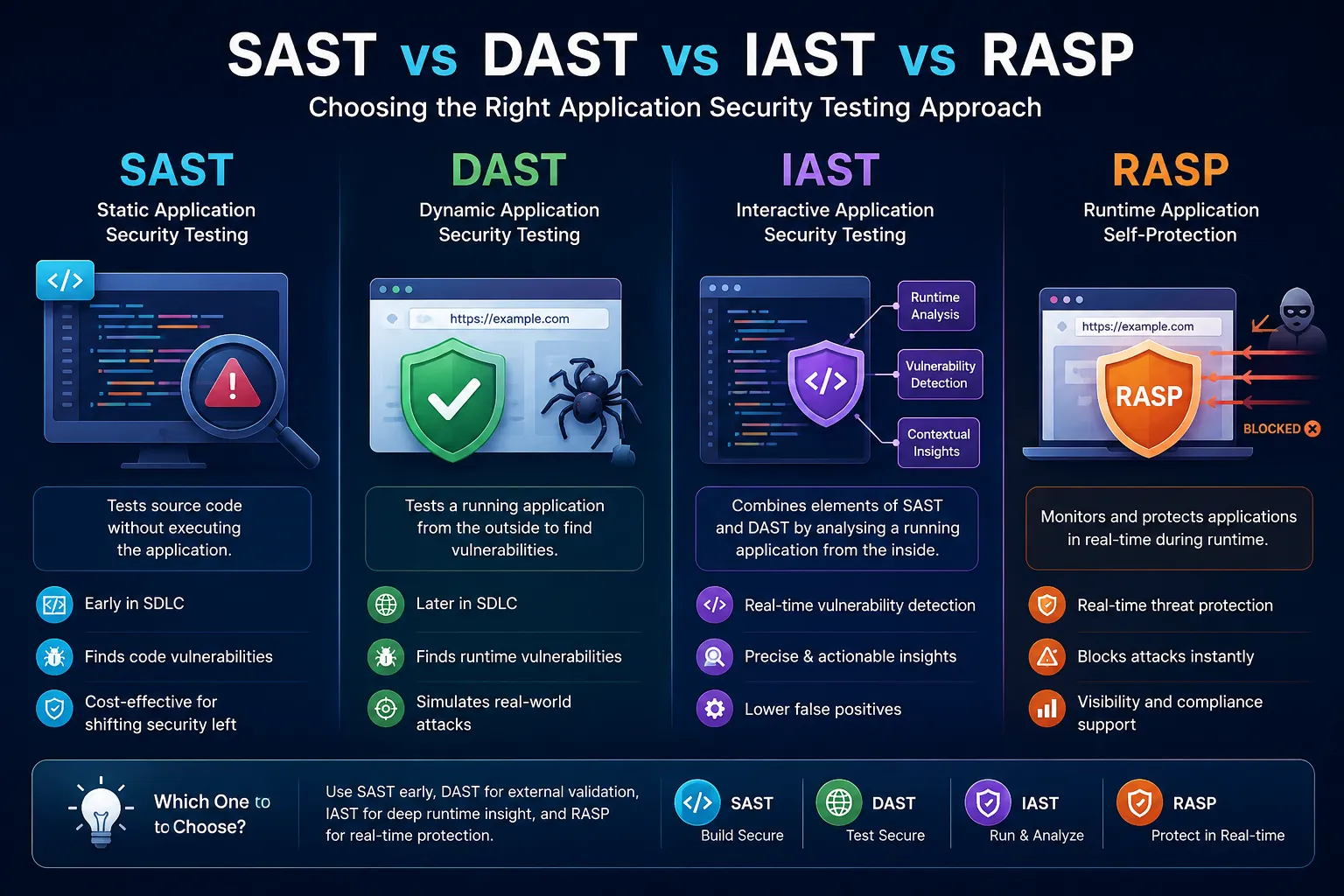

If you've sat through a vendor pitch in the last few years, you've probably heard all four acronyms in the same breath, usually followed by a promise that one tool "covers everything." It doesn't. Application security testing isn't a single problem with a single fix — it's a set of different questions asked at different points in the software lifecycle, and SAST, DAST, IAST, and RASP each answer a different one.
This guide breaks down what each approach actually does, where it tends to fall short, and how most mature security teams end up combining them rather than picking a winner.
Why "Which One Is Best" Is the Wrong Question
Before getting into the comparison, it's worth addressing the framing most people start with. Teams often ask which testing method catches the most vulnerabilities, as if these tools were competing for the same job. They're not.
SAST looks at code you haven't run yet. DAST attacks an application that's already running. IAST sits inside the application while it runs. RASP defends the application after it's already in production. Asking which one is "best" is a bit like asking whether a blueprint review, a stress test, a security camera, or a locked door is the most important part of protecting a building. You need different controls at different stages, and skipping one usually just means an attacker — or an auditor — finds the gap for you.
SAST: Catching Problems Before They Ship
Static Application Security Testing scans source code, bytecode, or binaries without executing the program. It's a white-box approach — the tool can see everything, including code paths that never get triggered in normal testing.
What it's good at:
- Running early, often as part of a pre-commit hook or CI pipeline
- Finding issues like SQL injection patterns, hardcoded credentials, and insecure API usage directly in the source
- Giving developers line-level feedback while the context is still fresh
Where it struggles:
- False positive rates can get noisy, especially on large legacy codebases, which trains developers to start ignoring the tool
- It has no visibility into runtime behavior, so issues that only appear when the app interacts with real infrastructure, third-party services, or live configuration go unnoticed
- Language and framework coverage varies a lot between vendors, so a polyglot stack often needs more than one SAST tool
SAST earns its keep by shifting cost left. A bug caught in a pull request costs a fraction of what the same bug costs after it's in production and someone has to trace it back through a deployed system.
DAST: Attacking the Application From the Outside
Dynamic Application Security Testing takes the opposite approach. Instead of reading code, it interacts with a running application the way an attacker would — sending malformed input, probing endpoints, and watching how the system responds. It's black-box testing; the tool doesn't need source code access at all.
What it's good at:
- Finding issues that only exist in the deployed, configured environment — misconfigured headers, exposed endpoints, broken authentication flows
- Testing the application as a whole, including third-party components and the web server itself, not just first-party code
- Producing results that are usually easier to reproduce, since it demonstrates an actual exploitable path rather than a theoretical one
Where it struggles:
- It runs late, typically against a staging or pre-production build, so fixes land much closer to release
- Pinpointing the exact line of vulnerable code is harder, since DAST sees symptoms, not source
- Coverage depends heavily on how well the scanner can crawl and authenticate into the app; anything behind complex workflows or multi-step forms can get missed
Where SAST tells you "this code pattern looks dangerous," DAST tells you "this endpoint is actually exploitable right now." Both statements matter, and they're not interchangeable.
IAST: Watching From the Inside While the App Runs
Interactive Application Security Testing tries to get the best of both worlds by instrumenting the application itself — usually through an agent — and then observing real traffic as the app is exercised, whether by QA testers, automated functional tests, or a DAST scanner running alongside it.
What it's good at:
- Combining runtime visibility with code-level context, so it can point to the exact vulnerable line while confirming the issue is actually reachable and triggered by real traffic
- Generally lower false-positive rates than SAST, since it's reporting on paths that were actually executed
- Fitting naturally into CI/CD, since it runs passively during existing test cycles instead of requiring a separate scanning phase
Where it struggles:
- Coverage is only as good as the test suite driving it; code paths nobody exercises never get analyzed
- Language and framework support is narrower than SAST or DAST, since instrumentation has to be built per platform
- Agent overhead can be a real concern in performance-sensitive test environments
IAST is often pitched as a replacement for SAST and DAST. In practice, it's better understood as a bridge between them — useful, but not a substitute for either.
RASP: Defense at Runtime, in Production
Runtime Application Self-Protection is different from the other three in a meaningful way: it's not really a testing method, it's a protection mechanism. RASP embeds itself in the running application in production and actively monitors, and can block, malicious behavior in real time — think of it as an application-layer immune response rather than a scanner.
What it's good at:
- Providing a last line of defense against attacks that made it past every earlier stage, including zero-days targeting known vulnerable patterns
- Understanding application context that a perimeter tool like a WAF can't see, since it sits inside the process itself
- Reacting immediately, without waiting for a patch cycle
Where it struggles:
- It's reactive by definition — it doesn't fix the underlying flaw, it just tries to stop it from being exploited
- Performance overhead and false blocks are a legitimate operational concern, especially in latency-sensitive applications
- It adds another agent to production systems, which itself becomes something that needs to be maintained, patched, and monitored
RASP shouldn't be your only control. It's what catches the thing that got past SAST, DAST, and IAST — which, over a long enough timeline, will happen.
Putting Them Together: A Layered Approach
| Method | When it runs | Visibility | Best for |
|---|---|---|---|
| SAST | Pre-build / commit | Source code only | Catching flaws early, before deployment |
| DAST | Staging / pre-prod | Running app, black-box | Confirming real, exploitable issues |
| IAST | During functional testing | Running app + code context | Accurate, low-noise findings during CI/CD |
| RASP | Production | Running app, live traffic | Blocking exploitation in real time |
Most teams that get this right don't treat it as a shopping list where more tools equals more security. They map each method to the stage of the pipeline where it adds the most signal and the least noise:
- SAST in the IDE and CI pipeline to catch obvious issues before code merges.
- IAST during QA and integration testing to validate what's actually reachable, with far less noise than SAST alone.
- DAST against staging environments before release, to catch configuration and environment-specific issues.
- RASP in production as a safety net, not a strategy.
The overlap between these tools is intentional, not wasteful. A vulnerability that SAST flags as low-confidence and IAST confirms as reachable is a very different finding than one SAST flags alone — and that layered confirmation is exactly what reduces alert fatigue on a security team that's already stretched thin.
Choosing a Starting Point
If a team is building an AppSec program from scratch, the honest advice is usually: start with SAST and DAST, because they require the least setup and give the broadest initial coverage. Add IAST once you have a mature CI/CD pipeline with solid test coverage, since IAST is only as useful as the tests driving it. Bring in RASP once the application is stable in production and you have the operational maturity to tune it — deploying RASP too early, before anyone understands its false-positive behavior, tends to create more firefighting than protection.
None of these tools replace secure coding practices, threat modeling, or a security team that actually reads the findings instead of just clearing the dashboard. They're instruments, not a strategy. The strategy is knowing which instrument to trust for which question — and building a pipeline where the answers from one stage inform the next.
Frequently Asked Questions
What are the differences between SAST, DAST, IAST, and RASP?
SAST focuses on analyzing source code before it's executed, identifying vulnerabilities early in the development process. DAST tests a running application from the outside to find issues that may only arise in the deployed environment. IAST combines elements of both by observing a running application while it is tested, and RASP provides real-time protection by monitoring the application in production.
Which application security testing method is the best?
Asking which method is the best is misleading because each tool addresses different aspects of application security at various stages. SAST, DAST, IAST, and RASP serve unique purposes, and a mature security strategy typically involves a combination of these methods rather than relying on a single solution.
How does SAST help in the software development lifecycle?
Static Application Security Testing (SAST) helps by analyzing code for vulnerabilities before the application is run, catching issues like SQL injections and hardcoded credentials early. This proactive approach allows developers to fix problems while the code context is still fresh, ultimately reducing costs associated with later-stage fixes.
What are the limitations of DAST?
Dynamic Application Security Testing (DAST) is limited because it analyzes a running application, making it harder to pinpoint the exact line of vulnerable code. Additionally, it often runs later in the development cycle, which means vulnerabilities are identified closer to release, increasing the risk of last-minute fixes.
Can IAST replace SAST and DAST?
While Interactive Application Security Testing (IAST) offers advantages by combining runtime visibility with code-level context, it is not a replacement for SAST and DAST. Instead, IAST is best understood as a bridge between the two, providing valuable insights during functional testing but relying on existing test coverage.
What role does RASP play in application security?
Runtime Application Self-Protection (RASP) acts as a last line of defense by monitoring and potentially blocking malicious activity in real-time within a running application. It is reactive in nature, meaning it addresses threats that have already bypassed other security measures like SAST, DAST, and IAST.
How should I implement these testing methods in my security strategy?
Start with SAST and DAST to cover the broadest initial vulnerabilities with minimal setup. As you mature your CI/CD pipeline and test coverage, introduce IAST and finally RASP for real-time protection in production. This layered approach ensures each method complements the others, providing a more robust security posture.


























Sign in to leave a comment.