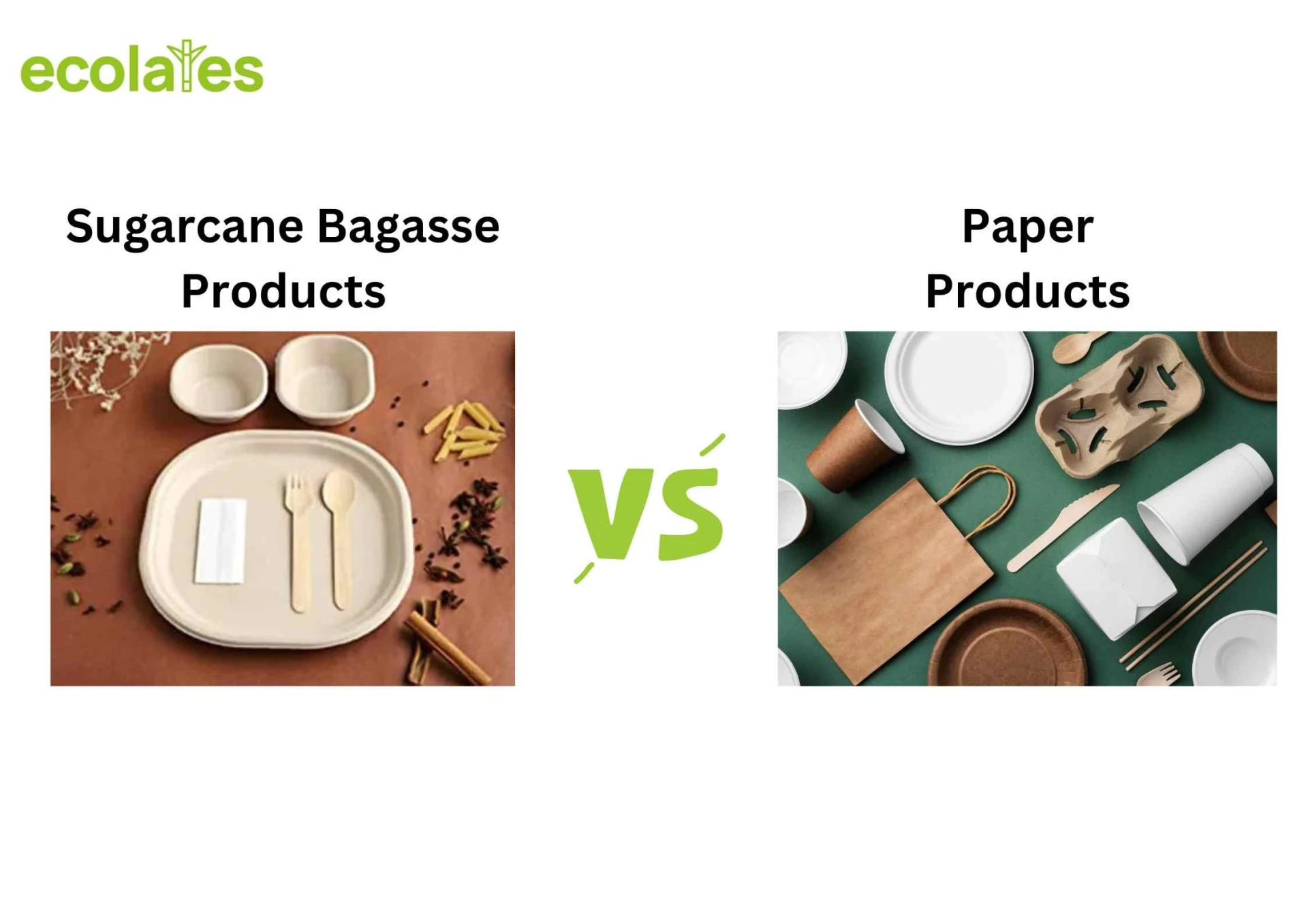
In the pursuit of sustainable and environmentally friendly alternatives to conventional packaging materials, two options that often come into consideration are sugarcane bagasse and paper products. Both possess their own merits and applications, but gaining an understanding of the distinctions between them can empower businesses and consumers to make well-informed choices. Within this article, we undertake a comparison of sugarcane bagasse and paper products, delving into their characteristics, environmental impact, and suitability for various uses.
1. Material Composition
Sugarcane bagasse and paper products diverge in terms of their material composition. Sugarcane bagasse represents the fibrous residue that remains after the extraction of juice from sugarcane stalks. It serves as a byproduct of the sugar industry, offering a sustainable alternative to traditional materials derived from plastic. Conversely, paper products emerge from wood pulp, which undergoes a complex process encompassing pulping, pressing, and drying, eventually forming sheets.
2. Environmental Impact
With respect to their environmental impact, both sugarcane bagasse and paper products possess distinctive advantages. Sugarcane bagasse is regarded as more sustainable due to its origin as a byproduct of the sugar industry, which would otherwise be discarded as waste. Through the utilization of bagasse, we mitigate waste generation and reduce reliance on non-renewable resources. Furthermore, sugarcane represents a rapidly renewable resource characterized by a short growth cycle.
Paper products, on the other hand, rely on the harvesting of trees. While responsible forestry practices can facilitate the sustainable management of trees, the process of converting wood into pulp necessitates a greater expenditure of energy and involves chemical treatments when compared to sugarcane bagasse. Additionally, the demand for paper contributes to deforestation, which in turn engenders habitat loss and adversely impacts biodiversity.
3. Strength and Durability
Strength and durability constitute areas where both sugarcane bagasse and paper products possess distinct strengths. Sugarcane bagasse products are renowned for their robustness and their capacity to retain liquids, rendering them suitable for food containers and disposable tableware. They exhibit commendable resistance to grease and oil, thereby delivering reliable performance across a spectrum of applications.
Conversely, paper products vary in strength contingent upon factors such as thickness, quality, and the manufacturing process. While paper generally proves well-suited to lightweight applications like packaging and printing, it may prove less resilient in the face of moisture, and it can be susceptible to tearing or damage.
4. Water and Heat Resistance
Significant disparities emerge between sugarcane bagasse and paper products in terms of their water and heat resistance. Sugarcane bagasse products, owing to their fibrous structure, manifest strong resistance to water, oil, and heat. They withstand moderate levels of moisture without succumbing to sogginess or compromising their structural integrity. Consequently, they represent viable options for containers intended to accommodate hot or cold food and beverages.
Conversely, paper products prove more susceptible to water damage. While select paper products can be treated with coatings or additives to bolster their resistance to liquids, they generally fail to rival sugarcane bagasse when confronted with wet conditions. Overexposure to moisture can render paper fragile, causing it to disintegrate or lose its form.
5. Biodegradability and Compostability
Both sugarcane bagasse and paper products provide benefits in terms of biodegradability and compostability. Sugarcane bagasse, being a plant-based material, undergoes natural decomposition over time through microbial activity. It can be composted alongside organic waste, thereby enriching the soil and reducing the volume of waste destined for landfills.
Similarly, paper products can biodegrade and be composted when devoid of non-biodegradable coatings or contaminants. However, it merits noting that certain paper products, such as those coated with plastic or containing inks and dyes, may not readily break down within composting systems and necessitate specialized treatment.
Conclusion
To conclude, when comparing sugarcane bagasse and paper products, it proves vital to account for factors such as material composition, environmental impact, strength and durability, water and heat resistance, as well as biodegradability. Sugarcane bagasse products furnish a sustainable alternative stemming from the byproduct of the sugar industry, and they exhibit commendable resistance to water and heat. Paper products, while possessing their own merits, may prove more vulnerable to water damage and necessitate adherence to responsible forestry practices. Ultimately, the selection between these materials hinges on specific requirements, applications, and environmental considerations.
#sugarcanebagasseproducts #ecolates #ecolatespvtltd #ecofriendlyfoodpackaging #gogreen #sustainability #ecofriendlyproducts #biodegradeables #sugarcanebagasseproductsmanufacturer
























Sign in to leave a comment.