


Preparing for the Certified Internal Auditor (CIA) exam can feel overwhelming at first. Certuvo offers one approach to CIA Exam Prep by combining structured study materials, practice questions, mock exams and AI-supported learning. But regardless of the platform you choose, successful preparation starts with understanding the CIA exam structure, building a realistic study schedule and regularly testing your knowledge.
What Is the CIA Exam?
The Certified Internal Auditor (CIA) exam is the globally recognized professional certification examination for internal auditors. It is administered by The Institute of Internal Auditors (IIA) and is designed to test knowledge and skills related to internal auditing, governance, risk management, controls and related professional practices.
The exam is divided into three parts:
- Part 1: Essentials of Internal Auditing
- Part 2: Practice of Internal Auditing
- Part 3: Business Knowledge for Internal Auditing
Candidates can take the parts separately rather than completing all three in one sitting. This makes it possible to build a study schedule around your work, education and other commitments.
CIA Exam Parts Explained
Understanding what each part covers is one of the first steps in effective CIA Exam Prep.
CIA Part 1: Essentials of Internal Auditing
Part 1 focuses on the foundations of internal auditing. Topics include the purpose of internal auditing, ethics, governance, risk management and internal control.
You should be comfortable with concepts such as:
- Internal audit fundamentals
- Professional ethics
- Independence and objectivity
- Governance and risk management
- Internal control frameworks
- Quality assurance and improvement
Because this section establishes the fundamentals, candidates should focus on understanding concepts rather than relying entirely on memorization.
CIA Part 2: Practice of Internal Auditing
Part 2 focuses more directly on the practice of internal auditing. It covers areas such as engagement planning, performing engagements, communicating results and monitoring recommendations.
Preparation should include understanding how internal auditors:
- Plan audit engagements
- Identify and evaluate risks
- Gather and evaluate evidence
- Document audit work
- Communicate findings
- Develop recommendations
- Monitor corrective actions
Scenario-based practice can be particularly useful because candidates need to apply concepts rather than simply recall definitions.
CIA Part 3: Business Knowledge for Internal Auditing
Part 3 covers broader business knowledge relevant to internal auditors.
Depending on the current exam blueprint, candidates may encounter areas involving:
- Business acumen
- Information technology
- Financial management
- Data analysis
- Business processes
- Organizational and operational concepts
This section can feel broader than the first two parts, so breaking the syllabus into smaller topic groups can make preparation more manageable.
Also read: How to Avoid Burnout While Studying for Professional Certification Exams
CIA Exam Preparation: Where Should You Start?
A common mistake is beginning with hundreds of practice questions before understanding the syllabus.
A better approach is to follow a simple preparation cycle:
Learn → Practice → Review → Test → Repeat
Start by reviewing the current official exam syllabus or content outline. Divide it into manageable topics and identify areas where you already have knowledge and areas that require more study.
Then use practice questions to test whether you can apply the concepts.
When you make a mistake, do not simply memorize the correct option. Review the explanation and identify why your original reasoning was incorrect.
This turns every incorrect answer into a learning opportunity.
How Long Should You Study for the CIA Exam?
There is no universal number of study hours that guarantees success. Preparation time depends on your professional experience, familiarity with internal auditing, academic background, available study time and the specific CIA part you are preparing for.
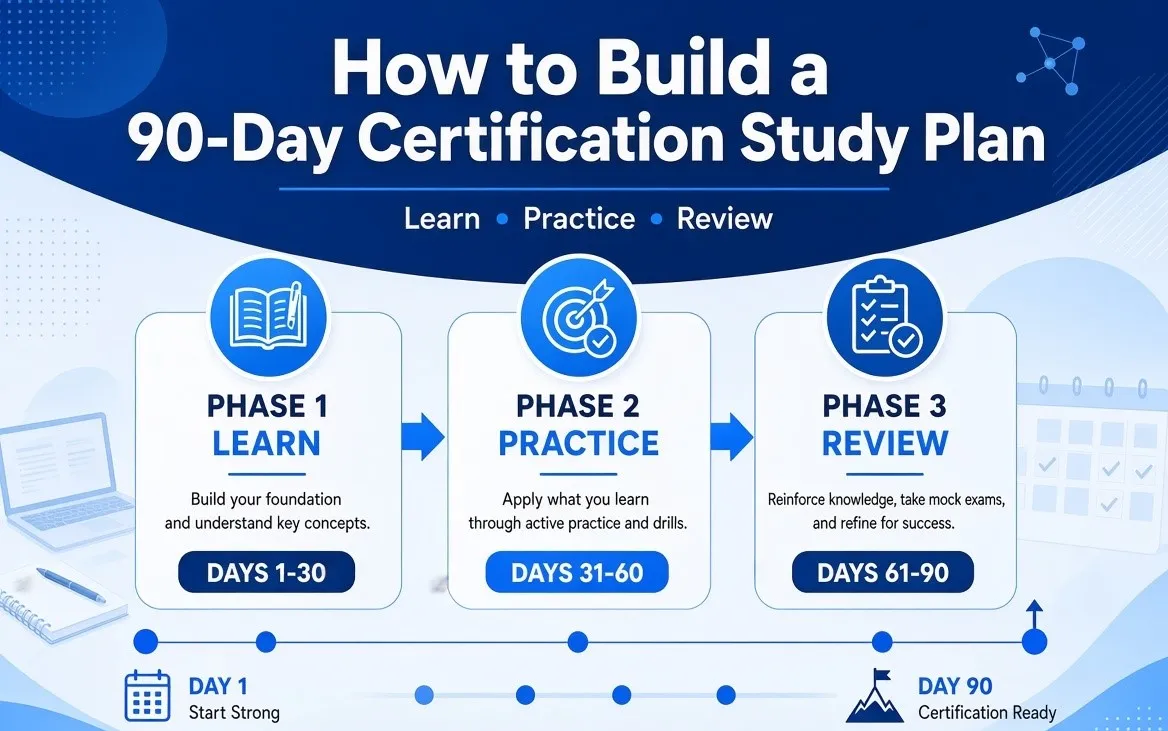
A practical approach is to create a weekly target instead of focusing only on the total number of hours.
For example:
Week 1–2: Build the foundation
- Review the exam syllabus
- Learn key concepts
- Create topic notes
- Identify weaker areas
Week 3–5: Increase practice
- Complete topic-based questions
- Review incorrect answers
- Revisit difficult concepts
- Track performance by topic
Week 6–7: Focus on application
- Complete mixed-question sets
- Practice under time limits
- Work on weaker sections
- Reduce reliance on notes
Final week: Simulate the exam
- Take full-length practice exams
- Review mistakes
- Revise important concepts
- Avoid trying to learn large amounts of new material at the last minute
The exact timeline should be adjusted according to your exam date and current level of preparation.
What Makes a Good CIA Review Course?
A CIA Review Course should provide more than a large library of questions. Before choosing a preparation platform, consider whether it offers:
- Current syllabus-aligned study material
- Clear explanations
- High-quality practice questions
- Progress tracking
- Topic-level performance analysis
- Timed mock exams
- Realistic exam simulations
- Revision resources
- Flexible study options
A useful course should help you identify what you know, what you do not know and what you should study next.
AI Study Tools for CIA Exam Preparation
AI is increasingly being used in professional certification exam preparation. However, the value of an AI tool depends on how it supports learning.
An AI study tool can help explain difficult concepts in simpler language, generate follow-up questions, provide examples or help candidates review mistakes.
An AI certification exam preparation platform can go a step further by combining AI assistance with structured course content, question banks, performance tracking and personalized practice.
For example, Certuvo combines CIA preparation resources with AI-supported learning features, including an AI Coach designed to provide interactive guidance. Its approach is intended to help students work through difficult questions instead of simply revealing answers.
What should you expect from an AI study tool?
A useful AI learning platform should ideally help you:
- Understand difficult concepts
- Ask follow-up questions
- Review mistakes
- Practice weak topics
- Get explanations quickly
- Adjust your study approach based on performance
AI should complement your preparation rather than replace the official exam syllabus or authoritative study resources.
Practice Questions vs Mock Exams
Practice questions and mock exams serve different purposes.
Practice questions are primarily for learning and identifying weaknesses. You can complete them by topic and immediately review explanations.
Mock exams are primarily for assessment. They help you evaluate your preparation under conditions that are closer to the actual examination.
A strong preparation strategy uses both.
A useful progression is:
- Start with topic-specific questions.
- Review every incorrect answer.
- Move to mixed-question sets.
- Introduce timed practice.
- Complete full-length mock exams.
- Analyze your performance before scheduling the actual exam.
Do not judge your readiness only by the number of questions completed. Your accuracy, consistency and ability to explain the reasoning behind an answer are more useful indicators of preparation.
CIA Exam Preparation: Key Things to Focus On
For candidates comparing different preparation options, these are the main factors to consider:
- Content coverage: Does the course cover the current CIA exam blueprint?
- Question quality: Are questions designed to test understanding and application?
- Explanations: Can you understand why an answer is correct or incorrect?
- Mock exams: Are there realistic timed simulations?
- Performance tracking: Can you identify weak topics?
- Flexibility: Can you study around work and other commitments?
- Learning support: Can you get help when a concept is difficult?
- Updates: Does the provider update content when the examination changes?
The best choice depends on your learning style, schedule, experience and preparation needs rather than on the number of features alone.
Common CIA Exam Preparation Mistakes
Even candidates who study consistently can lose valuable preparation time through inefficient methods.
1. Studying without a plan
Reading randomly across different topics can make it difficult to measure progress. Use a weekly plan with specific topics and practice targets.
2. Memorizing instead of understanding
The CIA exam requires candidates to apply internal auditing concepts. Understanding the reasoning behind an answer is generally more useful than memorizing answer patterns.
3. Ignoring incorrect questions
Incorrect answers show where additional learning is needed. Maintain a mistake log and revisit recurring problem areas.
4. Taking mock exams too early
Mock exams are most useful when you have already covered a substantial portion of the syllabus. Use them as a progress check rather than your primary learning method.
5. Relying entirely on AI
AI can provide useful explanations, but candidates should verify important information against authoritative and current exam resources.
Final Takeaway
Effective CIA Exam Prep is less about studying for a fixed number of hours and more about using the right process: understand the syllabus, learn the concepts, practice consistently, review mistakes and test yourself under realistic conditions. Certuvo can be considered as part of that preparation approach for candidates who want structured CIA study resources combined with AI-supported learning. Before choosing any CIA Review Course, review its current content coverage, question quality, mock exams, explanations and study features, then select the approach that fits your learning needs and schedule.
FAQ: CIA Exam Preparation
Q1. Is the CIA exam difficult?
The difficulty varies by candidate. Your professional experience, familiarity with internal auditing and preparation strategy can all affect how challenging the exam feels.
Q2. How many parts are in the CIA exam?
The CIA exam consists of three parts: Essentials of Internal Auditing, Practice of Internal Auditing and Business Knowledge for Internal Auditing.
Q3. Can I take CIA exam parts separately?
Yes. Candidates can complete the three exam parts separately rather than taking one combined examination.
Q4. How should I prepare for the CIA exam?
Start with the current exam syllabus, study each topic systematically, practice questions regularly, review mistakes and use timed mock exams before the actual test.
Q5. Are CIA practice questions important?
Yes. Practice questions help you apply concepts, identify weak areas and become familiar with the style of questions you may encounter.
Q6. Should I use AI for CIA Exam Prep?
AI can be useful for explanations, personalized practice and interactive learning. However, it should complement authoritative study resources rather than replace them.
Q7. How many hours should I study for the CIA exam?
There is no fixed number that works for everyone. Create a schedule based on your exam date, experience, available study time and performance in practice tests.
Q8. Are mock exams necessary for CIA preparation?
Mock exams are useful because they provide an opportunity to practice under timed conditions and identify areas that still require revision.






















Sign in to leave a comment.