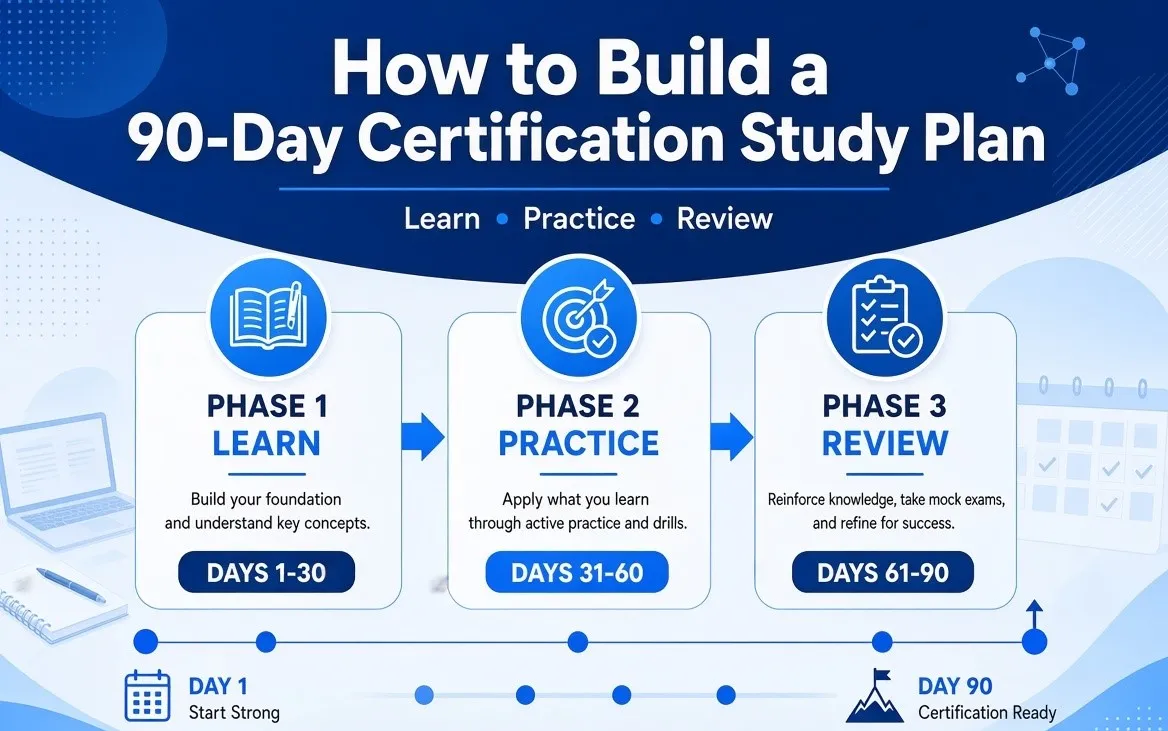


A 90-day certification study plan gives you a clear path from learning the syllabus to testing your exam readiness. The best approach is to divide the 90 days into three phases: learn, practice, and review. Start with the official exam content outline, set weekly goals, track weak areas, and gradually increase practice questions and mock exams as the test date approaches.
What Is a 90-Day Certification Study Plan?
A 90-day certification study plan is a structured schedule that organizes your preparation across approximately three months. Instead of trying to study everything at once, you divide the exam syllabus into smaller topics and assign specific learning, practice, and revision tasks to each week.
This approach works well for many types of professional certification exam preparation, including accounting, project management, auditing, technology, and other professional credentials.
The important point is that 90 days is a framework, not a fixed rule. Your ideal schedule depends on the exam difficulty, your existing knowledge, available study time, and the amount of material you need to cover.
Why Use a 90-Day Study Plan?
Without a plan, candidates often spend too much time reading and too little time practicing. A structured schedule helps balance both.
The main benefits include:
- Clear direction: You know what to study each day and week.
- Better time management: Large topics become manageable tasks.
- Progress tracking: You can see whether you are on schedule.
- Early identification of weak areas: Practice results show where more attention is needed.
- Better revision: You have dedicated time to revisit difficult topics.
- Lower last-minute pressure: The final weeks can focus on exam readiness rather than unfinished content.
For example, official CPA guidance recommends reviewing the exam Blueprints because they show tested content areas, topic groupings, weightings, task statements, and skill levels.
How to Build a 90-Day Certification Study Plan
Step 1: Start With the Official Exam Content
Before creating your calendar, understand exactly what the certification exam tests.
Find the official:
- Exam content outline
- Exam blueprint
- Candidate guide
- Syllabus or curriculum
- Exam format and question types
- Scoring information
- Official reference materials
Do not build your schedule around random online topic lists. The official exam documentation should be your starting point.
For example, ISACA's CISA exam is organized into five job-practice domains, while PMI's current PMP materials provide an Exam Content Outline explaining what candidates should expect on the examination.
Step 2: Assess Your Starting Knowledge
Take a short diagnostic test before serious preparation begins.
You do not need to score highly. The purpose is to discover your starting point.
Ask yourself:
- Which topics do I already understand?
- Which topics are completely new?
- Where am I making repeated mistakes?
- How comfortable am I with scenario-based questions?
- How many hours can I realistically study each week?
This prevents you from spending 30 days studying material you already know while ignoring difficult areas.
Step 3: Divide the 90 Days Into Three Phases
A simple structure is:
Days 1–30: Learn
Focus on understanding concepts and covering the core syllabus.
Days 31–60: Practice
Start applying what you learned through questions, scenarios, exercises, and topic-level tests.
Days 61–90: Review and Test
Focus on weak areas, timed practice, mock exams, revision, and exam strategy.
This progression is important because knowing a concept and being able to apply it under exam conditions are different skills.
Your 90-Day Study Plan: Week by Week
Days 1–30: Build Your Foundation
During the first month, focus on learning rather than chasing high practice scores.
Break the syllabus into weekly sections. Give more time to topics with greater exam weight or topics you find difficult.
A typical week might look like:
- Monday–Thursday: Learn new concepts.
- Friday: Review the week's material.
- Saturday: Complete practice questions.
- Sunday: Review mistakes and plan the next week.
Keep notes short. Instead of rewriting entire chapters, record definitions, formulas, important concepts, common mistakes, and areas that require further review.
Days 31–60: Move From Learning to Practice
The second month should gradually shift toward active learning.
Use practice questions after studying each major topic. When you get an answer wrong, do not simply memorize the correct option.
Ask:
Why was my answer wrong?
Then identify whether the problem was:
- Lack of knowledge
- Misreading the question
- Confusing two concepts
- Poor time management
- Applying the wrong rule
- Guessing
Keep a mistake log. This becomes one of your most useful revision tools during the final month.
AI study tools can also help organize mistakes, generate explanations, create personalized quizzes, and identify topics that need more attention. However, AI-generated explanations should be checked against authoritative exam materials, especially when the subject involves technical rules, standards, regulations, or professional requirements.
Days 61–75: Focus on Weak Areas
By this stage, you should have enough practice data to identify your weaker topics.
Do not spend equal time on everything.
For example, if your practice results show strong performance in three areas but repeated mistakes in two others, use more of your study time on those weaker areas.
A useful weekly cycle is:
- Identify your weakest topic.
- Review the underlying concept.
- Complete targeted practice questions.
- Analyze every mistake.
- Retest yourself after a few days.
This creates a feedback loop rather than simply repeating the same study routine.
Days 76–90: Simulate Exam Conditions
The final two weeks should feel increasingly similar to the real exam.
Use timed practice and full-length mock exams where appropriate. The goal is not only to improve your score but also to build stamina, pacing, and confidence.
For example, PMI provides a full-length PMP practice exam designed to simulate the exam experience and provide performance information after completion.
After every mock exam, review:
- Incorrect answers
- Questions answered through guessing
- Topics that took too long
- Repeated mistakes
- Changes in performance between attempts
Do not spend the final days trying to learn every remaining detail. Prioritize high-value revision, weak areas, and exam technique.
How to Allocate Your Study Time
Your study schedule should reflect your actual availability.
If you can study 10 hours per week, you might divide the time approximately as follows:
- 4 hours for learning and concept review
- 3 hours for practice questions
- 2 hours for reviewing mistakes
- 1 hour for revision and planning
As the exam approaches, gradually reduce passive reading and increase active practice.
The exact percentages should change according to your certification and personal performance.
90-Day Plan: Learning vs Practice vs Review
A useful comparison is:
1. Learning phase: Best for building foundational knowledge. Use textbooks, official resources, lessons, notes, and explanations.
2. Practice phase: Best for checking whether you can apply what you learned. Use topic-based questions, scenarios, exercises, and quizzes.
3. Review phase: Best for fixing weaknesses and improving exam readiness. Use mistake logs, targeted revision, timed tests, and mock exams.
The key difference is simple: learning tells you what something means; practice shows whether you can use it; review helps you correct what you still cannot do reliably.
How AI Can Improve a 90-Day Study Plan
An AI certification exam preparation platform can make a structured plan more adaptive.
Instead of giving every learner the same schedule, AI-powered tools can use performance information to suggest where additional practice may be useful.
For example, an AI learning platform may help you:
- Identify frequently missed topics
- Generate practice questions
- Explain difficult concepts in simpler language
- Create personalized quizzes
- Summarize revision notes
- Track progress
- Adjust study priorities
This does not mean AI should replace official study materials or professional judgment. It works best as a support layer around a structured preparation strategy.
For learners using Certuvo, this type of workflow can make preparation more focused by connecting study activity with practice and performance review rather than treating every topic equally.
Common Mistakes to Avoid
Even a well-designed 90-day plan can fail if the schedule is unrealistic.
Avoid these common mistakes:
- Studying without checking the official exam outline
- Creating an overly detailed daily schedule you cannot maintain
- Spending most of your time reading
- Ignoring practice questions until the final month
- Repeating questions without understanding mistakes
- Studying only topics you enjoy
- Taking mock exams without reviewing the results
- Changing resources too frequently
- Trying to learn everything during the final week
Consistency is more valuable than studying for long hours occasionally.
How to Know You Are Ready
There is no single practice score that guarantees success across every certification exam.
Instead, look for consistent evidence of readiness:
- You can explain major concepts without relying heavily on notes.
- Your practice performance is improving.
- Your mistakes are becoming less repetitive.
- You can complete questions within the expected time.
- You understand why answers are correct or incorrect.
- Your mock-exam performance is reasonably consistent.
- You have reviewed your weakest areas.
Most importantly, compare your preparation with the current official exam requirements, because exam content and formats can change. AICPA, PMI, and ISACA all publish official materials that candidates can use to understand what their respective exams cover.
Final Takeaway
A strong 90-day certification study plan is not about studying for a fixed number of hours every day. It is about using your time intelligently. Start with the official exam content, divide the syllabus into manageable sections, build knowledge during the first month, increase practice during the second, and use the final weeks to review weak areas and simulate exam conditions. Certuvo can be considered as part of a structured preparation workflow when you want to combine learning, practice, and performance-based revision in one study process.
The most important principle is simple: plan your study, measure your performance, learn from your mistakes, and adjust the plan as you progress.
Frequently Asked Questions
Q1. Is 90 days enough to prepare for a certification exam?
It can be enough for many candidates, but it depends on the certification, your existing knowledge, and weekly study time. A 90-day plan works best when the schedule is realistic and consistently followed.
Q2. How many hours should I study each day?
There is no universal number. A consistent 1–2 hours on most days can be more sustainable than occasional long study sessions. Adjust the schedule based on exam difficulty and your starting knowledge.
Q3. When should I start taking practice questions?
Start with a small number of questions during the first few weeks, then gradually increase practice. By the second month, practice should become a major part of your preparation.
Q4. Should I take a mock exam before finishing the syllabus?
Yes. An early diagnostic mock can show your starting level. Later mock exams should be used to measure progress and improve exam readiness.
Q5. Should I study every topic for the same amount of time?
No. Allocate more time to heavily weighted, difficult, or frequently missed topics. Your practice results should influence how you distribute study time.
Q6. Can AI tools create a certification study plan?
Yes. AI study tools can help organize topics, create practice activities, explain concepts, and identify potential weak areas. However, important information should be verified against official exam resources.
Q7. What should I do during the final week?
Focus on targeted revision, mistake review, key concepts, and exam strategy. Avoid starting large amounts of completely new material unless it is essential.
Q8. Is a 90-day plan better than studying without a schedule?
For most learners, a structured plan makes preparation easier to manage because it creates clear milestones and provides a way to measure progress. The best plan, however, is one you can realistically follow.






















Sign in to leave a comment.