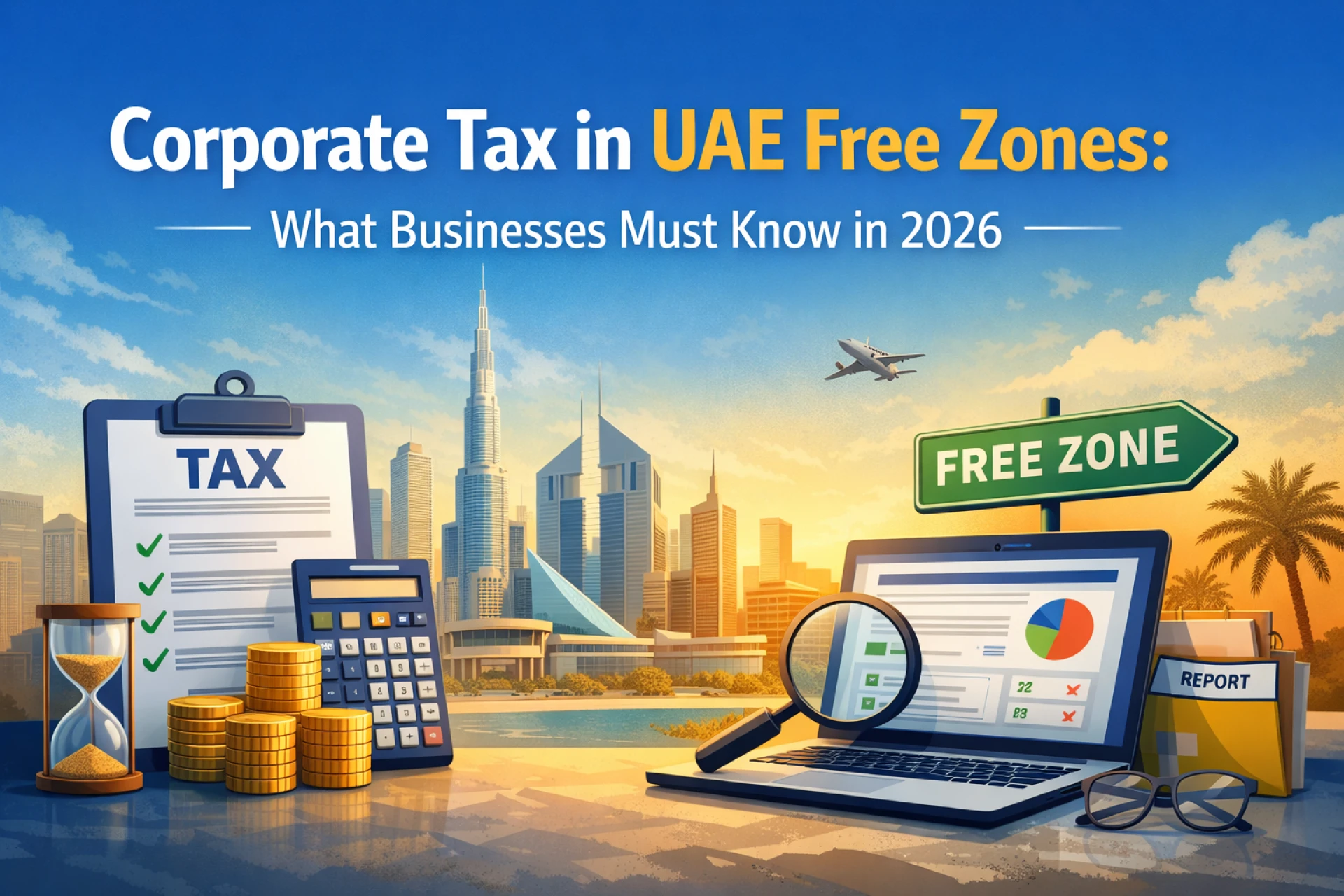

The UAE’s introduction of Corporate Tax has significantly changed the compliance landscape for businesses — including those operating in Free Zones. While Free Zones were historically known for offering 0% tax benefits, the new regime has added structure, conditions, and reporting obligations that every Free Zone entity must understand.
This article explains how Corporate Tax applies to Free Zone companies, what “Qualifying Free Zone Person” status means, and how businesses can remain compliant while still enjoying available benefits.
Understanding Corporate Tax in UAE Free Zones
As per the UAE Corporate Tax framework, Free Zone companies are not automatically exempt from tax. Instead, they may qualify for a 0% Corporate Tax rate only if specific conditions are met.
The default Corporate Tax rate in the UAE is:
- 0% on taxable income up to AED 375,000
- 9% on taxable income exceeding AED 375,000
Free Zone entities can still enjoy a 0% rate on certain income — but only if they maintain compliance with regulatory and substance requirements.
What Is a “Qualifying Free Zone Person”?
To benefit from the 0% Corporate Tax rate on qualifying income, a Free Zone company must be recognized as a Qualifying Free Zone Person (QFZP).
To maintain this status, the company must:
- Be incorporated in a recognized Free Zone
- Maintain adequate economic substance in the Free Zone
- Earn qualifying income (as defined under UAE Corporate Tax law)
- Not elect to be taxed under the standard Corporate Tax regime
- Comply with all transfer pricing and documentation requirements
- File Corporate Tax returns annually — even if tax payable is zero
Failing to meet even one of these conditions can result in loss of Free Zone benefits and exposure to the 9% Corporate Tax rate.
Common Misconceptions Among Free Zone Businesses
Many business owners assume:
- “Free Zone companies don’t need to file tax returns”
- “Free Zones are automatically exempt from Corporate Tax”
- “Only mainland companies need to worry about Corporate Tax”
These assumptions are incorrect.
Every Free Zone company must register, maintain records, and file a Corporate Tax return, regardless of whether they ultimately pay tax or not.
Why Corporate Tax Filing Is Still Mandatory
Even if your company qualifies for 0% tax, you are still legally required to:
- Register for Corporate Tax with the Federal Tax Authority (FTA)
- Maintain audited or compliant financial statements
- Track qualifying and non-qualifying income separately
- File an annual Corporate Tax return
Non-compliance can lead to:
- Administrative penalties
- Loss of QFZP status
- Back taxes and interest
- Regulatory scrutiny
This makes Corporate Tax filing a compliance necessity, not an optional activity.
Practical Challenges for Free Zone Businesses
Many Free Zone companies face challenges such as:
- Identifying whether income is “qualifying” or “non-qualifying”
- Meeting substance requirements with limited local presence
- Understanding transfer pricing obligations
- Structuring cross-border transactions correctly
- Preparing compliant documentation and filings
This is why many businesses choose to work with tax advisors who specialize specifically in UAE Free Zone compliance.
For a more detailed, step-by-step explanation of filing requirements, exemptions, timelines, and documentation, you can refer to this comprehensive guide on Free Zone Corporate Tax Filing in Dubai published by Ease to Compliance.
It breaks down eligibility, compliance steps, common risks, and how Free Zone businesses can remain compliant without losing tax benefits.
Final Thoughts
Corporate Tax in the UAE is not about eliminating benefits — it is about formalizing compliance.
Free Zone companies can still enjoy preferential tax treatment, but only when they operate transparently, meet regulatory standards, and file correctly. The businesses that adapt early will avoid penalties, protect their tax position, and gain credibility with banks, investors, and regulators.
If you operate a Free Zone business in the UAE, now is the right time to review your structure, confirm your eligibility status, and ensure your tax filings are in order.
About the Author:
The author is part of a corporate and tax advisory practice supporting startups, SMEs, and international businesses with UAE company formation, regulatory compliance, and cross-border structuring.


























Sign in to leave a comment.