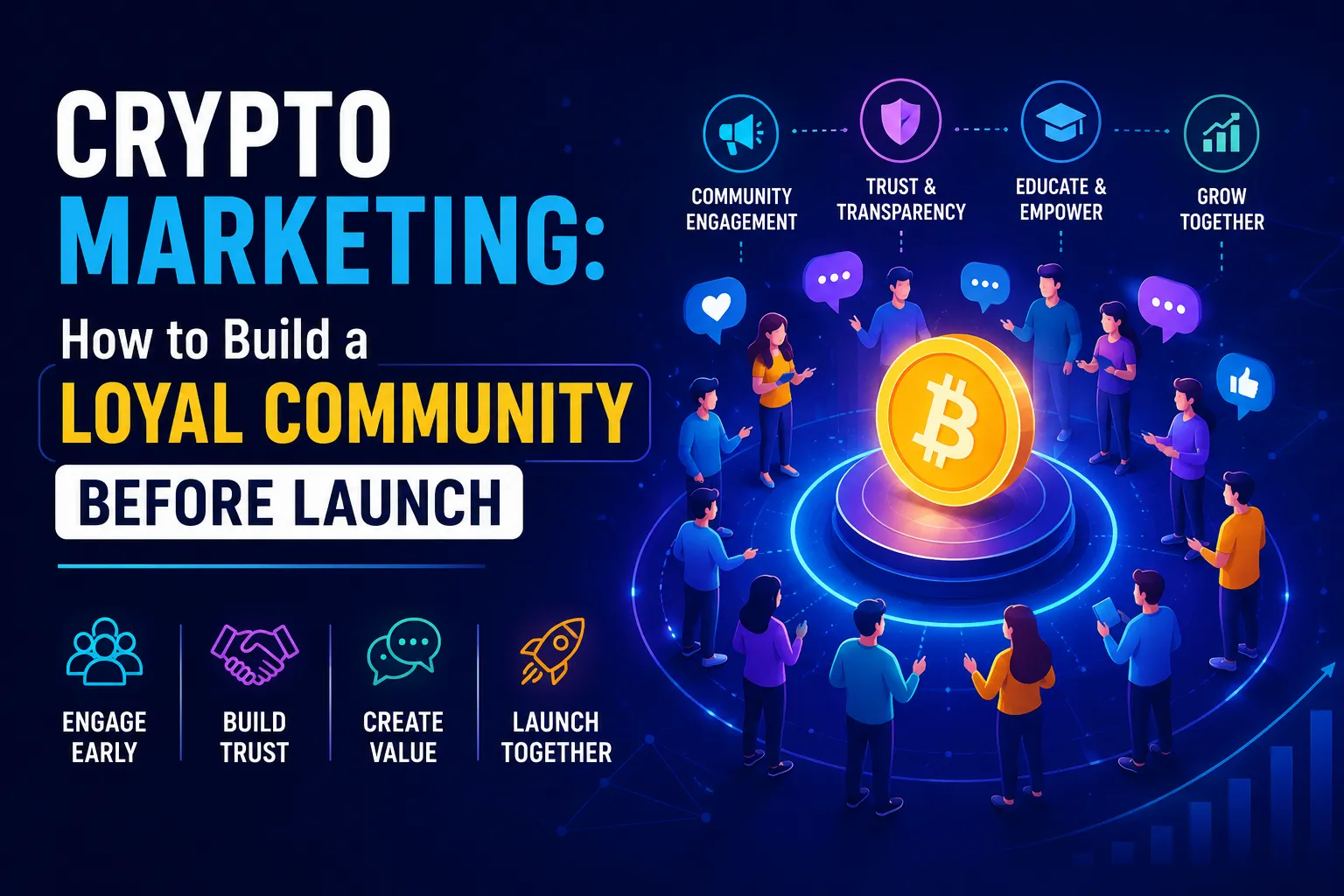

In the cryptocurrency industry, technology alone does not guarantee success. Many technically strong blockchain projects have struggled because they launched without an engaged audience, while others gained momentum by building loyal communities before releasing their products. Unlike traditional startups, crypto projects rely heavily on trust, network effects, and active community participation from the very beginning.
A strong pre-launch community helps validate demand, gather valuable feedback, amplify organic marketing, and create early advocates. In Web3, community members often become contributors, governance participants, content creators, and ambassadors, making them an essential part of the project's growth.
Building this kind of community requires more than growing social media followers or running giveaways. Lasting communities are built through transparency, consistent communication, meaningful engagement, and a shared mission. This article explores the key strategies crypto projects can use to build a loyal community before launch and set the foundation for long-term success.
Why Community Matters More in Crypto Than Traditional Startups
Traditional technology companies typically focus on customer acquisition after a product reaches market readiness. Crypto projects, however, often require community support well before the platform is fully operational. Whether launching a decentralized finance (DeFi) protocol, NFT ecosystem, Layer-2 network, blockchain game, or Web3 infrastructure, early adopters become an integral part of the product itself.
Community members contribute in several critical ways:
- Testing beta products and reporting bugs.
- Creating educational content for new users.
- Participating in governance discussions.
- Providing liquidity or staking assets.
- Referring new participants through organic advocacy.
- Defending the project's reputation during market uncertainty.
A professional crypto marketing agency, such as Blockchain App Factory, can play a crucial role in helping projects build and nurture engaged communities before launch. By combining community management, content marketing, influencer outreach, social media engagement, and strategic PR, these agencies help projects attract users who are genuinely interested in the ecosystem rather than solely motivated by short-term token speculation.
Research from blockchain analytics firms consistently shows that projects with high community engagement often experience stronger user retention than those driven primarily by speculative token interest. While token prices fluctuate rapidly, committed communities tend to remain active because they believe in the project's mission rather than seeking immediate financial gains.
This distinction becomes especially important during bear markets. Projects built solely around hype frequently lose engagement when prices decline, whereas mission-driven communities often continue developing, testing, and promoting the ecosystem.
Define a Mission That People Want to Join
Before creating Discord servers or launching social media campaigns, founders must answer a fundamental question: why should anyone care?
Many crypto projects make the mistake of leading with technical jargon, consensus algorithms, tokenomics, or throughput benchmarks. While these elements matter to developers and investors, communities are typically built around a compelling mission rather than technical specifications.
Successful projects communicate:
- The problem they are solving.
- Why existing solutions are inadequate.
- How decentralization improves the experience.
- What long-term vision unites participants.
People rarely become emotionally attached to blockchain architecture. They become attached to ideas such as financial inclusion, digital ownership, creator empowerment, privacy, or decentralized governance.
The mission should remain consistent across every communication channel, creating a shared identity that members can rally behind. Strong communities often describe themselves as participating in a movement rather than merely using a product.
Build Trust Before Asking for Commitment
Trust is arguably the most valuable asset in crypto marketing. The industry has experienced numerous scams, rug pulls, fraudulent token launches, and abandoned projects, making users increasingly cautious.
Consequently, projects should prioritize credibility from the earliest stages.
Transparency begins with the founding team. While pseudonymous founders have achieved success in crypto, they generally compensate through years of proven contributions or exceptional technical reputation. New projects benefit from publicly introducing team members, explaining their expertise, and sharing previous accomplishments.
Regular development updates also reinforce trust. Rather than promising unrealistic timelines, successful teams openly discuss:
- Development milestones.
- Technical challenges.
- Security considerations.
- Product iterations.
- Roadmap adjustments.
Communities generally tolerate delays far better than silence.
Publishing technical documentation, whitepapers, development blogs, GitHub updates, and governance proposals further demonstrates that meaningful work is occurring behind the scenes.
Consistency is equally important. A project that communicates weekly for twelve months builds considerably more confidence than one that appears only during fundraising or token launches.
Create Educational Content Instead of Promotional Content
Many crypto startups mistakenly believe marketing means continuous promotion. In reality, education often generates stronger long-term engagement.
Web3 remains technically complex. Wallets, private keys, staking mechanisms, gas fees, cross-chain bridges, and governance systems present steep learning curves for newcomers.
Educational content reduces this friction while positioning the project as a trusted knowledge source.
High-performing content includes:
- Beginner-friendly blockchain guides.
- Tutorials explaining project features.
- Technical deep dives for developers.
- Weekly ecosystem updates.
- Market trend analyses.
- Security best practices.
- Frequently asked questions.
Educational videos, live demonstrations, webinars, and interactive tutorials further improve accessibility.
Importantly, educational content should extend beyond the project itself. Discussing broader blockchain developments establishes credibility and attracts audiences interested in the wider ecosystem rather than solely speculative token discussions.
Choose Community Platforms Strategically
Crypto communities typically exist across multiple platforms, each serving distinct purposes.
Discord has become the primary hub for deeper conversations, support, governance discussions, and community organization. Telegram remains popular for real-time announcements and international communities, although moderation challenges require careful management.
X (formerly Twitter) functions as the industry's public conversation layer, where projects share updates, thought leadership, partnership announcements, and engage with influencers.
Meanwhile, developer-focused communities increasingly use GitHub alongside technical forums, while long-form educational content performs well through blogs, newsletters, YouTube, and podcasts.
Rather than attempting to dominate every platform immediately, projects should prioritize channels where their target audience naturally spends time.
Equally important is maintaining consistent messaging across all platforms while adapting content formats to suit each audience.
Encourage Meaningful Participation
Community loyalty grows when members feel they are contributing rather than merely consuming information.
Successful crypto projects actively involve their communities throughout development.
Examples include:
- Beta testing programs.
- Community governance discussions.
- Feature voting.
- Bug bounty initiatives.
- Ambassador programs.
- Translation contributions.
- Documentation improvements.
- Educational content creation.
This participatory approach transforms passive followers into stakeholders with emotional investment in the project's success.
Importantly, recognition often matters as much as financial rewards. Publicly acknowledging valuable contributors through leaderboards, contributor spotlights, governance roles, or exclusive access strengthens community identity.
Members who consistently receive recognition frequently become long-term advocates who voluntarily mentor newcomers.
Reward Loyalty Without Encouraging Short-Term Speculation
Airdrops and token incentives have become common community-building tools, but poorly designed reward systems often attract opportunistic participants seeking immediate profits rather than genuine engagement.
The challenge is rewarding contribution instead of mere presence.
Projects increasingly use engagement-based criteria such as:
- Educational participation.
- Governance involvement.
- Bug reporting.
- Community moderation.
- Content creation.
- Developer contributions.
- Referral quality rather than quantity.
This approach discourages "airdrop farming," where users create multiple accounts solely to maximize token distributions.
Gradual reward systems tied to sustained participation also outperform one-time giveaways. Long-term contributors are significantly more likely to remain engaged after launch because their incentives align with ecosystem growth rather than short-term token appreciation.
Collaborate with Trusted Voices Instead of Chasing Celebrity Endorsements
Influencer marketing remains influential in crypto, but audiences have grown increasingly skeptical of paid promotions.
Rather than pursuing celebrities with limited blockchain expertise, successful projects often collaborate with respected educators, developers, researchers, newsletter authors, and community leaders who have earned trust through consistent contributions.
These partnerships produce more authentic discussions, including:
- Podcast interviews.
- Technical AMAs.
- Educational livestreams.
- Research reports.
- Twitter Spaces.
- Developer workshops.
Authenticity generally generates stronger long-term credibility than expensive promotional campaigns.
Similarly, partnerships with established blockchain ecosystems, infrastructure providers, developer communities, and open-source contributors often enhance legitimacy more effectively than traditional advertising.
Foster Two-Way Communication
Many organizations treat community management as broadcasting announcements. Successful crypto projects instead prioritize conversations.
Founders who actively participate in discussions humanize the project and reduce the perceived distance between builders and users.
Regular question-and-answer sessions allow communities to express concerns before misinformation spreads. Transparent responses—even when acknowledging uncertainty—often increase confidence rather than diminish it.
Community managers play an equally critical role. Rather than acting solely as moderators, they serve as relationship builders who collect feedback, identify recurring concerns, and relay community sentiment to development teams.
Projects that visibly implement community suggestions demonstrate that participation genuinely influences product direction.
This feedback loop strengthens loyalty because members recognize their voices matter.
Manage Expectations During the Pre-Launch Phase
Overpromising remains one of crypto marketing's most damaging mistakes.
Aggressive timelines, exaggerated claims, unrealistic revenue projections, and inflated token expectations may generate short-term excitement but often lead to disappointment when inevitable development challenges arise.
Instead, successful projects communicate realistic milestones while emphasizing incremental progress.
Communities generally appreciate:
- Honest roadmaps.
- Transparent delays.
- Clear explanations of technical trade-offs.
- Measurable development updates.
Expectation management becomes especially important before token generation events or mainnet launches, where speculation can overshadow product development.
Projects that consistently prioritize sustainable growth over temporary hype often maintain healthier communities throughout market cycles.
Case Studies: Lessons from Successful Crypto Communities
Several blockchain projects illustrate the power of community-first marketing.
Ethereum's growth was fueled not only by groundbreaking smart contract technology but also by one of the world's largest developer communities. Extensive documentation, educational resources, hackathons, grants, and open collaboration encouraged thousands of developers to build applications long before widespread enterprise adoption.
Chainlink similarly cultivated a technically engaged community through continuous education, transparent development updates, research publications, and close engagement with developers. Its community became one of the project's strongest marketing assets, regularly producing educational content and supporting ecosystem expansion.
Polygon expanded its influence through developer grants, strategic partnerships, educational initiatives, hackathons, and strong social engagement. Rather than relying solely on token incentives, it invested heavily in ecosystem development, creating a network effect that attracted both builders and users.
These examples demonstrate that enduring communities are built over years through consistent value creation rather than viral marketing alone.
Measuring Community Health Beyond Vanity Metrics
Follower counts and Discord membership can be misleading indicators of success. Many inactive or automated accounts artificially inflate community size without contributing meaningful engagement.
Instead, projects should monitor metrics that reflect genuine participation.
These include active daily users in community channels, discussion quality, event attendance, governance participation, newsletter engagement, developer contributions, user retention, referral quality, and content generated organically by community members.
Qualitative indicators also matter. Constructive discussions, helpful peer-to-peer support, and independent community initiatives often reveal stronger loyalty than raw membership statistics.
Healthy communities increasingly become self-sustaining, with experienced members welcoming newcomers and answering questions without constant intervention from the founding team.
Conclusion
Building a loyal community before launch is one of the most important factors in a crypto project's long-term success. By focusing on transparency, education, meaningful engagement, and trust, projects can cultivate a dedicated user base that supports adoption well beyond the initial launch. Rather than relying on short-term hype, investing in authentic community-building creates lasting value and resilience in an ever-evolving Web3 landscape. For projects seeking expert guidance, Blockchain App Factory provides comprehensive crypto marketing agency services, helping businesses develop effective community-building strategies, increase brand visibility, and drive sustainable growth from pre-launch through post-launch.






























Sign in to leave a comment.