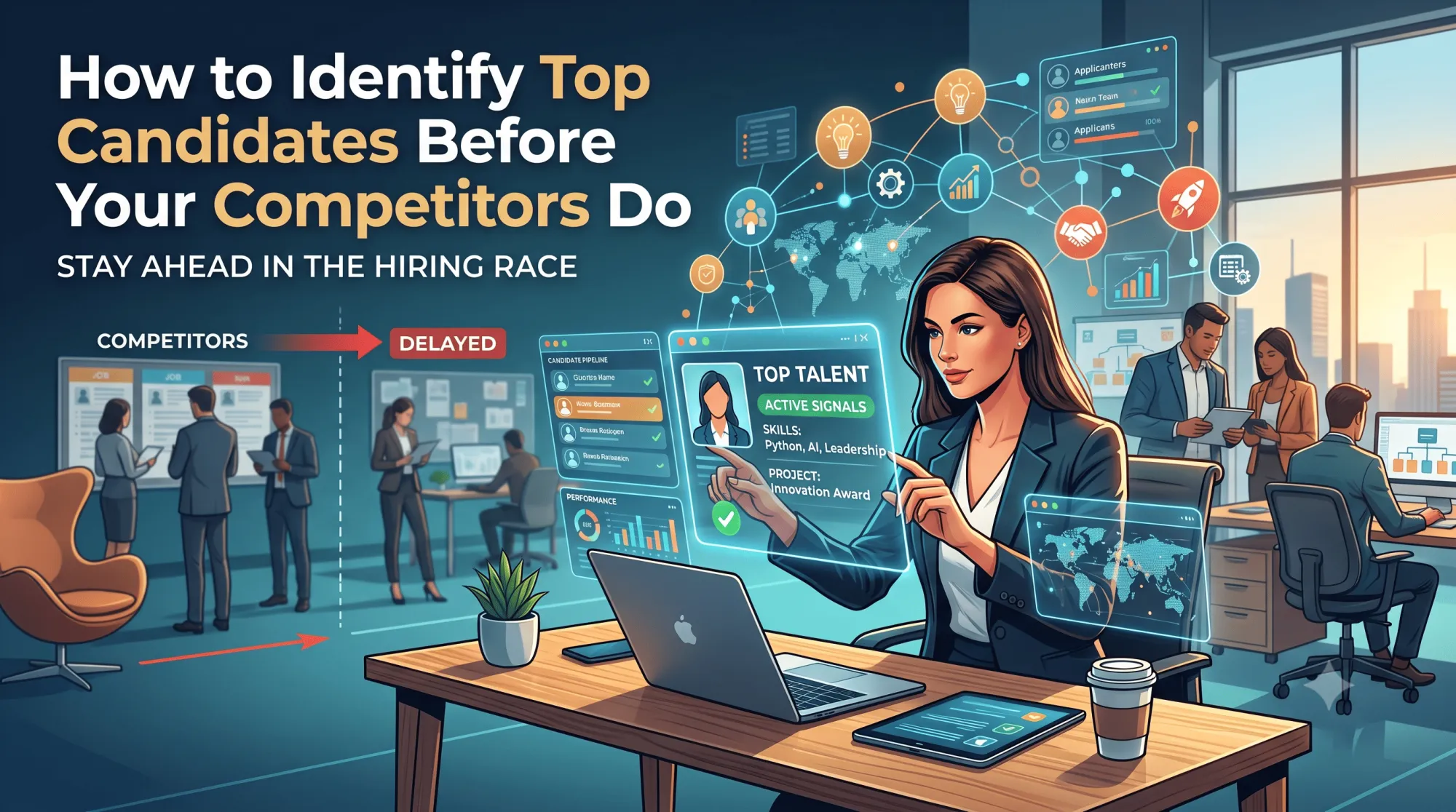

Hiring teams are under renewed pressure to find qualified people faster, while candidates continue to move quickly through the market. For employers, the challenge is no longer simply attracting applicants. It is identifying the strongest candidates early, understanding their fit with reliable data, and engaging them before a competitor makes an offer.
That shift is changing how organizations approach talent acquisition. Traditional workflows that depend on manual resume review, delayed screening calls, and disconnected spreadsheets often reveal strong candidates too late. Modern recruiting teams are increasingly turning to AI, automation, structured assessments, and hiring intelligence to make earlier, better-informed decisions.
For HR leaders, the practical question is clear: what signals help reveal top candidates before everyone else sees them?
Early identification starts with a sharper candidate profile
One of the most common recruitment challenges is misalignment at the beginning of the hiring process. Hiring managers may say they want “strong communication skills,” “strategic thinking,” or “technical depth,” but those phrases are difficult to screen for unless they are translated into measurable criteria.
Effective recruitment strategies begin with a structured success profile that defines:
- Must-have skills versus trainable skills
- Required experience versus preferred background
- Role-specific competencies
- Behavioral indicators of success
- Performance expectations for the first 90 to 180 days
- Deal-breakers that should remove a candidate from consideration
This profile gives recruiters and hiring managers a common decision framework. It also improves consistency across resume screening, assessments, interviews, and final evaluations. Without it, teams often rely on subjective impressions, which can slow decisions and increase the risk of overlooking high-potential talent.
A Hiring Intelligence Platform such as CandidHR.ai can support this process by helping teams connect job requirements with AI-assisted screening, assessments, video interviews, and analytics. The goal is not to replace recruiter judgment, but to give recruiters clearer evidence earlier in the funnel.
Resume screening must move beyond keyword matching
Resume review remains one of the first points of candidate evaluation, but it is also one of the most vulnerable to delay and inconsistency. Manual screening can be slow, especially when roles attract high applicant volume. Basic keyword searches may also miss candidates who describe relevant experience differently.
AI resume screening improves top candidates identification by analyzing resumes against role-specific criteria rather than relying only on exact-match terms. A strong screening model can help surface candidates who demonstrate relevant skills, adjacent experience, progression, certifications, or domain knowledge, even when their resume language is not identical to the job description.
For hiring teams, the value is speed and prioritization. Instead of reviewing every application with the same level of effort, recruiters can focus attention on the candidates most likely to meet the role requirements. This is especially useful for organizations hiring across multiple roles, geographies, or business units.
However, AI screening should be governed carefully. HR teams should regularly review selection criteria, monitor outcomes, and ensure screening logic aligns with business needs and fair hiring practices. Technology works best when it makes decision-making more structured, transparent, and auditable.

Assessments reveal capability before interviews consume time
Resumes show what candidates claim they have done. Assessments help show what they can actually do.
Skill-based and role-relevant assessments are becoming a central part of modern talent acquisition because they create comparable data points across applicants. Depending on the role, assessments may evaluate technical ability, problem-solving, communication, sales judgment, job knowledge, cognitive skills, or scenario-based decision-making.
The key is relevance. Assessments should be designed around actual job tasks, not generic hurdles. A software engineering candidate may need a practical coding challenge. A customer success candidate may need to respond to a realistic client escalation. A finance candidate may need to interpret a business scenario and explain risk.
Platforms like CandidHR.ai provide unlimited assessments, which can help companies evaluate candidates more consistently without adding manual administrative burden. For growing organizations, this matters because assessment volume often increases quickly when hiring expands. Unlimited assessment capability can make structured evaluation more accessible across roles and departments.
Assessment data is also valuable because it reduces overdependence on pedigree signals such as school, previous employer, or years of experience. Those signals may be useful, but they are incomplete. Capability-based evidence gives hiring teams a stronger foundation for shortlisting.
Automated video interviews help teams engage candidates sooner
Speed is one of the most important competitive factors in recruiting. Strong candidates often evaluate multiple opportunities at once, and slow scheduling can create unnecessary drop-off.
Automated 24×7 video interviews address this challenge by allowing candidates to complete interviews at a time that works for them. For employers, AI scoring can help evaluate responses consistently against predefined competencies, while recruiters gain faster access to structured interview insights.
This does not mean every interview should be automated. Human conversation remains essential for relationship-building, culture alignment, complex evaluation, and offer-stage engagement. But early-stage video interviews can reduce bottlenecks, especially for high-volume roles or distributed hiring teams.
When used well, automated video interviews support better recruitment strategies by helping teams:
- Screen candidates outside standard business hours
- Reduce scheduling delays
- Standardize early interview questions
- Compare responses more objectively
- Move qualified candidates to the next stage faster
CandidHR.ai is one example of a platform that combines automated video interviews with AI scoring, helping hiring teams identify strong candidates earlier while preserving recruiter time for higher-value conversations.
Hiring analytics turn recruiting from reactive to predictive
Organizations often track basic hiring metrics, such as time to fill or cost per hire. But identifying top candidates before competitors do requires deeper analytics.
Useful hiring analytics may include:
- Source quality by role
- Candidate conversion rates by funnel stage
- Assessment performance patterns
- Interview-to-offer ratios
- Offer acceptance trends
- Drop-off points in the process
- Recruiter and hiring manager response times
- Quality-of-hire indicators after placement
These data points help teams diagnose where strong candidates are being lost. For example, a company may discover that its best applicants come from referrals and targeted sourcing, but those candidates wait too long for interview feedback. Another organization may find that assessment scores strongly correlate with later hiring manager satisfaction, making assessments more central to future screening.
Hiring analytics also help HR leaders allocate resources more effectively. Instead of spreading effort evenly across every sourcing channel, teams can invest in the channels, criteria, and workflows that consistently produce better outcomes.
A modern Hiring Intelligence Platform can make these insights easier to access by consolidating screening results, assessment data, interview scoring, and funnel metrics in one place. This is where CandidHR.ai’s analytics capabilities can be particularly relevant for teams seeking measurable hiring efficiency improvements, not just faster task completion.
Talent pool creation is a long-term competitive advantage
Not every excellent candidate is ready to move immediately. Not every runner-up is a poor fit. Many strong candidates are simply a better match for a future role.
That is why talent pool creation should be treated as a strategic asset, not an administrative afterthought. A well-managed talent pool gives recruiters a warm audience of prequalified people who have already shown interest, passed certain evaluation steps, or demonstrated relevant skills.
High-performing recruiting teams segment talent pools by factors such as:
- Role family
- Skill set
- Location or work preference
- Seniority level
- Assessment results
- Interview feedback
- Availability timeline
- Candidate engagement history
This allows recruiters to re-engage strong prospects quickly when new roles open. It also reduces dependency on starting every search from zero.
For organizations competing in specialized or fast-moving labor markets, talent pools can shorten hiring cycles and improve candidate quality. When paired with AI screening and hiring analytics, talent pools become even more powerful because teams can identify which past candidates are most relevant to new opportunities.
Security and trust now influence HR technology decisions
As hiring becomes more data-driven, HR teams must also consider how candidate data is protected. Resumes, interview recordings, assessment results, and evaluation notes may contain sensitive personal information. Employers need systems that support responsible data handling and strong security controls.
That is why certifications such as SOC 2 Type II matter when evaluating recruitment technology. They indicate that a platform has undergone an independent review of controls related to areas such as security, availability, and confidentiality over a defined period.
For HR leaders, this is not just an IT consideration. Candidate trust, employer brand, compliance expectations, and internal governance all depend on responsible technology choices. CandidHR.ai’s SOC 2 Type II certification is contextually relevant for organizations that want AI-powered hiring capabilities while maintaining a strong security posture.
What leading hiring teams are doing differently
The most competitive employers are not waiting until the interview stage to discover who their best candidates are. They are building structured, data-rich recruiting systems that identify fit earlier and move faster with confidence.
In practice, that means they are:
- Defining success criteria before opening a role
- Using AI resume screening to prioritize qualified applicants
- Applying role-relevant assessments early in the funnel
- Automating first-stage interviews where appropriate
- Using AI scoring to support consistent evaluation
- Tracking hiring analytics to improve decisions over time
- Building reusable talent pools for future demand
- Choosing secure, scalable HR technology
This approach helps recruiters focus less on administrative triage and more on strategic candidate engagement. It also helps hiring managers make decisions based on evidence rather than instinct alone.
The bottom line
Identifying top candidates before competitors do requires more than speed. It requires clarity, structure, data, and timely engagement. Organizations that combine human expertise with AI-powered hiring intelligence are better positioned to recognize strong talent early, reduce process friction, and improve hiring outcomes.
For HR teams evaluating the next stage of their talent acquisition strategy, it may be worth assessing whether a platform like CandidHR.ai fits their hiring needs, especially if the goals include faster screening, scalable assessments, automated interviews, stronger analytics, secure candidate data handling, and measurable improvements in recruitment efficiency.



























Sign in to leave a comment.