

If you operate a trucking company, manage freight, or verify carriers before booking loads, understanding the CSA Score Chart can help you make better safety and compliance decisions. The Federal Motor Carrier Safety Administration (FMCSA) uses the Compliance, Safety, Accountability (CSA) program and its Safety Measurement System (SMS) to evaluate motor carrier safety performance.
The CSA program organizes safety-related inspection, crash, and investigation data into seven Behavior Analysis and Safety Improvement Categories (BASICs). These categories help identify areas where a carrier may need additional attention.
A dot number lookup can help you identify a carrier and connect its USDOT number with available safety information before reviewing its CSA-related data.
One important point is that CSA does not work like a simple overall score where a carrier receives one universal number. Instead, SMS calculates measures and percentiles within individual BASIC categories. Higher percentiles generally represent worse relative performance, while lower percentiles indicate better performance.
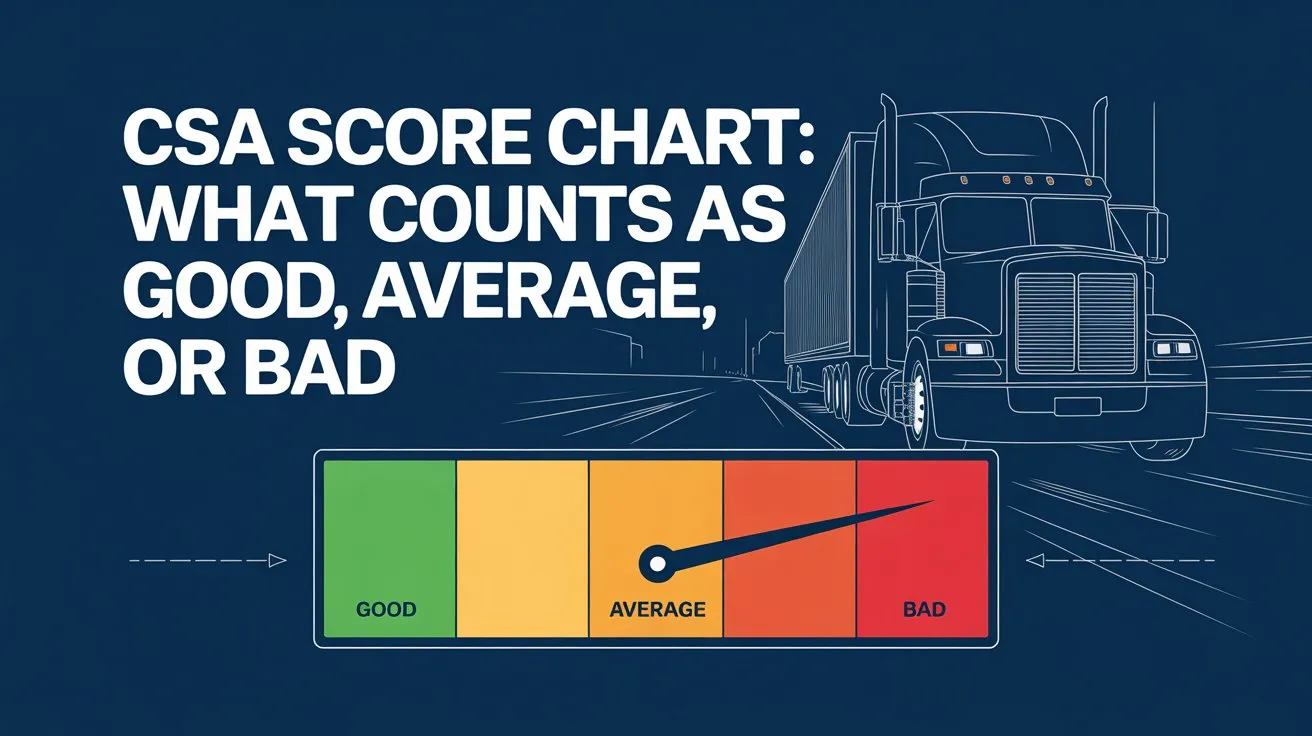
What Is a CSA Score?
People commonly use the term “CSA score” to describe a carrier's performance in the FMCSA Safety Measurement System. Technically, however, the SMS produces BASIC measures and percentiles rather than one single overall CSA score.
The SMS evaluates 24 months of safety-related information, including roadside inspection violations and state-reported crashes. Violations and crashes are weighted according to factors such as severity and how recently they occurred. The system also accounts for carrier exposure when comparing carriers.
A CSA Score Chart is therefore best understood as a practical way to organize the seven BASIC categories, explain what each category measures, and show what a carrier should review when a particular category raises concerns.
CSA BASIC Categories at a Glance
| BASIC Category | What It Measures | Common Examples |
| Unsafe Driving | Unsafe driving behavior | Speeding, reckless driving, improper lane changes |
| Crash Indicator | Crash involvement | Reportable crashes and crash-related history |
| Hours-of-Service Compliance | Compliance with HOS rules | Logbook, driving-time, and rest violations |
| Vehicle Maintenance | Condition of commercial vehicles | Brakes, lights, tires, defects |
| Controlled Substances/Alcohol | Drug and alcohol compliance | Prohibited substance or alcohol violations |
| Hazardous Materials Compliance | HM transportation compliance | Packaging, labeling, loading, securement |
| Driver Fitness | Driver qualification and fitness | Invalid license, medical qualification issues |
FMCSA currently recognizes seven BASIC categories. However, Crash Indicator and Hazardous Materials Compliance are not publicly displayed in the same way as the other BASICs on the public SMS carrier view; they are available to carriers through their own profiles and to enforcement personnel.
1. Unsafe Driving BASIC
The Unsafe Driving BASIC focuses on behaviors that can increase the likelihood of a crash. Examples include speeding, reckless driving, improper lane changes, inattention, texting, and using a hand-held mobile phone while driving.
For trucking companies, this category deserves close attention because repeated unsafe-driving violations can indicate a need for stronger driver training, supervision, or fleet safety policies.
For example, if roadside inspections repeatedly identify speeding or distracted-driving violations, the carrier should investigate why those violations are occurring and take corrective action. Reviewing inspection records alongside a USDOT Number Lookup can help transportation professionals better understand the carrier's safety history.
It is also important to remember that a higher percentile does not mean the carrier has a “percentage chance” of causing a crash. It represents the carrier's relative performance compared with carriers in a similar safety event group.
2. Crash Indicator BASIC
The Crash Indicator BASIC looks at a carrier's history of crash involvement. Unlike the other categories that primarily rely on inspection violations, this category focuses on crash data reported to FMCSA.
Crash involvement can provide important context when evaluating a carrier's overall safety performance. However, simply seeing crashes in a carrier's record does not automatically mean that every crash was caused by the carrier or driver.
This is one reason transportation professionals should avoid making decisions based on a single number or data point. A proper CSA Score Guide should be used as part of a broader review that includes inspections, violations, operating authority, and other available carrier information.
FMCSA currently identifies Crash Indicator as one of the seven BASICs, but it is not publicly displayed in the standard public carrier view.
3. Hours-of-Service Compliance BASIC
The Hours-of-Service (HOS) Compliance BASIC measures compliance with federal hours-of-service requirements. These rules are designed to manage driver work and rest periods and help reduce fatigue-related risks. Common concerns can include inaccurate records of duty status, exceeding allowable driving time, or other HOS-related violations.
For carriers, maintaining accurate records and ensuring drivers understand applicable HOS requirements are essential parts of compliance management. Repeated HOS violations may indicate weaknesses in dispatch procedures, driver training, recordkeeping, or operational oversight.
When performing an MC number lookup, brokers and shippers can use the carrier identification information as a starting point for broader due diligence. The goal should be to understand the carrier rather than rely on one compliance indicator alone.
4. Vehicle Maintenance BASIC
The Vehicle Maintenance BASIC focuses on whether commercial motor vehicles are properly maintained and safe to operate.
Examples of maintenance-related problems can include defective brakes, lighting issues, tire problems, missing or damaged equipment, and failures to make required repairs. FMCSA's CSA materials specifically identify brakes, lights, defects, and required repairs among the areas covered by this BASIC.
Vehicle maintenance is especially important because a mechanical problem can create an immediate safety risk. A carrier may have strong driver performance but still face compliance concerns if its equipment is not properly inspected and maintained.
Fleet managers should therefore monitor inspection results, repair records, preventive maintenance schedules, and recurring defects. Correcting the underlying problem is more valuable than simply trying to improve a metric.
5. Controlled Substances/Alcohol BASIC
The Controlled Substances/Alcohol BASIC addresses violations involving controlled substances and alcohol regulations applicable to commercial motor carriers and drivers.
This category can involve serious compliance concerns because drug and alcohol violations may directly affect driver safety and the carrier's regulatory responsibilities.
Carriers should maintain appropriate testing programs, records, policies, and procedures and ensure that drivers meet applicable federal requirements. Because this category can involve significant regulatory consequences, transportation companies should treat any drug- or alcohol-related compliance issue seriously and investigate it promptly.
6. Hazardous Materials Compliance BASIC
The Hazardous Materials (HM) Compliance BASIC focuses on compliance with regulations governing the transportation of hazardous materials. Depending on the operation, this can involve requirements related to packaging, labeling, handling, loading, documentation, communication of hazards, and other hazardous-material transportation procedures.
Not every trucking company handles hazardous materials, so this BASIC may be more relevant to specialized carriers than to general freight operations. FMCSA currently lists Hazardous Materials Compliance as one of the seven BASIC categories, but it is not publicly available in the standard public carrier profile.
For companies that transport regulated materials, however, understanding this category is essential. A carrier should have appropriate training, documentation, equipment, and procedures for the materials it transports.
7. Driver Fitness BASIC
The Driver Fitness BASIC addresses whether drivers are properly qualified and physically and administratively fit to operate commercial motor vehicles.
Potential issues can include invalid or improper licensing, medical qualification concerns, and other driver-qualification problems. Driver qualification is a fundamental part of carrier compliance. A carrier may have well-maintained trucks and good HOS practices, but problems with driver qualifications can still create serious regulatory concerns.
When performing a dot number lookup, brokers and shippers can use the carrier's USDOT information as part of their initial verification process and then review available safety and operating information before making a transportation decision.
How to Read a CSA Score Chart
One of the biggest misunderstandings about CSA is assuming that every BASIC has a simple score from 0 to 100 where 100 automatically means a carrier is unsafe.
The SMS uses a percentile system. Percentiles range from 0 to 100, with 0 representing the best relative performance and 100 representing the worst relative performance. Carriers are compared with other carriers in similar safety event groupings.
For example:
| Percentile Range | General Interpretation |
| 0–25 | Lower relative safety concern |
| 26–50 | Moderate relative performance |
| 51–75 | Higher relative concern |
| 76–100 | Increasingly poor relative performance |
This table is a general educational interpretation, not an FMCSA intervention threshold chart. Actual intervention thresholds differ by BASIC and carrier type. A percentile should always be interpreted within its specific BASIC and safety event group.
FMCSA also emphasizes that BASIC percentiles are used to prioritize carriers for possible intervention; they should not be interpreted as an official safety rating or safety fitness determination.
Why CSA Scores Matter for Carrier Verification
For freight brokers, shippers, and logistics professionals, CSA information can provide useful insight into a carrier's safety performance. However, responsible carrier verification should involve more than checking one BASIC category.
A practical review can include the carrier's legal name, USDOT number, MC number, operating authority, inspection history, insurance information, safety indicators, and other relevant records.
This is where MC Lookup can be useful as part of a carrier verification workflow. By searching carrier information using an MC or DOT number, transportation professionals can organize important carrier details before making a business decision.
If you are looking for the best MC number lookup approach, focus on tools and processes that make it easy to cross-check carrier identity and regulatory information rather than relying on a single score.
How to Improve a Carrier's CSA Performance
Improving CSA performance starts with identifying the specific BASIC category creating concern.
Carriers can take several practical steps:
- Review recent inspection reports to identify recurring violations.
- Train drivers regularly on speeding, HOS, distracted driving, and other safety requirements.
- Strengthen preventive maintenance to reduce recurring equipment defects.
- Audit driver qualification files and required documentation.
- Monitor HOS records for patterns that could lead to violations.
- Investigate crashes and recurring incidents to identify preventable risks.
- Correct problems quickly rather than waiting for another roadside inspection.
FMCSA explains that SMS uses 24 months of inspection and crash data, with more recent events receiving greater weight. This means consistent improvement over time can matter as older events become less influential in the calculation.
Use CSA Data as Part of a Bigger Verification Process
A CSA percentile can be valuable, but it should not be treated as the complete story of a trucking company. Different BASICs measure different areas of safety performance, and some information is not publicly displayed.
For brokers and shippers, the better approach is to combine CSA information with carrier identity verification, operating authority, insurance, inspection history, and other relevant compliance information. Tools such as MC Lookup can help make this process more convenient by giving transportation professionals a straightforward way to search carrier information using DOT or MC numbers.
Final Thoughts
Understanding the CSA Score Chart makes it easier to interpret the seven BASIC categories and recognize what each one says about a carrier's safety and compliance performance. Unsafe Driving, Crash Indicator, HOS Compliance, Vehicle Maintenance, Controlled Substances/Alcohol, Hazardous Materials Compliance, and Driver Fitness each address a different part of commercial motor carrier safety.
The most important takeaway is that there is no single CSA number that tells the entire story. Percentiles must be interpreted within the appropriate BASIC, safety event group, and FMCSA methodology.
Whether you are a carrier monitoring your own performance or a broker conducting an MC number lookup, reviewing CSA information alongside other regulatory and operational records can support more informed decisions. A consistent verification process, supported by reliable information and regular compliance reviews, can help transportation businesses reduce risk and maintain stronger safety practices.


























Sign in to leave a comment.