
If you are trying to work out how much custom healthcare software costs in 2026, you have seen quotes from thirty thousand dollars to past a million for what sounds like one brief. Every number is defensible. None of these guides tells you which cost range your project will fall into. At the same time, the January 1, 2027 federal deadline is fixed. This guide breaks down what your number is made of, and which line items vanish from the proposal before it reaches you.
What Custom Healthcare Software Cost Looks Like in 2026
Healthcare software development cost guides published in 2026 show four main cost ranges. Use them as a starting point, not the final cost. They tell you where a project starts, not where it lands once integration depth and user roles enter.
Where the 2026 Ranges Actually Land
Development of a targeted patient-facing application with booking and/or secure messaging will run from $30,000 to $80,000. Where there are features like user logins, patient profiles, scheduling appointments and a simple integration, the cost will be $80,000 to $150,000. An application with strict compliance, telemedicine video and complete EHR integration will go for $150,000-$300,000. In case of large healthcare companies which cater to several hospitals, the cost starts at $300,000 and can easily go beyond $500,000.
Here the tier model fails you. Two products in the same band can finish five times apart, and the gap is rarely the feature list. One published account describes a Series A team that budgeted $80,000 for a patient engagement product and closed at $310,000. Compliance architecture, EHR work and AI data preparation never surfaced during scoping. Most healthcare app development cost tables stop before that conversation, which is why your custom healthcare software cost keeps moving after you sign.
What Decides Your Final Price
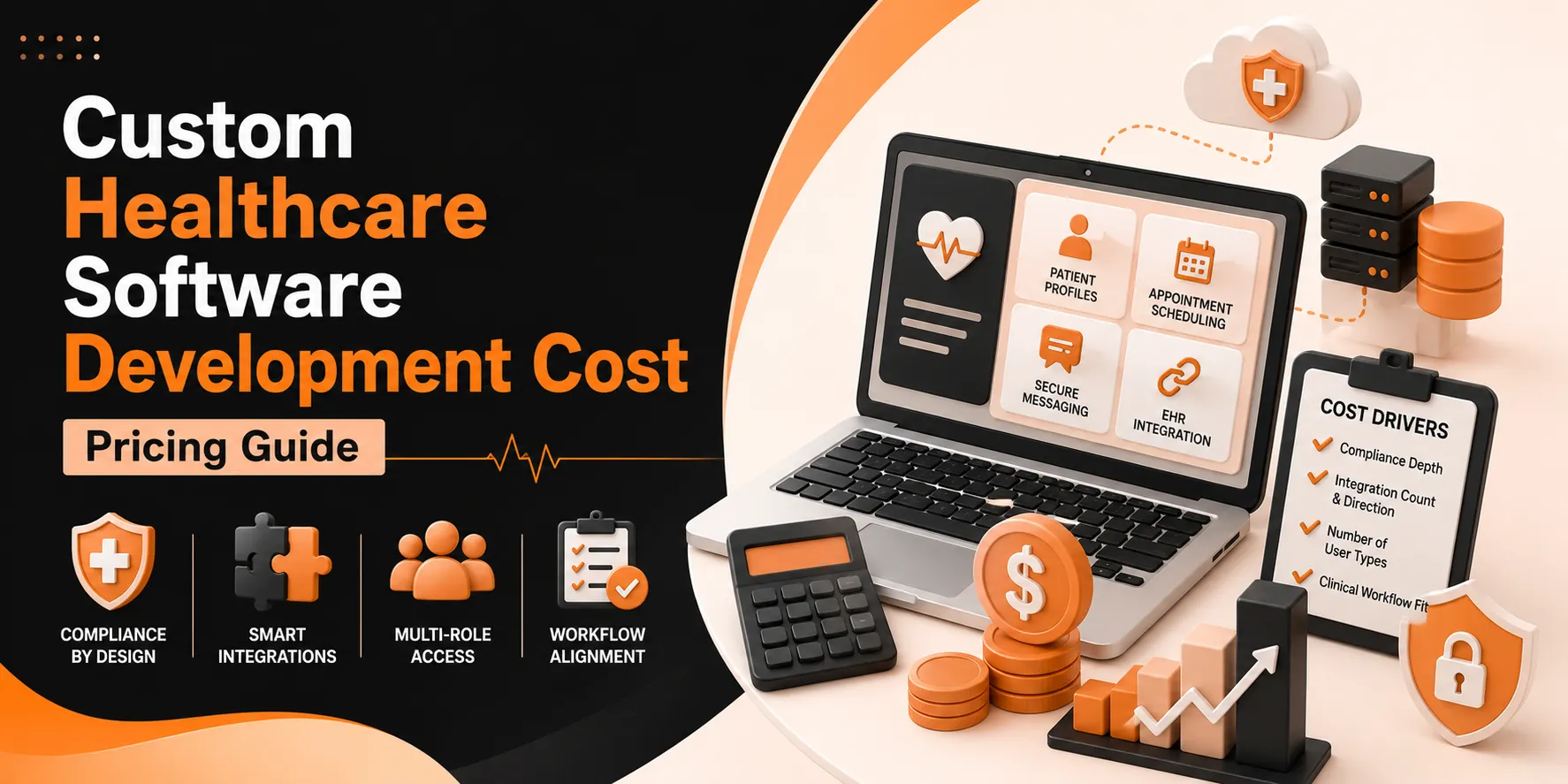
Four things decide your custom healthcare software cost, and only one shows up on a feature list. Sort them out before you request proposals, and you get a budget you can defend.
1. Compliance Depth
- Published guidance puts HIPAA at 15 to 30% of budget when built in early
- Adding it after launch costs two to three times more
- Your HIPAA compliance cost is a design decision, not a later task
2. Integration Count and Direction
- Reading data from an EHR costs less than writing back
- One EHR costs less than three
- Each extra connection adds testing and failure handling
3. Number of User Types
- Patients, clinicians and admins each need separate permissions
- Each role adds audit trails and testing
4. Clinical Workflow Fit
- Ask if anyone checked how the software fits real clinical routines
- Assuming it fits turns a launch into a rebuild
Here is what vendors leave out: the feature list is usually the smallest cost in a healthcare build. That is why healthcare app development cost works nothing like consumer pricing. Pick a Custom Healthcare Software Development Company on how early it handles compliance, not its hourly rate.

The FHIR Line Item That Does Not Buy Interoperability
Published 2026 guides quote a read-only FHIR connection at $15,000 to $30,000 and a bidirectional integration at $30,000 to $60,000. Those bands read as settled fact and are the most misread figures in any EHR integration cost estimate.
Passing a FHIR conformance test is not the same as exchanging data clinicians can use. Identifier reconciliation across systems, terminology mapping to USCDI data elements, failed response handling, and multi-site groups running different EHR versions are all real engineering hours that sit outside the quoted band.
The Question to Ask Your Vendor
Ask whether the quote covers conformance only, or data your staff can actually work from. That distance is where most EHR integration cost overruns live, and where a predictable custom healthcare software cost stops being predictable.
Why the January 2027 Deadline Changes Your Budget Math
If you sit inside a regulated payer organisation, your timeline is not yours to set. The CMS Interoperability and Prior Authorisation final rule, CMS-0057-F, requires impacted payers to implement and maintain HL7 FHIR APIs.
Impacted payers include Medicare Advantage organisations, state Medicaid and CHIP Fee for Service programs, Medicaid and CHIP managed care entities, and QHP issuers on the Federally Facilitated Exchanges. Operational provisions generally began January 1, 2026, and API requirements carry compliance dates generally beginning January 1, 2027, with exact dates varying by payer type. See the CMS fact sheet on CMS-0057-F.
For those payers, FHIR work is not a phase two item. Deferring it does not reduce your custom healthcare software cost. It compresses the same scope into a shorter window against a fixed supply of FHIR engineers.
Do Not Budget for a Rule That Is Not Law Yet
Several 2026 pricing guides tell you to budget for the updated HIPAA Security Rule as though it is law. It is not, and pricing against it inflates your estimate for nothing.
The Notice of Proposed Rulemaking reached the Federal Register on January 6, 2025, and comments closed that March. No final rule exists, and the federal agenda now targets July 2027. Build to encryption, multi-factor authentication and audit logging anyway, since enforcement already examines them. Do not let a proposed rule enter your custom healthcare software cost as a mandatory HIPAA compliance cost line.
Conclusion
The useful question was never the range. It is which line items your quote is missing. Before your next vendor call, get three answers in writing: is compliance architected or bolted on, does the integration quote cover conformance or usable data, and what does year two cost. A credible custom healthcare software cost estimate survives all three.























Sign in to leave a comment.