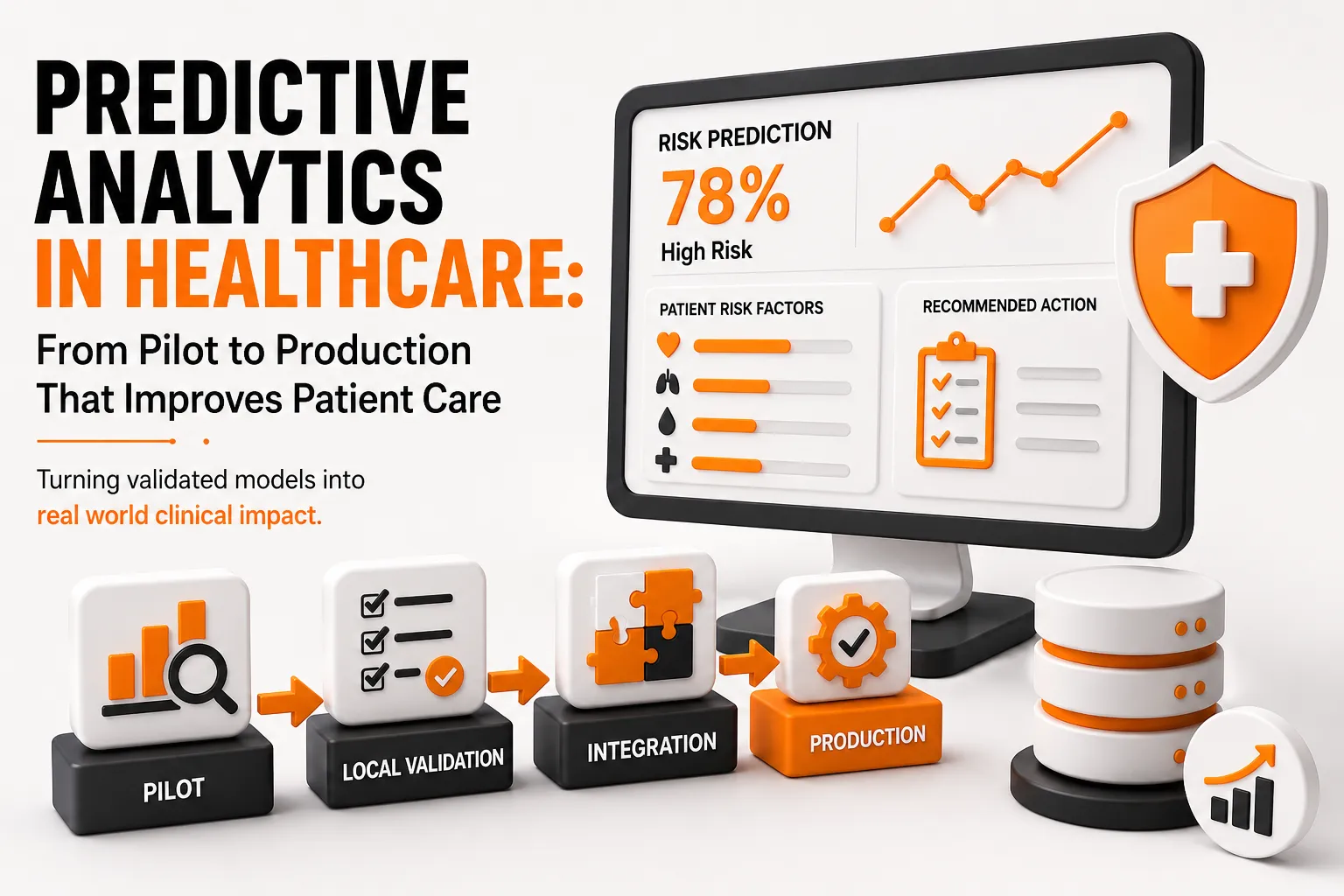

Predictive Analytics in Healthcare rarely fails during the pilot. It fails after it. Most health systems can show a model that scored well on historical data. Far fewer have one running in live clinical workflow a year later. This covers what changes between pilot and production, not what predictive analytics is.
Why Predictive Analytics Pilots Get Stuck Before Production
The model is rarely what breaks. Ask how to implement predictive analytics in healthcare and the honest answer starts with ownership, not architecture. Most predictive analytics implementation challenges in healthcare are organizational.
A pilot has a data science sponsor. Production needs a clinical owner accountable for acting on the score. It needs an insertion point, because a prediction in a dashboard nobody opens changes nothing. It needs a financial owner holding the year two budget line. And it needs a retraining plan, or the model decays quietly. Healthcare predictive analytics programs break at this operating layer, which is why Predictive Analytics in Healthcare stalls so often.
The Validation Step That Can Make or Break Your Model
A model validated on someone else's population is not validated for yours. Predictive modeling in healthcare depends on local context, so an approach that scores well in the source dataset can misfire on your case mix.
The clearest caution on record is the JAMA Internal Medicine external validation of a widely deployed proprietary sepsis prediction model, which found real world performance well below vendor reported figures. Run a silent trial on historical data, then a shadow period against live cases, before a clinician sees a score. Predictive Analytics in Healthcare earns clinical trust here or never.
Move Predictions Into Real World Clinical Use
Once a model holds up locally, healthcare predictive analytics becomes an integration project, not a modeling project. The question is no longer accuracy. It is where the score appears and what a clinician does next.
Where the Prediction Surfaces in Clinical Workflow
A SMART on FHIR application can launch inside the chart. CDS Hooks can fire the prediction at an order or encounter trigger. Population level risk belongs on a worklist, point of care risk closer to the flowsheet. Most predictive analytics use cases in healthcare succeed or fail on that choice.
The Healthcare Data Analytics Pipeline Behind the Score
The healthcare data analytics pipeline underneath carries equal weight, which is where teams bring in healthcare data analytics implementation support. Treat how to deploy predictive analytics in healthcare as a workflow question first, because Predictive Analytics in Healthcare pays back only inside an existing routine.
Regulatory Expectations for Production-Ready Models
A pilot carries almost no disclosure obligation. A production model inside certified health IT is different, and this is where AI predictive analytics in healthcare raises the documentation bar.
ONC HTI-1 Source Attribute Requirements
Under the ONC HTI-1 final rule, certified health IT developers offering Predictive Decision Support Interventions must publish source attributes covering training data, intended use, and validation.
When Clinical Decision Support Becomes a Regulated Device
FDA guidance on Clinical Decision Support Software separately marks when a tool becomes a regulated medical device, turning on whether a clinician can independently review its basis. Decide which side of that line your Predictive Analytics in Healthcare program sits on before go live.
Keeping Your Predictive Model on Track After Go Live
Production is a standing cost, not a launch cost. Budget for drift monitoring, retraining triggers, a model inventory with a named owner, and accountability under a governance group. Mature predictive modeling in healthcare funds this from the start. Across the predictive analytics in healthcare industry, teams that scale pay for year two before year one ships.
Conclusion
The distinction between pilot and production comes down to issues of ownership, workflow integration, and documentation. Accuracy of the model is the easy part. Bacancy Technology works with healthcare providers specifically at this stage, taking validated models and turning them into production systems used by healthcare practitioners. If getting predictive analytics to move from pilot to production is one of your goals, then consider Predictive Analytics in Healthcare as an operational choice, not a scientific one.

























Sign in to leave a comment.