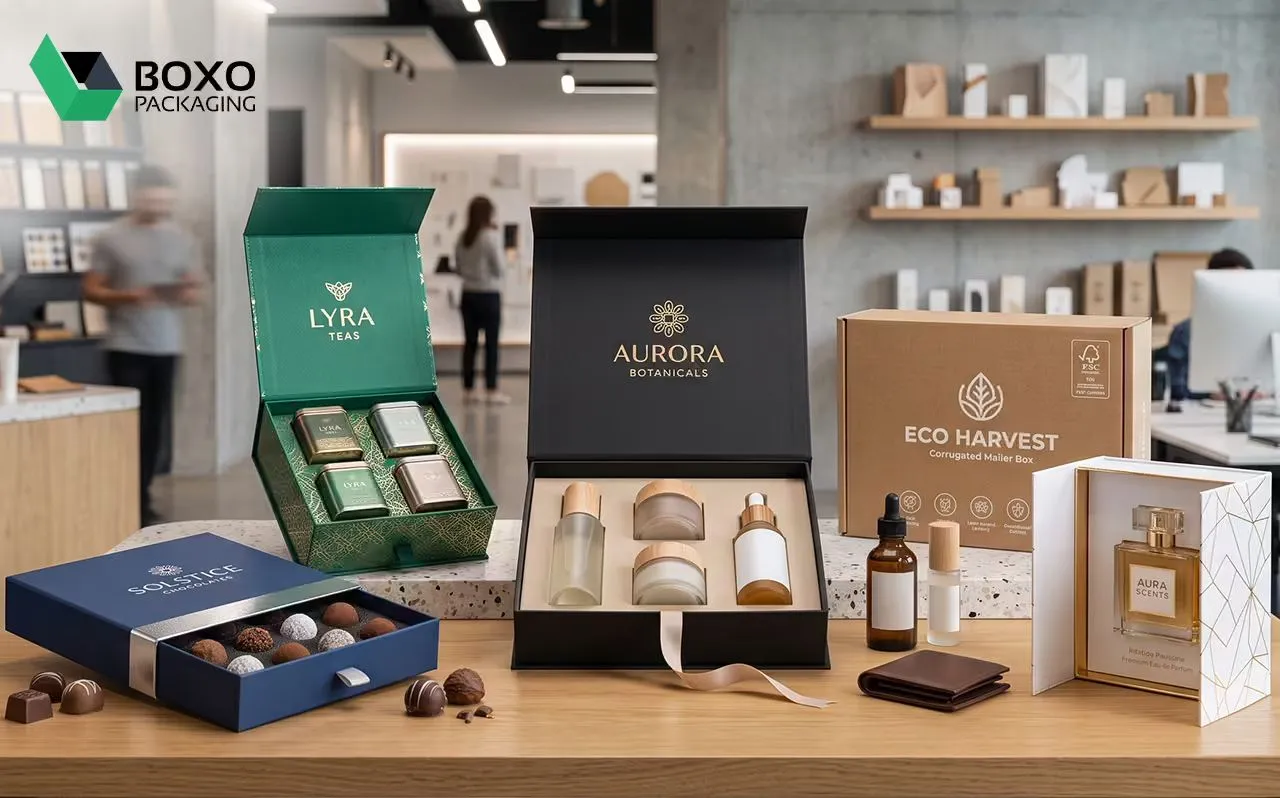

Buying packaging outright used to be the only option, design it, order it, own the inventory risk if demand shifts. That's changing. Customized Packaging is increasingly available as a service now, not just a product, letting brands access design, sustainable materials, and logistics support on a subscription or pay per use basis instead of committing to fixed contracts and owned infrastructure. Towards Packaging's market research on this shift, known as Packaging as a Service or PaaS, found the B2B segment contributed 62 percent of market share in 2025, with recyclable packaging formats accounting for 42 percent of demand within that model. That's a genuinely different way of thinking about packaging procurement than most brands grew up with. Boxo Packaging has watched interest in flexible, service based packaging arrangements grow steadily, especially among smaller brands wary of tying up capital in packaging inventory they might need to redesign in six months anyway.
Why Is Customized Packaging Shifting Toward a Service Model Instead of a One Time Purchase?
Because owning packaging infrastructure, design capability, and inventory outright ties up capital that smaller and mid sized brands increasingly want flexibility around instead. Customized Packaging delivered as a service removes a lot of that upfront commitment.
Packaging Labelling's coverage of B2B PaaS explains the shift plainly, the traditional model required significant upfront investment in infrastructure, machinery, and labor, which limited a company's ability to adapt quickly to market changes, while PaaS outsources the entire packaging lifecycle to specialized providers instead.
That lifecycle coverage is broader than people might assume too. The same coverage describes PaaS providers handling design, sustainable material sourcing, smart automation, compliance, and logistics together, essentially becoming an extension of a brand's operations rather than just a vendor filling a purchase order.
Towards Packaging's broader B2B packaging market research adds useful context on where this demand concentrates. Tertiary, transport focused packaging held 55 percent share of the B2B packaging market in 2024, while pharmaceuticals and cold chain logistics are projected to grow fastest, both categories where flexibility and compliance support genuinely matter more than owning fixed infrastructure.
Does Renting Customized Packaging Through a Service Model Actually Save Money Compared to Owning It?
For the right business profile, genuinely yes, mainly by converting a large upfront capital cost into a smaller, predictable recurring expense. Customized Packaging delivered as a service shifts financial risk away from the brand and onto the provider managing infrastructure and inventory.
Real industry movement backs up how seriously this shift is being taken. Yahoo Finance's coverage of the PaaS market notes Saica Paper launched an entirely recycled paper product line for corrugated board customers in June 2025, part of a broader wave of providers building sustainability directly into service based packaging offerings rather than treating it as a separate add on.
That kind of investment only makes sense if demand for the service model is real and growing, which lines up with the broader packaging design services market being projected to reach 30.38 billion dollars by 2034, according to the same coverage, a category increasingly delivered through flexible engagement models rather than one off design contracts.
The tradeoff worth understanding is control. A brand outsourcing its packaging lifecycle gains flexibility but gives up some of the direct oversight that owning the process outright would provide, a balance that makes more sense for a fast scaling brand than for one with highly specific, stable production needs.
A few reasons customized packaging is moving toward service based delivery:
- Converts large upfront infrastructure costs into predictable recurring expenses
- Gives smaller brands access to design and compliance expertise without hiring in house
- Built in sustainability sourcing reduces the burden of vetting materials independently
- Scales up or down more easily than owned packaging infrastructure allows
Where Does Gable Packaging Actually Get Tested for Real World Handle Strength?
At the handle attachment points specifically, which is where nearly every failure actually happens rather than in the flat paper walls themselves. Gable Packaging depends entirely on its built in handle holding up under real carrying weight, and that's exactly where structural testing concentrates.
Nanwang Paper Packaging's testing research explains this directly, the handle represents a customer's complete trust in a bag or box's strength, which is why testing focuses intensely on the handle itself and its attachment points, the most common points of failure in practice.
That testing gets genuinely rigorous. The same research describes pulling the handle and the box body in opposite directions on a tensile tester, not just to break the handle, but specifically to test whether the adhesive bonds hold and whether the perforations tear under real load, since either failure point can compromise the whole structure.
Drop testing plays a role here too, simulating what happens when a loaded gable box or bag actually gets carried and occasionally dropped. Nanwang's methodology involves dropping loaded samples from a full meter onto a hard surface in three orientations, base, side, and corner, to replicate realistic mishandling during actual use.
Does the Paper Weight of a Gable Box Actually Determine How Much It Can Safely Carry?
Not on its own, which surprises a lot of people sourcing packaging for the first time. Gable Packaging strength depends far more on construction quality than on the raw paper weight listed on a spec sheet.
Paperindex's material research makes this point directly, GSM tells you mass per area, but it doesn't tell you how the finished bag or box actually handles loads, moisture, or rough handling in practice, and construction, specifically handles, base seams, and adhesive, is where most failures actually happen, not the paper walls themselves.
LiPack's comparative testing research backs this up with a concrete example, noting the lighter of two tested bags actually outperformed a heavier competitor because of better fiber quality and tensile properties, not because of raw paper weight, a distinction that directly challenges the assumption that heavier paper automatically means stronger packaging.
Tensile strength testing for handles and load bearing seams typically follows standardized methods like TAPPI T494, according to LiPack's research, giving manufacturers a consistent way to compare actual carrying performance across different paper stocks rather than relying on GSM numbers alone.
What Weight Standard Should a Custom Gable Box Actually Be Built to Meet?
It depends heavily on the product category and how premium the brand positioning needs to feel, not a single universal number. Gable Packaging built for luxury retail faces a notably higher bar than packaging meant for lighter, everyday bakery or gift items.
LiPack's research notes luxury brands often require their shopping bags to carry at least 15 kilograms without losing their premium look or structural integrity, a meaningfully higher bar than a standard bakery gable box would ever need to meet for a pastry or small gift item.
That distinction matters directly for anyone specifying a gable box's construction. Overbuilding a bakery box to luxury handle standards adds unnecessary cost, while underbuilding a luxury retail gable box to bakery standards risks exactly the kind of visible failure that damages a premium brand's credibility at the worst possible moment, in front of the customer.
Boxo Packaging works through this exact calibration with clients regularly, matching handle and construction specifications to the actual product weight and brand positioning rather than defaulting to a generic standard that either overspends or underdelivers.
Bringing Customized Packaging and Gable Packaging Together
Customized Packaging and Gable Packaging intersect at a point worth remembering, whether packaging arrives through a traditional purchase or a flexible service model, and whatever shape it takes, it still has to hold up under real handling conditions once it leaves the design phase behind.
A brand exploring a Packaging as a Service arrangement for its gable box program still needs the same underlying construction quality question answered, does the handle attachment actually meet the carrying weight the product demands, regardless of who's managing procurement and logistics behind the scenes.
Whether it's a growing brand testing a service based packaging model to stay flexible, or a bakery specifying handle strength for a gable box carrying a genuinely heavy gift basket, the fundamentals stay the same, match the packaging investment and the structural spec to what the actual product and business model require. Teams like Boxo Packaging tend to walk through both the procurement model and the construction spec together, since getting one right without the other still leaves real risk on the table.





















Sign in to leave a comment.