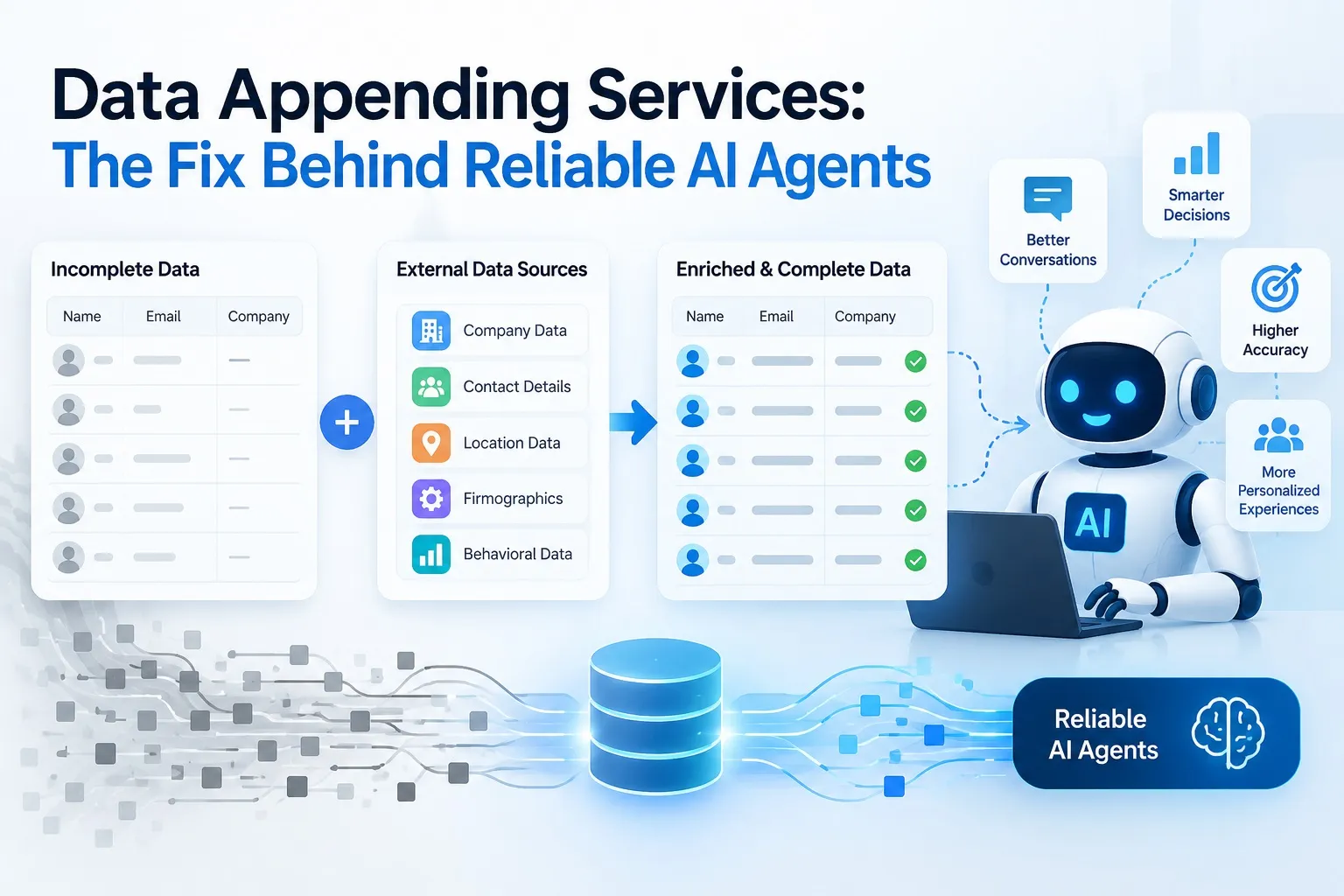

An agent tells a sales rep that a 4,000-person manufacturer is a startup and routes it to the self-serve tier. The model did nothing wrong. The record it read had an empty employee-count field, an industry code inherited from a 2019 web form, and no parent-company link. Data appending services exist for exactly this failure, and they rarely appear in the AI budget.
Enterprises spend heavily on model selection and orchestration while the records feeding those models stay half-filled. Gartner expects organizations to abandon 60% of AI projects through 2026 for want of AI-ready data. The word "ready" hides the real work. Readiness is not a pipeline or a governance charter. It is whether the individual fields an agent reads actually contain values, and whether those values are current enough to act on.
Why a Blank Field Behaves Worse Than a Wrong One
A wrong value gets caught. Someone notices that a hospital is tagged as a retailer and files a ticket. An empty value passes through every validation layer built for accuracy, because nothing about it looks incorrect.
Language models make this worse. Faced with a missing attribute, the system infers one from surrounding context and states the inference in the same confident register as a retrieved fact. The record said nothing about revenue band, so the agent reasoned from the company name and the email domain, then wrote a recommendation as though the number came from the database. Nothing in the output signals which parts were read and which were guessed.
The asymmetry shows up in testing too. Quality assurance suites check that values conform to expected formats and ranges, so a null sails through while a malformed entry gets rejected. Coverage tests that count populated fields per decision path are rare, which is why the defect surfaces in production, inside an answer a customer already received.
What Data Appending Services Actually Add
Appending attaches verified attributes to records you already own, matched against external and internal reference sources. The work is narrow by design: identify the fields a specific decision requires, then fill those fields and leave the rest alone.
Four categories cover most enterprise demand:
- Firmographic attributes: employee count, revenue band, industry classification, corporate hierarchy, and location roll-ups that determine segment and routing.
- Contact attributes: verified business email, direct-dial numbers, job function and seniority mapped to a standard taxonomy, plus role changes since last contact.
- Technographic attributes: the platforms and infrastructure a company runs, which shape qualification for integration-dependent offerings.
- Intent and engagement signals: research behavior and topic activity, useful for prioritization but the shortest-lived of the four and the most easily over-trusted.
Reverse appending deserves separate mention. Given a phone number or a physical address, the process returns the identity attributes attached to it, which resolves the duplicate records that accumulate when the same buyer arrives through three channels under three spellings.
Start inside the building before buying anything. Support tickets, contract records, billing systems, and product telemetry usually hold attributes the CRM never received, and an internal append costs nothing in licensing and carries no third-party consent exposure. A services company that discovers its own provisioning database already knows the installed product set has just filled a technographic field it was about to purchase. External sources should cover what the enterprise genuinely does not hold.
The distinction between appending and cleansing matters for scoping. Cleansing corrects and standardizes what a record already holds. Appending supplies what it never captured. A record can pass every cleansing rule, contain no errors, and still be useless to an agent that needs a firmographic attribute nobody ever collected.
Where Enrichment Changes an Agent's Answer
Lead routing is the clearest case. Territory and tier assignment depend on employee count, revenue, and corporate parent. When those fields are blank, routing logic falls back to defaults, and the enterprise opportunity lands in the self-serve queue. Appending restores the inputs the rule was written for.
Service agents fail differently. A support agent answering an entitlement question needs the contract tier, the installed product set, and the account hierarchy. Missing hierarchy links are why an agent tells a subsidiary it has no active contract while the parent holds an enterprise agreement.
Pricing and eligibility carry the highest cost of error. Discount bands, regulatory eligibility, and credit terms key off attributes that must be both present and current. An agent quoting from a stale revenue band produces a number the business has to honor or retract, and both outcomes cost something.
Retrieval-augmented systems inherit the same weakness. A vector index over incomplete records returns the closest available text, which reads as authoritative regardless of whether the underlying record held the attribute. Enrichment before indexing changes what the retrieval layer has to work with.
Governing Sources, Consent, and Provenance
Appended data arrives with obligations attached. Under the General Data Protection Regulation (GDPR), personal data acquired from a third party triggers notification duties toward the individual, and the lawful basis claimed by the original collector does not automatically extend to a new controller with a different purpose. State privacy laws in the United States add their own consent and opt-out mechanics.
Three controls carry most of the weight:
- Record provenance per field, not per batch. Store the source, collection date, and stated lawful basis alongside each appended attribute. Batch-level lineage collapses the moment a regulator asks about one record.
- Apply suppression before the append, not after. Opt-outs, do-not-contact flags, and deletion requests have to filter the input set. Enriching a suppressed record then removing it later still counts as processing.
- Bound retention to field volatility. Attributes that decay quickly should expire on a schedule rather than persist indefinitely because no rule required their removal.
Sector rules narrow the field further. Health, financial services, and public sector programs restrict which external sources qualify, and a partner unable to name and document its sources per attribute is not a partner those programs may use. Ask any prospective data appending company to demonstrate field-level lineage on a live sample rather than describe it in a questionnaire response.
Running an Appending Program That Holds Up
The sequence below reflects how successful programs sequence the work.
- Name the decision first. List the automated decisions in scope, then the fields each one reads. This produces a short, defensible list of attributes rather than an open-ended enrichment wish.
- Measure the gap in those fields only. Fill rate, staleness, and conflict rate on the decision-critical attributes give you a baseline worth reporting.
- Set match logic before selecting a vendor. Deterministic matching on stable identifiers, probabilistic matching with a documented confidence floor, and an explicit rule for what happens below that floor.
- Pilot against a labeled holdout. Take several hundred records whose true values are independently known, run the append blind, and measure field-level accuracy against the truth set.
- Resolve conflicts by policy. When an appended value contradicts an existing one, decide in advance which source wins, and log the override.
- Schedule refresh by decay rate. Contact attributes and job titles move fastest; industry classification and corporate hierarchy move slowly. One cadence for all fields overpays for stability and underpays for volatility.
Teams that choose to outsource data appending gain access to source coverage and match infrastructure that rarely justifies in-house construction. What stays in-house is the decision list, the confidence floor, and the acceptance test. Handing all three to a vendor removes the only means of knowing whether the work succeeded.
Measuring Whether the Append Paid for Itself
Match rate is the number most providers lead with, and on its own it proves very little. A 95% match rate on attributes nobody uses is expensive noise, while a 60% match rate on the field that governs routing may be the highest-value work in the quarter.
Report three measures instead:
- Field-level accuracy against a holdout: measured on the decision-critical attributes, sampled quarterly rather than certified once at onboarding.
- Decision lift: the change in correct routing, correct entitlement, and correct pricing after enrichment, which is the only figure that connects appending to money.
- Escalation and override rate: how often humans reverse an agent's decision, which typically falls as fill rate rises and is the earliest signal that quality has drifted.
MIT's research on enterprise deployments found 95% of GenAI pilots produced no measurable return, with brittle workflows and weak context handling cited ahead of model quality. Context is largely a function of what the record contains. A pilot that stalls on incomplete data will stall again on the next model, because the missing field was never a modeling problem.
Set the acceptance threshold before the pilot rather than after seeing results. A vendor reporting 88% field-level accuracy has delivered either a strong outcome or an unusable one, and only the decision tells you which: an 88% accurate revenue band is fine for campaign segmentation and unacceptable for automated credit terms. Write the required accuracy next to each field on the decision list, then hold the sample against it.
Data append services also earn their keep outside AI. Deduplication improves, campaign targeting narrows, and reporting stops double-counting the same buyer under three identities. Those returns arrive whether or not the agent programs proceed on schedule.
The Cheapest Line in the AI-Readiness Budget
Enrichment competes for funding against model licensing, orchestration platforms, and integration work, and it loses on visibility every time. It also costs a fraction of what it protects. An agent program with a seven-figure budget riding on records where a third of the decision-critical fields sit empty is a spending decision no one would defend if stated plainly.
Start with the decisions, not the database. Identify what the agent must read to be right, measure how often those specific fields are populated and current, and fix that set. Governance, refresh cadence, and vendor selection all follow from that list. Without it, enrichment becomes an unbounded purchase of attributes nobody validates and no decision consumes.
Reliable agents rest on records that answer the questions the agent asks. Data appending services close the specific gaps that make automated decisions wrong, and they do it at a cost that fits inside the rounding error of a model budget. The right partner helps enterprises scope, govern, and measure record enrichment programs against the decisions they support rather than the volume they process. Name the fields your agents depend on, test how many are populated today, and treat that number as the honest measure of AI readiness. The organizations that fix the record will get answers they can act on; the ones that keep tuning the model will keep getting confident guesses.



















Sign in to leave a comment.