
A blind reader in the European Union can now expect to buy the same title, on the same day, as everyone else. That expectation is not a courtesy. Since June 28, 2025, the European Accessibility Act (EAA) has made it a legal requirement for ebooks sold in the EU. Yet there are very few published works that have ever been produced in a format people with print disabilities can actually read. The gap between those two facts is where most conversion projects quietly fail.
Publishers who treat ebook conversion services as a line item, a cheap export from print files, inherit the problem rather than solve it. The output looks like an ebook. It opens, it shows pages, it passes a glance. Then a screen reader hits it, or a phone tries to reflow it, or a distributor rejects its metadata, and the file turns out to be a picture of a book rather than a book. Conversion done properly is a content-modeling job, not a save-as.
What Actually Happens During Ebook Conversion Services
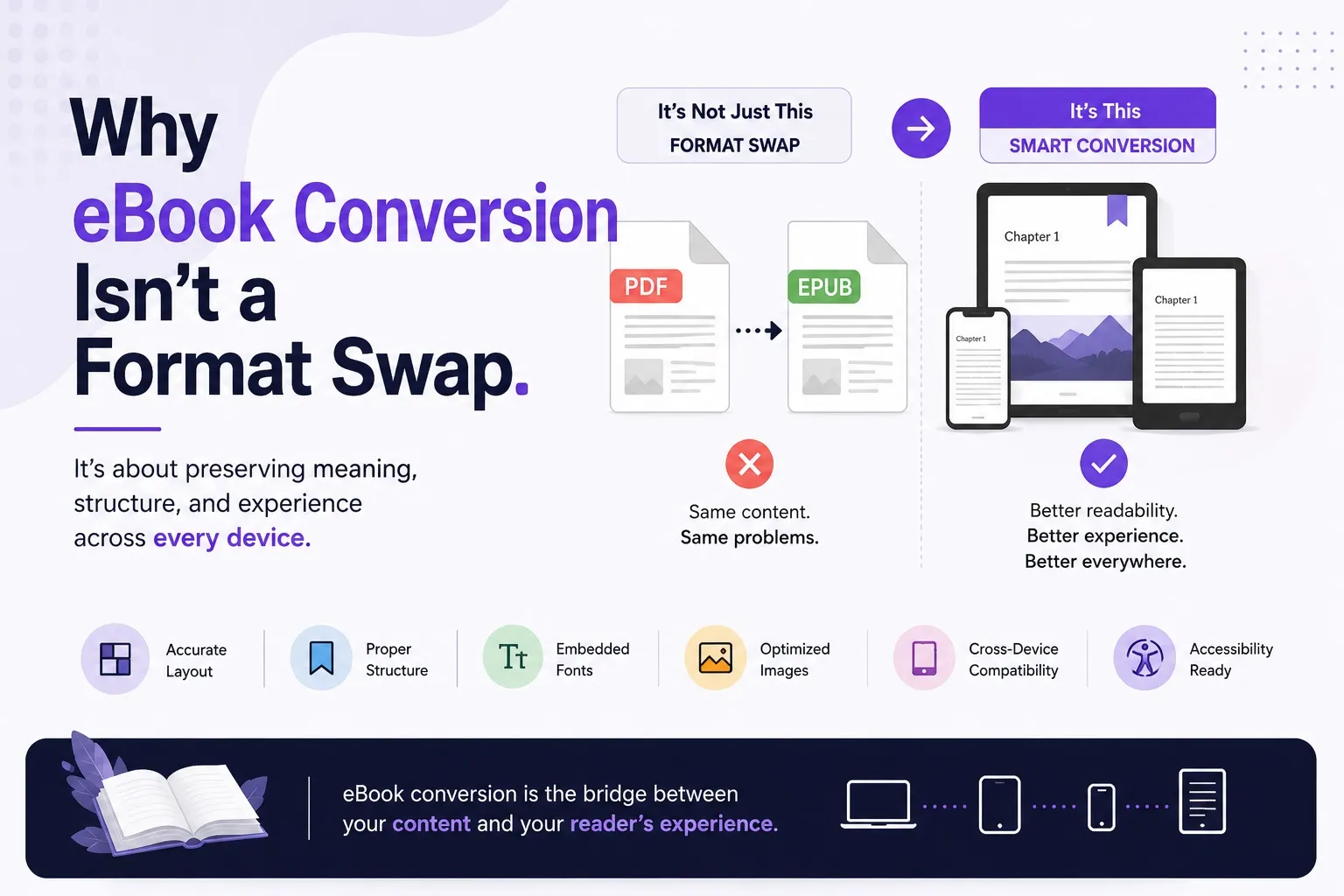
Strip away the marketing and two very different processes hide under the same phrase. The first flattens a print layout into a fixed digital page, often a wrapped PDF or an image-based file. The second rebuilds the manuscript as structured content: real headings, a defined reading order, tagged lists, described images, and machine-readable navigation.
Only the second produces a file that behaves like an ebook across devices. The format most conversion targets, EPUB (Electronic Publication), is not a page format at all. It is a package of HTML, CSS, and metadata, closer to a small website than to a printout. When ebook conversion services do the work well, they are writing that structure by hand or validating it carefully, deciding what is a chapter, what is a heading, what is a caption, and what order a reading system should follow.
Skip that step and the damage is invisible until someone depends on it. A sighted reader scrolling on a large tablet may never notice. A student using text-to-speech, a librarian filtering a catalog, or a retailer's ingestion pipeline notices immediately. The structure is the product. The visible page is a byproduct.
Consider a two-column academic page flattened straight from print. A screen reader, following the raw order in the file, may read the first line of the left column, then the first line of the right, then back again, turning an argument into noise. The words are all present. The meaning is gone, because the reading order was never captured. A converted file records that order deliberately, so software follows the sequence a human intends rather than the coordinates ink happened to land on.
Reflowable Structure Is the Real Deliverable
Fixed-layout files freeze text and images onto a page, like a comic or a heavily designed cookbook. Reflowable files let the text find its own shape: the reader changes the font, the size, the spacing, the contrast, and the words rearrange to fit a watch face or a widescreen monitor without breaking.
That flexibility is the whole point of a digital book, and it is exactly what a format swap destroys. Export a print PDF and you tend to get fixed pages with the reading order scrambled, footnotes stranded, and headings that are simply large bold text rather than tagged structure. A reading system cannot navigate that. Neither can assistive technology.
Reflowable EPUB earns its keep through concrete features:
- Adjustable Typography: Font family, size, line spacing, and contrast controlled by the reader, not baked into the page.
- Logical Reading Order: Content flows in the sequence a human would read it, so audio and navigation stay coherent.
- Semantic Markup: Headings, lists, tables, and quotations carry meaning that software can interpret.
- A Linked Table of Contents and Endnotes: Navigation that jumps to the right place instead of an approximate page.
Fixed layout still has a place for illustrated children's titles and design-driven pages. The mistake is defaulting to a frozen page because it was faster to generate, then discovering the file cannot serve most of the readers who bought it.
Reflow also decides how a book ages. Screens keep changing shape, from phones to foldables to e-ink readers with unusual aspect ratios, and a reflowable file adapts to each without new work. A fixed page designed for one screen size looks cramped or clipped on the next. The structural investment made during conversion is really an investment in every device that has not shipped yet, which is the part a per-file price tag never shows.
Accessibility Moved From Preference to Legal Baseline
The stakes here are not abstract. A considerable chunk of population worldwide lives with a vision impairment, and roughly a billion of those cases could have been prevented or remain unaddressed. Print disability reaches further still, taking in dyslexia and physical conditions that make a printed page hard to hold or turn. A book that only works for readers with perfect sight and full mobility excludes an enormous audience by design.
Regulation has caught up with that reality. The EAA now requires ebooks, ereaders, and the software around them to be accessible for products placed on the EU market. The W3C's official mapping of the Act points implementers to a clear technical target: EPUB Accessibility 1.1 together with the Web Content Accessibility Guidelines (WCAG) at Level A and AA. The requirements are specific rather than aspirational.
- Assistive technology must not be blocked, and Digital Rights Management (DRM) cannot interfere with it.
- Content structure, navigation, and reading order must be exposed to software.
- Images and non-text content need meaningful alternative text.
- Accessibility metadata must be discoverable, so a reader knows what a file supports before buying it.
- When a book carries audio alongside text, the two must stay synchronized.
Meet those criteria and a file serves screen readers, refreshable braille displays, and text-to-speech without special handling. Miss them and the title is not merely awkward; in the EU it is now non-compliant.
The 2025 Deadline Already Reshaped the Backlist
For frontlist titles, accessibility can be built into production. The harder question is the backlist, the thousands of files a publisher already owns. Many of those were produced years ago as quick exports, and they do not meet the current standard. The EAA does not grandfather them in. A backlist title still selling in the EU has to comply.
That turns a compliance date into an inventory audit. Every file has to be assessed: which ones carry real structure, which ones are image-only PDFs pretending to be ebooks, and which ones need full remediation. The World Health Organization also puts a figure on the cost of exclusion, estimating the global productivity loss from unaddressed vision impairment at roughly USD 411 billion a year. The economic argument for accessible content ran ahead of the legal one.
Retailers and aggregators have started enforcing the standard at ingestion, checking accessibility metadata before a title goes live. A file that once passed now bounces back. Publishers who invested in structure during the original conversion face a metadata and validation task. Those who bought the cheapest possible export face a rebuild, title by title, often against a distributor's deadline rather than their own.
The scale of that work depends entirely on how the files were made in the first place. A backlist built on structured EPUB can often be brought into compliance by adding or correcting accessibility metadata and running validation. A backlist of image-based exports has no structure to correct, so each title effectively returns to the start of the conversion process. The decision made years ago, to swap or to convert, sets the size of the bill that arrives now.
Files You Reuse, or Files You Rebuild Forever
Future-proofing sounds like a slogan until you count how often a single book gets reprocessed. A well-structured source file feeds an EPUB, an audiobook script, a large-print edition, a print-on-demand PDF, and whatever format a new device demands next year. Each output draws from the same clean structure. That is single-source publishing, and it only works when the underlying file carries real semantics.
A flattened export gives none of that. Because the structure was never captured, every new requirement starts close to zero. A new accessibility rule means re-tagging. A new retailer's specification means reconversion. An audio edition means someone reconstructs the reading order that the original conversion threw away. The cheap file is not cheap; its cost is deferred and paid repeatedly.
This is where the difference between a swap and a conversion compounds. Clean semantic markup, complete metadata, validated navigation, and described images cost more once. A picture-of-a-book costs less once and more forever, because the content trapped inside it cannot be reused without extracting and rebuilding it. Reliable ebook formatting services treat the structured file as a durable asset, not as a disposable deliverable aimed at a single store.
How to Vet Ebook Conversion Companies
Price per file is the wrong first question, because it hides what you actually receive. A useful evaluation looks at the artifact handed back and whether it holds up to scrutiny. When comparing ebook conversion companies, weigh a few practical signals.
- Validation Evidence: Ask whether files pass EPUBCheck and an accessibility evaluation, and ask to see the report, not just a claim.
- Accessibility Depth: Confirm that alternative text, reading order, and accessibility metadata are produced as standard rather than sold as an upgrade.
- Format Range: A serious partner handles reflowable and fixed-layout EPUB, source formats such as Word, HTML, and QuarkXPress, and legacy scanned material.
- Backlist Remediation: Check for a repeatable process to audit and fix existing files at volume, since that is where most of the current pressure sits.
- Quality Control: High accuracy on complex elements like tables, equations, and footnotes separates careful vendors from bulk converters.
The best ebook conversion services will talk about structure, standards, and reuse before they talk about turnaround. If a quote focuses only on speed and cost per title, it is describing a format swap, and the file you get back will reflect that.
Professional providers approach conversion as content engineering, building structured, standards-aligned files rather than disposable exports. Explore accessible ebook conversion services to see how structured EPUB, WCAG-aligned accessibility, and backlist remediation fit a catalog built to last. Ebook conversion services that start from structure hand back files you reuse for the next device, the next store, and the next standard, instead of a page image that gets rebuilt the moment anything changes. The question worth asking of any file is simple: when the next requirement lands, will this book adapt, or will it need to be made all over again?



























Sign in to leave a comment.