

The Data Science Definition has changed a lot over the last few years. Earlier, many people believed Data Science was only about charts, coding, dashboards, and machine learning models. Some thought it was simply a technical job where people sit in front of screens all day writing Python code while silently fighting with missing values and mysterious error messages.
Then reality arrived.
Organizations across the world started using data science for much bigger goals. Businesses wanted faster decisions. Hospitals wanted better patient support. Financial institutions wanted fraud detection. Retail companies wanted accurate forecasting. Manufacturing teams wanted predictive maintenance. Governments wanted smarter planning.
Suddenly, the Data Science Definition became much larger than analytics and machine learning alone. Today, Data Science includes business understanding, communication, ethics, project management, storytelling, cloud systems, automation, problem-solving, and decision-making. It is no longer limited to building models. It is about turning information into useful action. That is why the modern Data Science Definition matters so much in 2026.
And honestly, many people discovered this truth right after spending six hours training a model only to realize the dataset column names were incorrect.
The model was innocent.
The dataset had other plans.
Why the Data Science Definition Changed Across Industries
The old version of the Data Science Definition focused mostly on:
- statistics,
- analytics,
- reporting,
- and machine learning.
Those skills are still important. But industries now expect much more from a Data Science professional.
Organizations need people who can:
- Understand business problems,
- clean and organize information,
- explain results clearly,
- build useful systems,
- work with teams,
- and improve project success.
This shift happened because businesses realized something important:
A beautiful dashboard means very little if nobody understands what action to take.
A machine learning model with 95% accuracy also means very little if it solves the wrong problem. This is why the Data Science Definition expanded beyond analytics.
Companies no longer want only technical output.
They want useful results.
Data Science Definition and the Growth of Modern Business Needs
Modern organizations create massive amounts of information every day.
This includes:
- customer transactions,
- website activity,
- delivery records,
- hospital reports,
- social media interactions,
- sensor readings,
- and financial operations.
Without proper analysis, this information becomes digital clutter.
Data Science helps turn raw information into decisions.
Earlier, many teams stopped at analysis. Today, organizations expect the process to continue all the way to action. That is why the modern Data Science Definition includes communication, operations, automation, and business thinking.
Data Science Definition and the Rise of Problem Solving
One major reason the Data Science Definition expanded is because organizations now care more about solving problems than simply generating reports.
For example:
A retailer does not only want sales charts.
The retailer wants answers such as:
- Which products may sell out next month?
- Which customers are likely to leave?
- Which locations are underperforming?
- Which marketing campaigns bring the best results?
- A hospital does not only want patient data.
It wants:
- faster scheduling,
- improved resource planning,
- and better treatment support.
A logistics company does not only want delivery records.
It wants:
- route optimization,
- delay prediction,
- and lower transportation costs.
This is where modern Data Science becomes important.
The work is no longer only technical.
It becomes strategic.
Data Science Definition and Communication Skills
One of the biggest surprises for many beginners is this:
A large part of Data Science involves communication.
A professional may build an excellent model, but if the explanation is confusing, the project may fail.
This is why communication is now part of the modern Data Science Definition.
Teams must explain:
- what the data means,
- why the result matters,
- what action should follow,
- and what risks exist.
For example:
Weak explanation: The model achieved 91% accuracy.
Better explanation: The model can help identify customer churn earlier, allowing the company to improve retention strategies.
The second explanation connects technical work with business value. That connection is now essential in Data Science.
Data Science Definition and Data Cleaning Reality
Many people imagine Data Science as exciting machine learning experiments.
Then they open a real dataset.
Suddenly:
- dates are missing,
- columns are duplicated,
- values are inconsistent,
- and half the rows look like they survived a natural disaster.
This is where reality begins.
A large portion of every data science project involves data cleaning.
In many projects:
- 60% to 80% of the time is spent preparing data,
- not building models.
Here is a simple project effort breakdown:
- Data Cleaning ██████████████
- Data Analysis ████████
- Model Building █████
- Visualization ██████
- Reporting ███████
This is why the modern Data Science Definition also includes:
- data preparation,
- quality checks,
- database handling,
- and workflow organization.
Without clean data, even advanced algorithms struggle.
Sometimes the model performs badly not because the algorithm failed, but because the dataset quietly decided to create chaos.
Data Science Definition Beyond Machine Learning
Machine learning remains an important part of Data Science, but it is no longer the only focus.
Modern organizations also need:
- cloud systems,
- data engineering,
- automation pipelines,
- API integration,
- dashboard creation,
- and real-time analytics.
A company may have a strong machine learning model, but if the system cannot process incoming information quickly, the project may still fail.
That is why the Data Science Definition now includes technical infrastructure as well.
A complete datascience workflow may involve:
- data collection,
- storage systems,
- ETL pipelines,
- model deployment,
- monitoring,
- and reporting.
This broader role explains why companies increasingly search for professionals who understand multiple parts of the process.
Data Science Definition and Project Success
The modern Data Science Definition strongly connects with project success.
A successful data science project usually follows these steps:
- Define the business problem.
- Collect relevant information.
- Clean and organize the data.
- Analyze patterns.
- Build and test models.
- Measure performance.
- Explain results clearly.
- Support business decisions.
Projects often fail when one of these steps is ignored.
For example:
- unclear goals,
- poor data quality,
- weak communication,
- or unrealistic expectations.
This is why organizations now want professionals who can manage the complete process instead of only building models.
Data Science Definition and Metrics That Matter
Metrics are a major part of modern Data Science.
Organizations need measurable results.
For classification tasks, common metrics include:
- accuracy,
- precision,
- recall,
- F1-score.
For regression tasks:
- MAE,
- RMSE,
- and R².
A simple fraud detection example helps explain this.
Suppose:
- 1,000 transactions are analyzed,
- 120 are fraud cases,
- 90 fraud cases are detected correctly,
- 30 normal transactions are flagged incorrectly.
Precision Calculation
[ Precision = \frac{90}{90+30} = 75% ]
Recall Calculation
[ Recall = \frac{90}{120} = 75% ]
These numbers help teams evaluate whether the model is useful. But the most important metric is usually business impact. Project Metrics Importance A project that improves decision-making creates long-term value. A project with beautiful charts but no useful action may become decorative office wallpaper.
Data Science Definition and Ethical Responsibility
Another reason the Data Science Definition expanded is the growing importance of ethics and responsible AI.
Organizations now think carefully about:
- data privacy,
- fairness,
- bias,
- transparency,
- and security.
A model may produce strong predictions, but if the process is unfair or unsafe, the project becomes risky.
This is especially important for industries such as:
- healthcare,
- finance,
- insurance,
- education,
- and public services.
Modern Data Science professionals must think beyond algorithms.
They must also think about impact.
Data Science Definition and Career Opportunities
As the role expands, career opportunities continue to grow.
Professionals with Data Science skills may work as:
- Data Scientists,
- Data Analysts,
- Machine Learning Engineers,
- Business Intelligence Analysts,
- Data Engineers,
- AI Specialists,
- Analytics Consultants,
- or MLOps Engineers.
The good news is that many backgrounds can transition into Data Science.
Common starting points include:
- engineering,
- mathematics,
- commerce,
- healthcare,
- marketing,
- economics,
- and computer science.
What matters most is:
- curiosity,
- consistency,
- and practical learning.
Data Science Definition and the Human Side of Learning
Learning Data Science can feel exciting, confusing, stressful, and rewarding at the same time.
One day everything works perfectly.
The next day:
- the notebook crashes,
- the dataset disappears,
- and the model accuracy suddenly drops for reasons nobody understands.
This happens to almost everyone.
The important thing is persistence.
The modern Data Science Definition includes patience because solving problems often takes multiple attempts.
A learner may spend hours fixing one issue and finally solve it after changing a single line of code.
That moment feels amazing. Then another error message appears immediately afterward.
This is not failure. This is simply part of the process.
Data Science Definition and the Future of Work
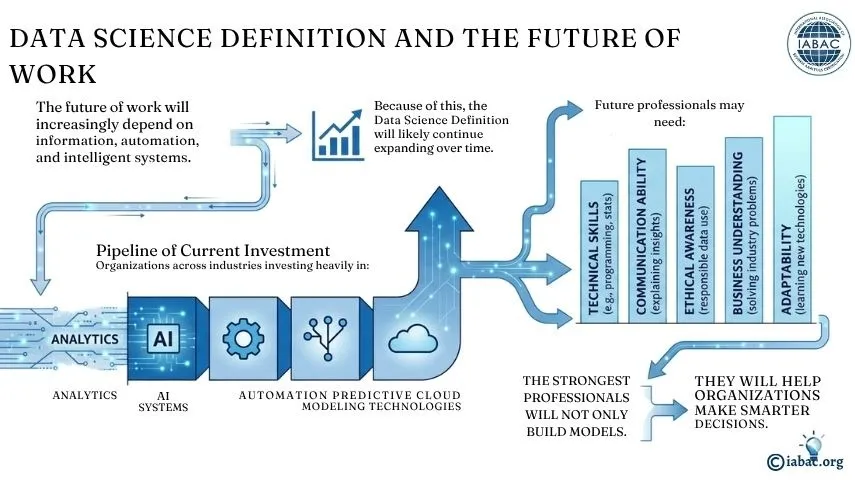
The future of work will increasingly depend on information, automation, and intelligent systems.
Organizations across industries are investing heavily in:
- analytics,
- AI systems,
- automation,
- predictive modeling,
- and cloud technologies.
Because of this, the Data Science Definition will likely continue expanding over time.
Future professionals may need:
- technical skills,
- communication ability,
- ethical awareness,
- business understanding,
- and adaptability.
The strongest professionals will not only build models.
They will help organizations make smarter decisions.
Data Science Definition Conclusion
The modern Data Science Definition has grown far beyond analytics and machine learning.
Today, Data Science includes:
- problem-solving,
- communication,
- data cleaning,
- ethics,
- automation,
- business understanding,
- project management,
- and decision-making.
Organizations no longer want only technical outputs.
They want measurable results and practical solutions.
That is why Data Science has become one of the most valuable skill areas across industries.
Whether someone is building a data science project, learning datascience, or exploring Data Science certifications, the message is clear: The role of Data Science is becoming broader, more practical, and more connected to real business needs every year. And for learners starting this journey, the IABAC website and certification pathways can provide a structured direction toward stronger skills and long-term career growth.

























Sign in to leave a comment.