
Dental tourism is not a new idea, but the way patients research it has changed. A decade ago, someone considering treatment abroad might have relied on a recommendation from a friend, searched for a clinic online, or contacted several providers individually.
Today, patients can compare treatment prices, read reviews, investigate dentists and even organise flights and accommodation from their phones. So why would someone need a dental travel coordinator?
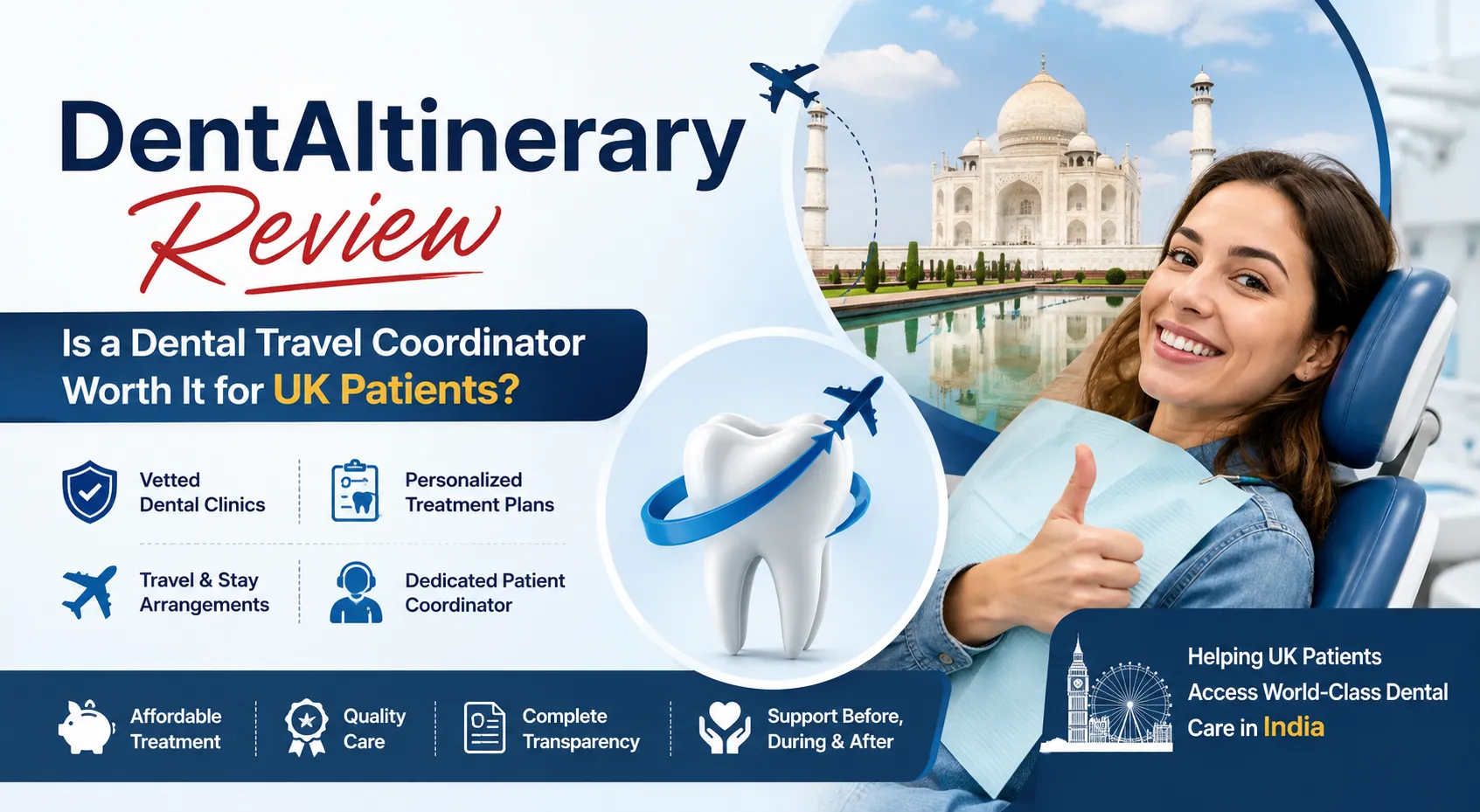
That was the question I wanted to explore when looking at DentAItinerary, a platform designed to help UK patients plan dental treatment in India.
Rather than reviewing it simply on the basis of whether Indian dentistry is cheaper, I looked at the parts of the experience that can make dental tourism complicated: clinic selection, treatment planning, pricing, travel logistics and what happens after treatment.
What Is DentAItinerary?
DentAItinerary is not a dental clinic. It describes itself as a coordination platform connecting international patients with independently operated dental clinics in India. Its model includes an initial patient assessment, clinic matching, treatment planning, quote comparison and coordination of travel-related arrangements. That distinction is important.
A dental clinic is responsible for diagnosis and treatment. A coordinator's role is to help the patient navigate the process around that treatment. For someone travelling internationally for substantial dental work, those can be two very different problems.
Why Would Someone Need a Coordinator?
Imagine receiving a recommendation for a dental clinic in Delhi.
You might still need to figure out:
- Whether the dentist is appropriate for your case
- What treatment you actually need
- Whether the quote includes all necessary components
- How long you need to stay
- Whether you need one trip or several
- Where to stay
- How to get from the airport to the clinic
- What documentation you'll receive
- What happens after you return to the UK
For a simple dental procedure, that might not justify using a coordinator.
For multiple implants, full-mouth rehabilitation or other extensive treatment, the logistics become considerably more complicated.
This is the gap DentAItinerary is trying to fill.
The Pricing Question
Cost is inevitably one of the biggest reasons patients investigate dental tourism.
DentAItinerary's current UK guidance provides indicative comparisons between Indian and UK private dental treatment. For example, it lists All-on-4 treatment at approximately £3,400–£4,800 per arch in India compared with £10,000–£18,000 in UK private dentistry. Full-mouth treatment is listed at approximately £6,200–£9,200 in India versus £20,000–£36,000 in the UK.
These are substantial differences.
But this is also where patients need to be careful.
An overseas dental quote should never be judged purely by its headline number.
The real calculation may include:
Treatment + flights + accommodation + insurance + time away from work + additional procedures + follow-up.
DentAItinerary's own cost-comparison material makes the same broader point: UK patients should compare treatment plans rather than simply comparing advertised implant prices.
That approach makes sense.
A £4,000 quote isn't necessarily better than a £5,000 quote if the cheaper option excludes important parts of the treatment.
Clinic Selection Is More Important Than Country Selection
One thing I particularly like about the concept is that it moves the discussion away from:
“Which country is cheapest?”
and toward:
“Which clinic and treatment plan are appropriate for this patient?”
DentAItinerary says its clinic-vetting approach considers factors such as dentist qualifications, clinical experience, facilities, international-patient experience and other criteria.
That doesn't eliminate the need for personal due diligence.
Patients should still ask who will perform the procedure, what qualifications they hold, what implant or restorative systems will be used, and what clinical documentation will be provided.
But having a structured starting point can make the research process less overwhelming.
What Happens When the Treatment Plan Changes?
This is probably one of the most important questions for anyone considering dental treatment abroad.
A treatment plan created before travel may be based on photographs, previous records, X-rays or other information.
Once a patient is examined in person and appropriate imaging is completed, the dentist may discover something that changes the plan.
That could mean additional treatment, a different sequence or a longer stay. DentAItinerary says its process includes a written deviation protocol intended to clarify changes to the treatment plan and associated costs before additional treatment proceeds. For patients, that is a useful concept.
Before travelling, I would want to know:
- What happens if additional treatment is recommended?
- Can I decline it?
- Will I receive a revised written quote?
- Could it require a longer stay?
- What happens if I need to return for another appointment?
These questions are relevant regardless of the country involved.
The Travel Side of Dental Tourism
Dental tourism has one major difference from ordinary tourism:
You aren't simply going somewhere to relax. You may be recovering from a procedure while you're there. That means travel planning needs to account for appointments, recovery time and potential changes to the treatment schedule.
DentAItinerary's UK patient guidance generally recommends allowing around 7–14 days for surgical dental cases, while some treatments may require a second visit after healing. The exact timeline should always be determined by the treating dental team.
Still, having someone coordinate the practical side of the trip can be useful. The company's published UK journey includes assistance with clinic matching, accommodation, airport transfers and appointment coordination.
Aftercare: The Part I Wouldn't Ignore
If there is one subject that deserves more attention in dental tourism, it is aftercare.
Saving money on treatment is only part of the equation. What happens when you return home?
If you have discomfort, need an adjustment or have another concern, you are no longer a short taxi ride from the clinic. That makes documentation particularly important. DentAItinerary says patients can receive clinical records and information about materials and treatment for continuity of care after returning to the UK.
I'd still recommend discussing follow-up arrangements with a UK dentist before travelling.
A patient should know in advance where they will go if they need an examination after returning home.
Who Is DentAItinerary Best Suited To?
Based on its current model, DentAItinerary appears most relevant to patients considering larger or more complex treatment plans.
That might include:
- Multiple dental implants
- All-on-4 treatment
- Full-mouth rehabilitation
- Multiple crowns or veneers
- Extensive restorative work
It is less obvious why someone would need a dedicated international coordinator for a routine check-up or straightforward filling. The larger the treatment plan, the more important planning and coordination become.
What I Would Check Before Booking?
Even if you decide to use a coordinator, I'd recommend doing your own homework.
Before paying a deposit, I'd want answers to these questions:
1. Who is treating me?
Ask for the dentist's name, qualifications and professional registration.
2. What exactly is included?
Don't accept “implant package” as sufficient detail.
Ask what the price covers.
3. Which materials are being used?
For implants and restorations, ask for the manufacturer and relevant product information.
4. How many visits are required?
A short advertised package shouldn't automatically be interpreted as the entire treatment being completed within that period.
5. What happens if the plan changes?
Ask for the process in writing.
6. What happens after I return home?
Find out what records you'll receive and how follow-up will work.
7. What is the total trip cost?
Add flights, accommodation, insurance, local transportation and potential additional costs.
These questions can help you compare dental tourism more objectively.
My Take on DentAItinerary
The interesting thing about DentAItinerary isn't simply that it promotes dental treatment in India. There are already plenty of websites and clinics doing that. Its more useful proposition is coordination. For a patient considering major dental treatment abroad, the difficult part isn't necessarily finding a clinic.
It's connecting all the pieces:
Treatment → clinic → pricing → travel → appointments → recovery → documentation → aftercare.
That's where a coordinator can potentially add value. The service won't eliminate the risks associated with travelling for healthcare, and it shouldn't replace independent professional dental advice.
But for someone considering substantial treatment and feeling overwhelmed by the logistics, having a structured process may make the decision easier to navigate.
Would I recommend dental tourism simply because it is cheaper?
No.
Would I rule it out because treatment takes place abroad?
Also no.
The sensible approach is somewhere between those two extremes.
For major dental work, patients should compare the complete treatment plan, investigate the clinician and clinic, understand the total cost, plan sufficient recovery time and establish an aftercare strategy before travelling.
DentAItinerary's approach is interesting because it attempts to bring those considerations together rather than treating dental tourism as simply a cheap-dentistry proposition.
Ultimately, the question isn't:
“How cheaply can I get my teeth treated abroad?”
A better question is:
“Can I get the treatment I need from an appropriately qualified provider, at a transparent total cost, with a realistic treatment timeline and a sensible plan for what happens when I return home?”
That is the standard I'd use to evaluate any dental tourism provider, including DentAItinerary.
Disclosure
DentAItinerary is a commercial dental-treatment coordination platform discussed in this article. This review is intended for informational purposes and should not be interpreted as a guarantee of clinical quality or a recommendation for a specific treatment or dental clinic.
DentAItinerary coordinates with independently operated dental providers; it is not itself the treating dental provider. Patients should independently verify clinical credentials, treatment plans, pricing, travel requirements and follow-up arrangements and seek advice from qualified dental professionals before making healthcare decisions.
Pricing and treatment timelines mentioned above are indicative and can vary according to the individual patient's clinical requirements, treating clinic, materials and travel arrangements.



























Sign in to leave a comment.