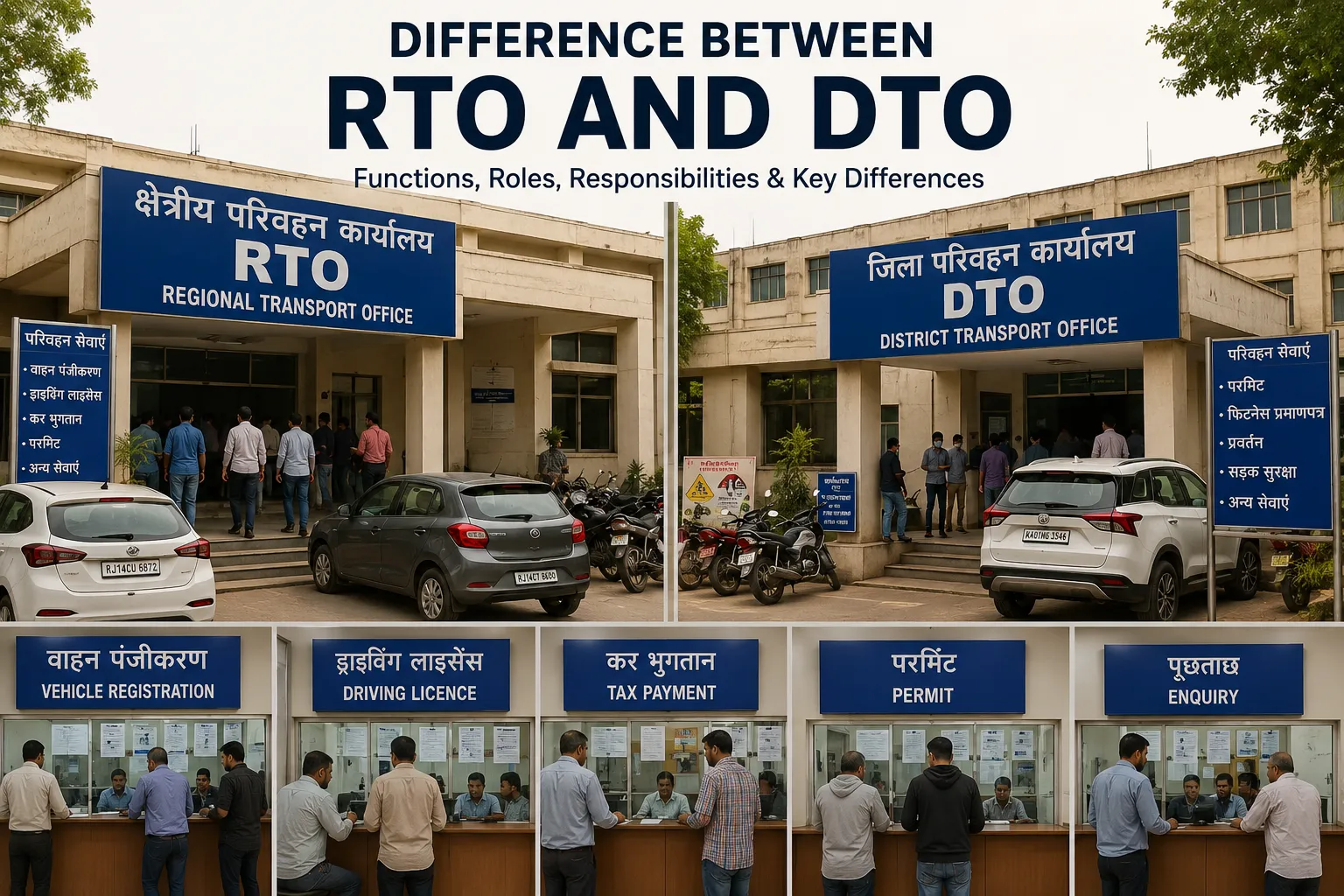

If you've ever applied for a driving licence, registered a new vehicle, or paid road tax, you've probably come across the terms RTO and DTO. Many people assume they refer to the same office because both deal with transport-related services. However, that isn't always true. Depending on the administrative structure of a state, the roles and responsibilities of an RTO and a DTO can differ.
Understanding the difference between RTO and DTO is useful for every vehicle owner, driver, and transport operator. It helps you identify the correct authority for services such as vehicle registration, driving licences, permits, road tax, and transport administration. While both offices function under the State Transport Department and work towards enforcing the Motor Vehicles Act, their responsibilities may vary from one state to another.
In this article, we'll explain what RTO and DTO mean, how they work, their key responsibilities, and the major differences between them in simple and easy-to-understand language.
What Is an RTO?
RTO stands for Regional Transport Office. It is a government office established by the State Transport Department to manage transport-related services within a specific region or jurisdiction. Every state in India has multiple RTO offices that serve different cities or regions, making transport services more accessible to the public.
The Regional Transport Office is responsible for implementing the provisions of the Motor Vehicles Act, 1988. Its primary role is to regulate motor vehicles, issue driving licences, register new vehicles, collect road taxes, and ensure that vehicles operating on public roads comply with legal and safety standards.
For most citizens, the RTO is the first point of contact for vehicle-related services.
What Is a DTO?
DTO stands for District Transport Office or District Transport Officer, depending on the terminology used by the respective state government.
Unlike the RTO, which generally focuses on providing transport services directly to the public, the DTO often performs district-level administrative and supervisory functions. In several states, the DTO manages transport administration across the district, coordinates with Regional Transport Offices, oversees transport enforcement, and ensures the implementation of government transport policies.
It is important to note that the role of a DTO is not identical across India. Some states operate mainly through District Transport Offices, while others primarily use Regional Transport Offices. In many cases, both offices work together to deliver transport services efficiently.
Difference Between RTO and DTO
Although both offices belong to the State Transport Department, they differ mainly in terms of administrative responsibilities and jurisdiction.
The Regional Transport Office (RTO) primarily delivers transport-related services directly to citizens. It handles activities such as vehicle registration, driving licence issuance, road tax collection, ownership transfer, permits, and vehicle fitness certification.
The District Transport Office (DTO) generally performs administrative, regulatory, and supervisory functions at the district level. It may oversee transport operations, coordinate transport enforcement, monitor implementation of government policies, supervise subordinate transport offices, and manage district-level transport administration.
In simple terms, if you need a driving licence or want to register a vehicle, you'll usually visit the RTO. The DTO, on the other hand, is more involved in managing and supervising transport administration within the district.
Functions of an RTO
The Regional Transport Office performs a wide range of services that directly affect vehicle owners and drivers. It ensures that vehicles operating on public roads meet legal requirements and that drivers possess valid licences.
Some of the major responsibilities of an RTO include issuing learner's licences and permanent driving licences, registering new vehicles, renewing registration certificates, collecting road tax, transferring vehicle ownership, issuing permits for commercial vehicles, conducting driving tests, granting fitness certificates, issuing duplicate licences and registration certificates, and maintaining official records of registered vehicles.
The RTO also plays an important role in enforcing road safety regulations by ensuring compliance with transport laws and vehicle standards.
Functions of a DTO
The District Transport Office mainly focuses on district-level transport administration rather than individual citizen services. It works to ensure that transport-related policies are implemented effectively throughout the district.
Its responsibilities often include supervising transport offices, monitoring public transport operations, coordinating enforcement drives, implementing state transport policies, managing district transport records, overseeing permit administration, conducting road safety awareness programmes, and ensuring compliance with transport regulations.
Depending on the state's administrative structure, some DTOs may also provide services that are otherwise handled by RTOs in other states.
Which Office Should You Visit?
For most vehicle owners, the answer depends on the service they require.
If you need to register a new vehicle, renew a driving licence, transfer vehicle ownership, apply for a learner's licence, pay road tax, or obtain a fitness certificate, the Regional Transport Office (RTO) is generally the appropriate office to visit.
If your matter involves district-level transport administration, transport policy implementation, public transport management, or services specifically assigned to the District Transport Office in your state, then you may need to approach the DTO.
Since transport administration differs across India, it's always advisable to verify the responsible office through your state's official transport department portal.
Similarities Between RTO and DTO
Although the administrative roles of RTOs and DTOs differ, both offices work towards the same objective of maintaining an efficient, safe, and legally compliant transport system.
Both operate under the State Transport Department and implement the provisions of the Motor Vehicles Act. They help regulate vehicle movement, enforce transport laws, improve road safety, maintain official transport records, and support government initiatives aimed at improving transportation infrastructure and public safety.
Together, these offices ensure that India's road transport system functions smoothly while protecting the interests of both vehicle owners and the general public.
Why Do Some States Use DTO Instead of RTO?
One of the reasons behind the confusion is that transport administration is not organized identically across all Indian states. Every state government has the authority to structure its transport department according to administrative requirements and local governance needs.
As a result, some states primarily operate through Regional Transport Offices, while others use District Transport Offices or a combination of both. Despite the difference in names, their overall objective remains the same—providing efficient transport administration and ensuring compliance with transport laws.
Why Understanding the Difference Matters
Knowing the difference between an RTO and a DTO can save time and reduce confusion when dealing with transport-related work. Visiting the correct office helps ensure faster processing of applications, smoother documentation, and fewer unnecessary visits.
Whether you're purchasing your first vehicle, renewing a licence, applying for a commercial permit, or managing transport-related documentation, understanding the responsibilities of each office allows you to complete the process more efficiently.
Frequently Asked Questions
Is RTO and DTO the same?
No. Although both operate under the State Transport Department, their roles may differ depending on the state's administrative structure. The RTO mainly provides citizen services, while the DTO generally manages district-level transport administration.
What is the full form of RTO?
RTO stands for Regional Transport Office.
What is the full form of DTO?
DTO stands for District Transport Office or District Transport Officer, depending on the state.
Which office issues driving licences?
In most Indian states, driving licences are issued through the Regional Transport Office (RTO) or the designated transport office responsible for licensing.
Which office registers vehicles?
Vehicle registration is generally handled by the Regional Transport Office (RTO).
Why do some states use DTO instead of RTO?
State governments have different administrative structures. Some states prefer District Transport Offices, while others function mainly through Regional Transport Offices or a combination of both.
Conclusion
Understanding the difference between RTO and DTO helps vehicle owners, drivers, and transport operators approach the correct authority for transport-related services. While both offices work under the State Transport Department and are responsible for implementing transport laws, their responsibilities vary according to the administrative framework of each state.
In most cases, the RTO is responsible for public-facing services such as vehicle registration, driving licences, permits, fitness certificates, and road tax collection. The DTO, meanwhile, generally focuses on district-level transport administration, supervision, and policy implementation. Knowing the role of each office not only saves time but also ensures a smoother experience when dealing with transport-related procedures.


























Sign in to leave a comment.