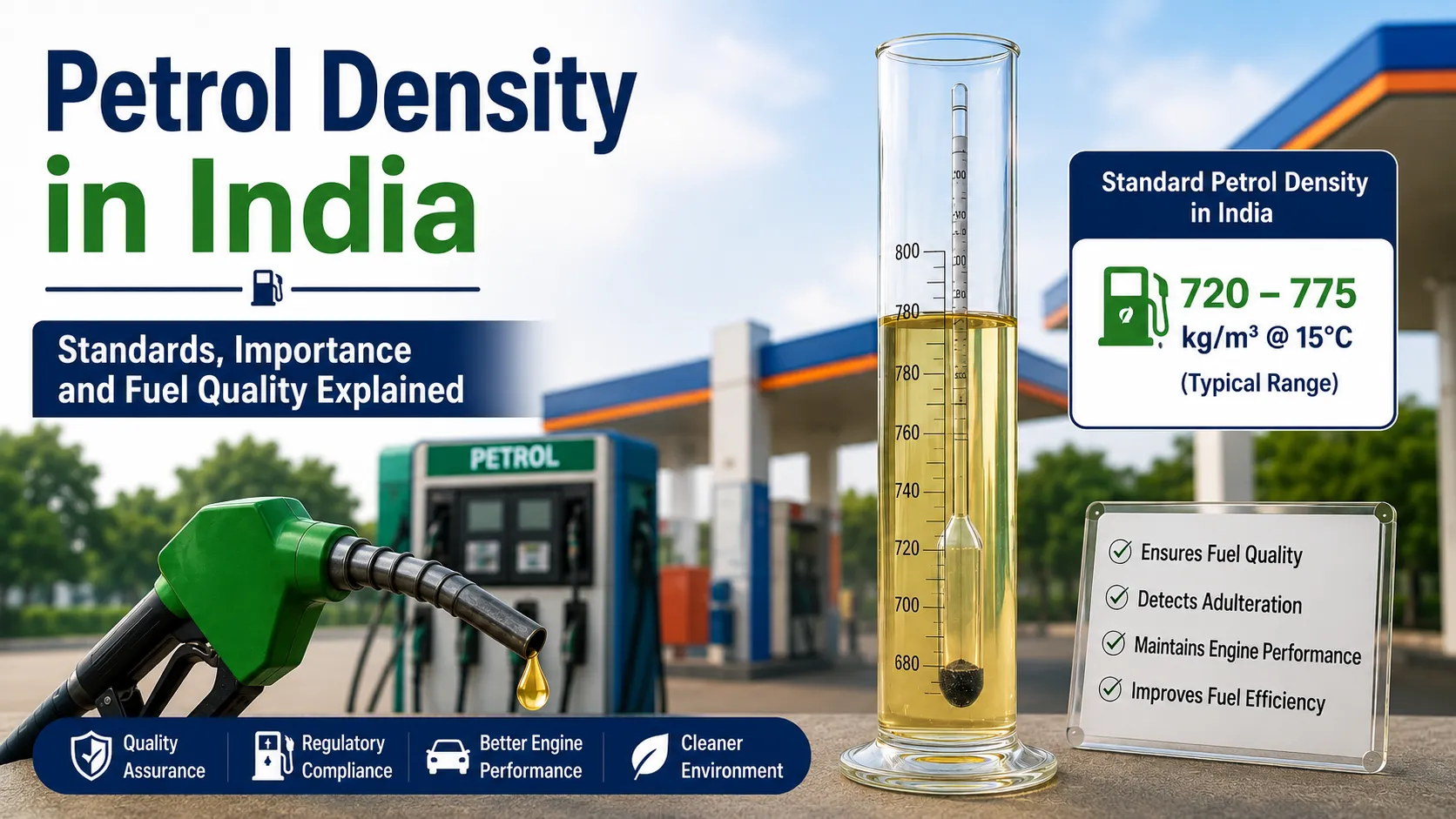

Petrol quality is an important concern for every vehicle owner. While most people check the price and quantity before filling fuel, fewer people know that petrol density is also an important quality parameter. Density can help indicate whether the fuel being supplied meets the prescribed specification and can be used as one of the checks for possible fuel-quality issues.
What Is Petrol Density?
Petrol density is the mass of petrol contained in a specific volume. It is normally expressed in kilograms per cubic metre (kg/m³). Because petrol expands and contracts with temperature, density is compared at a standard reference temperature rather than simply relying on the reading taken at the temperature of the petrol pump.
In India, the Petroleum Planning & Analysis Cell (PPAC) describes motor spirit (petrol) as having a density range of 720–775 kg/m³ at 15°C. The specification is linked to BIS standard IS 2796 for motor gasoline.
What Is the Standard Petrol Density in India?
The standard reference range for petrol in India is generally 720 to 775 kg/m³ at 15°C.
| Parameter | Standard |
|---|---|
| Fuel | Petrol / Motor Spirit |
| Density reference temperature | 15°C |
| Density range | 720–775 kg/m³ |
| Relevant BIS standard | IS 2796 |
The Bureau of Indian Standards' petroleum standards material shows that the 720–775 kg/m³ range applies to BS VI motor gasoline. Current BIS laboratory records also continue to list density at 15°C as a testing parameter under IS 2796.
It is important to understand that 720–775 kg/m³ is a specification range, not a single ideal number. Petrol from different locations or batches can have different density readings while still meeting the applicable standard.
Why Is Petrol Density Measured at 15°C?
Temperature has a direct effect on the volume of petrol. When petrol becomes warmer, it expands; when it becomes cooler, it contracts. As a result, the density measured at the actual temperature of a fuel sample may differ from its density at the standard reference temperature.
That is why petrol-pump density testing involves recording both temperature and observed density and converting the reading to the equivalent density at 15°C.
This standardised approach makes it possible to compare the fuel sample with the reference density recorded for the retail outlet. HPCL's customer guidance describes this exact procedure using a calibrated hydrometer, thermometer and conversion chart.
How to Check Petrol Density at a Petrol Pump?
Customers can request a density check when they have concerns about fuel quality. A proper test uses specific equipment rather than simply looking at the petrol.
The basic process is:
Step 1: Take a Petrol Sample
A sample is collected from the dispensing nozzle into a suitable calibrated container.
Step 2: Measure the Temperature
A thermometer is used to record the temperature of the petrol sample.
Step 3: Measure the Density
A calibrated hydrometer is placed in the sample to obtain the observed density reading.
Step 4: Convert the Reading to 15°C
Because the sample may not be at 15°C, the observed reading is converted to the equivalent density at 15°C using the appropriate conversion method or chart.
Step 5: Compare With the Reference Density
The converted result is compared with the reference density maintained by the retail outlet. HPCL's published customer guidance explains that a density check requires a calibrated hydrometer and thermometer, with the measured result converted to 15°C before comparison.
This is much more reliable than judging petrol quality based only on its colour or appearance.
Can Customers Ask for a Petrol Density Test?
Yes. Oil marketing companies provide procedures for customers who want to check fuel quality.
For example, published BPCL customer guidance states that customers can request a density check for petrol and diesel. It describes using a calibrated hydrometer and thermometer and comparing the converted density with the reference density maintained at the retail outlet.
This means that if you have a genuine concern about the quality of petrol, you can ask the petrol-pump staff about the available quality-check procedure instead of relying on assumptions.
What Does Low or High Petrol Density Mean?
A density reading outside the applicable specification can indicate that the fuel needs further investigation. However, density alone should not be treated as conclusive proof of adulteration.
Fuel quality depends on several characteristics, including appearance, composition, volatility and other parameters prescribed under the relevant standard. IndianOil states that its fuel-quality laboratories test motor gasoline and its variants against applicable BIS and other recognised standards.
Therefore, an unusual density result should be followed by proper testing rather than an immediate conclusion that the petrol has been adulterated.
Does Petrol Density Affect Mileage?
Petrol density can influence the amount of fuel mass delivered for a given volume, but mileage should not be judged using density alone.
A vehicle's fuel economy depends on several factors, including:
- Driving style
- Traffic conditions
- Tyre pressure
- Vehicle load
- Engine condition
- Fuel quality
- Road conditions
- Air-conditioning usage
Modern petrol specifications are designed around a range of fuel properties rather than one density value. So, a petrol density reading within the prescribed range does not automatically guarantee better mileage.
Is Petrol Density the Same at Every Petrol Pump?
Not necessarily. Density can vary within the permitted specification because petrol is a blended fuel and its properties can vary with factors such as composition, temperature and supply conditions.
What matters is whether the fuel meets the applicable specification and whether the retail outlet's measured value is consistent with the required quality controls.
IndianOil has also recently highlighted strengthened fuel-quality monitoring, including density testing at retail outlets as part of its intensified quality surveillance.
Petrol Density vs Petrol Quality: Are They the Same?
No. Petrol density is one parameter used to assess fuel quality, but it is not the complete definition of petrol quality.
A proper fuel-quality assessment can involve multiple characteristics. BIS material for motor gasoline lists parameters such as density, distillation characteristics, sulphur, benzene, olefin content and other specifications.
Therefore, checking density can be useful, but it should not be the only basis for deciding whether petrol is good or bad.
What Should You Do If You Suspect Poor Petrol Quality?
If you believe the petrol supplied at a retail outlet may have a quality problem, ask for the applicable quality check and retain your fuel purchase receipt.
If the concern is not resolved, use the oil marketing company's official complaint mechanism. For example, HPCL provides an online retail-pump complaint facility covering fuel-quality concerns, while oil companies maintain customer grievance channels for their retail outlets.
Avoid making conclusions based only on mileage dropping after one fuel refill, as many mechanical and driving factors can produce similar symptoms.
Frequently Asked Questions
What is the normal petrol density in India?
The standard petrol density range is generally 720–775 kg/m³ at 15°C, according to PPAC and BIS-related specifications for motor gasoline.
How is petrol density measured?
Petrol density is measured using a calibrated hydrometer and thermometer. The observed reading is converted to the reference temperature of 15°C before comparison with the applicable reference value.
Can I check petrol density at a petrol pump?
Yes. Customers can request the applicable density or fuel-quality check at a retail outlet. Published oil-company customer guidance provides a procedure for conducting the test.
Does high petrol density mean adulterated petrol?
Not necessarily. Density outside the applicable range may require investigation, but density alone does not prove adulteration. A proper fuel-quality test should be conducted before reaching a conclusion.
Why is petrol density measured at 15°C?
15°C provides a common reference point because petrol's volume changes with temperature. Using a standard temperature makes density readings easier to compare consistently.
Final Words
Understanding Petrol Density in India can help vehicle owners become more aware of fuel quality and the checks available at retail outlets. The commonly specified range for petrol is 720–775 kg/m³ at 15°C, but density is only one part of the overall fuel-quality assessment.
If you ever have doubts about petrol quality, ask for the appropriate density or filter-paper test at the outlet and keep your purchase receipt. Most importantly, remember that a single density number should not be used to make an immediate claim about adulteration. Proper testing against the applicable fuel standard provides a more dependable answer.





























Sign in to leave a comment.