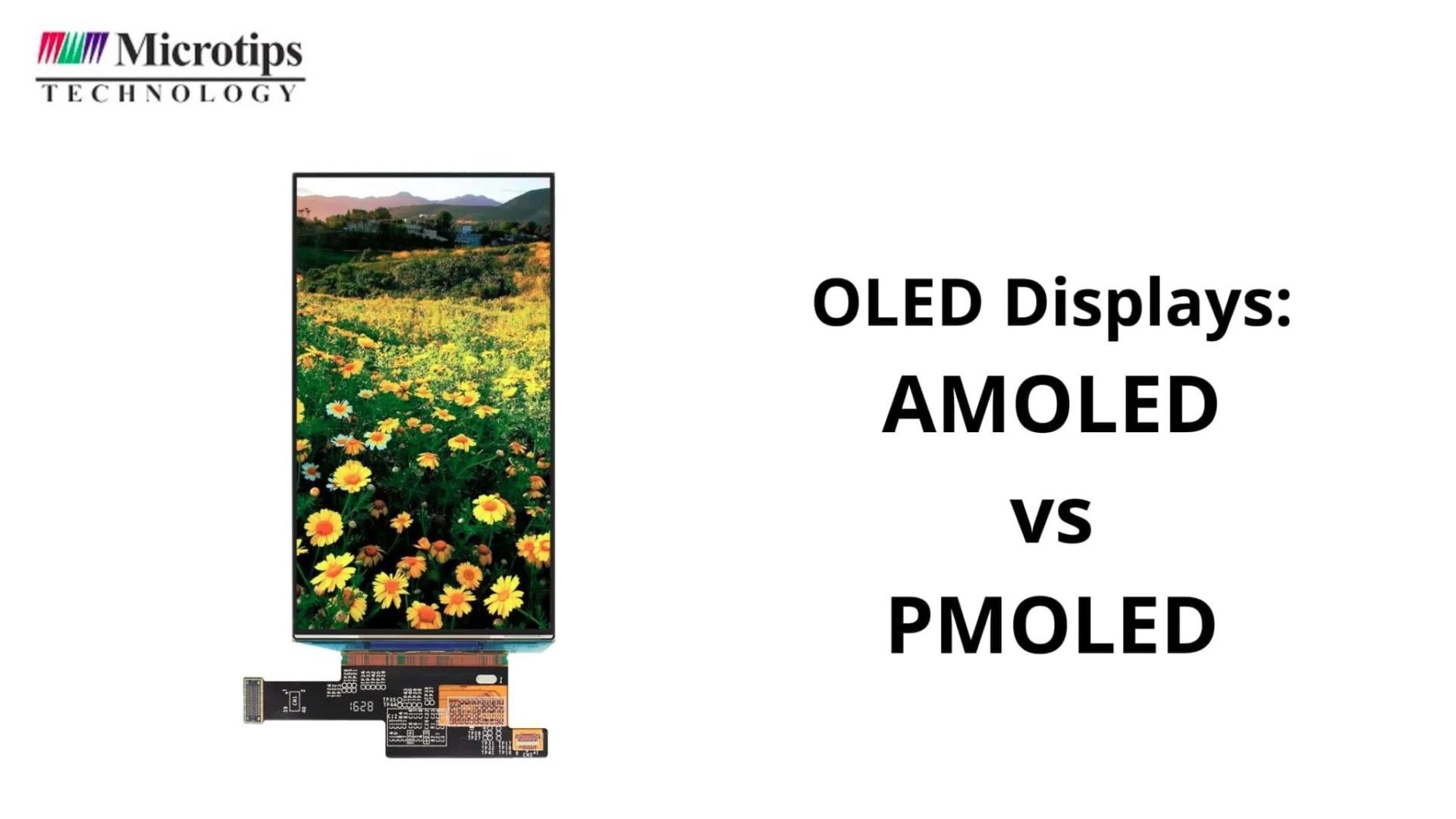

OLED technology is revolutionizing the screen display experience today at a great pace and range, starting from high-quality TV screens, smartphones, wearables to foldable display screens all across the globe.
The Organic Light Emitting Diode, commonly known as OLED, is formed when the films of two conductors have organic substrates placed between them. They are widely prominent and known as an advanced alternative to LCDs as they offer better image quality and lesser consumption of energy.
Everyone is aware of the two common OLED displays: Passive Matrix Organic Light Emitting Diode or PMOLED and Active Matrix Organic Light Emitting Diode or AMOLED.
It is imperative to note that some 2 to 3 years ago, PMOLEDs were widely used for monochrome and color displays. But, with the advancements of AMOLED in the supply chain, and their vibrant colors, several manufacturers prefer the option of creating OLED-based color displays.
This is one reason why PMOLED is often used in small-scale, monochrome applications where you need less voltage. There are several companies that use PMOLED displays in their fitness wearables, unit measuring devices, automobiles, mini players, and so forth.
Major Differences Between AMOLED & PMOLED
The difference between the two OLED types is the different color control mechanisms. For emitting the light when given power, both AMOLED and PMOLED use organic materials. Though, there are some procedure-related differences between AMOLED and PMOLED, which makes a difference in their applications.
The active component of AMOLED, TFT (Thin Film Display), causes the substrate to store some more energy. Resultantly, there will be less decay and higher performance. They are unlike PMOLED and will even increase the longevity of the used material and the entire device component.
AMOLED gets an added advantage of being energy efficient as PMOLED is a passive component. Undoubtedly, the AMOLED displays are more efficient and flexible. So, now you can use them in numerous applications like smartphones, OLED TVs, and a lot more.
Furthermore, this is one of the reasons why AMOLED is often used in large-scale applications and produces light in several different colors. While on the other hand, PMOLED displays are comparatively smaller in size (approx 3 inches), making them less expensive and easier to fabricate than AMOLED displays.
Several advancements in AMOLED display features make them superior to PMOLED displays in several ways, like:
The integration of touch functions via smartphonesBroader viewing anglesContrast ratios as high as from 100,000:1 to 2,000,000:1Illustration of transparent displaysMicrotips Technology is a leading OLED displays manufacturer based in the USA. The company launched a 1.39 Inch Round AMOLED Display with a 400 x 400 pixels resolution in 2018. Moreover, they have set some significance in the world of OLEDs, including its 5.49″ AMOLED Display Module (Microtips MTD0550AZOM-T) that provides a resolution of 1080(RGB) x 1920.
Both of these developments are getting preference and praise extensively by a large audience.























Sign in to leave a comment.