

Introduction
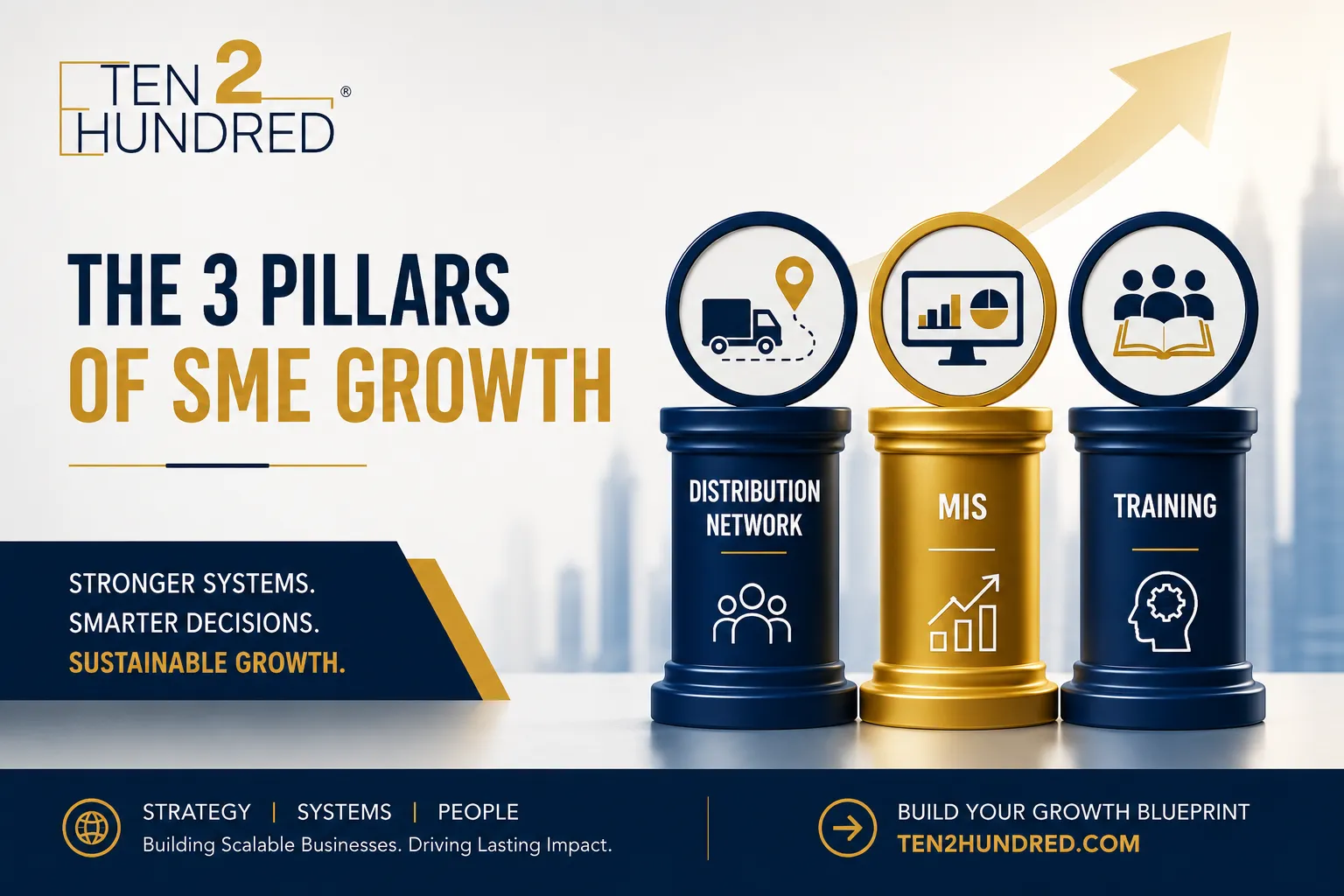
A distribution network India SME businesses build determines whether they scale or stagnate. In India, demand alone does not drive growth—availability does. If your product is not consistently available across markets, your growth will plateau, no matter how strong your marketing is.
For SMEs aiming to grow from ₹10 crore to ₹100 crore, distribution is not a support function—it is the primary growth engine. Businesses that build structured channel systems scale faster, while those that rely on ad-hoc distribution struggle with inconsistency and poor reach.
To understand how structured business growth works beyond distribution, explore Ten2Hundred business consulting.
Why Distribution Is the Core Growth Lever for SMEs
Most Indian SMEs at early growth stages:
- Operate in limited geographies
- Depend on a few distributors
- Lack a clear channel strategy
This leads to:
- Uneven market presence
- Stock accumulation in some regions
- Lost sales opportunities in others
A strong dealer network in India ensures:
- Wider product availability
- Faster market penetration
- Predictable revenue flow
Scaling is not about selling more—it is about reaching more markets efficiently.
The 3 Distribution Models for Indian SMEs
1. Direct Distribution
- Brand sells directly to retailers
- Works in high-density urban markets
- High control, but expensive to scale
2. Distributor-Led Model
- Distributors handle retail sales
- Ideal for Tier-2 and Tier-3 markets
- Cost-efficient but less visibility
3. Hybrid Model (Recommended)
- Direct in metros, distributor-led elsewhere
- Balances control and expansion
- Best suited for scaling SMEs
How to Select the Right Distributor in India
Not every distributor is the right fit.
Key Criteria
1. Financial Stability
Ensures smooth inventory flow and payments.
2. Retail Coverage
Must already serve your target outlets.
3. Category Alignment
Avoid conflict with competing brands.
4. Sales Team Strength
Active selling matters more than passive order-taking.
5. Infrastructure
Warehousing, logistics, and delivery systems
A wrong distributor can slow growth more than having no distributor.
Channel Strategy and Execution Systems
A distribution network works only when supported by strong systems.
Businesses that scale successfully invest in business strategy consulting for SME growth to align channel expansion with long-term goals.
At the execution level, efficient workflows are critical. This is where business process optimization for scalable operations ensures consistency across markets.
Channel Margin Structure: The Real Growth Driver
Incorrect pricing and margins are the biggest reasons distribution fails.
Typical Benchmarks
- Distributor margin: 5–12%
- Retail margin: 10–20%
- Credit cycle: 30–45 days
What Works
- Volume-based incentives
- Retail visibility schemes
- Performance-linked rewards
👉 If your channel is not profitable, your brand will not be prioritised.
To maintain control and visibility, businesses must implement performance management systems for SMEs.
Geographic Expansion Strategy
Scaling distribution requires sequencing.
Phase 1: Deepen Core Markets
Maximise presence where you are already strong.
Phase 2: Expand to Adjacent Markets
Leverage proximity and brand awareness.
Phase 3: Tier-2 and Tier-3 Expansion
Focus on high-growth regions with tailored distribution strategies.
India’s growth is increasingly driven by non-metro markets, making structured expansion essential.
Common Distribution Mistakes
- Expanding too quickly without depth
- Choosing distributors based on availability
- Ignoring margin economics
- Lack of performance tracking
- Treating India as a single market
Conclusion
A strong distribution network India SME businesses build is the foundation of scalable growth.
If your product is not available, it does not exist.
If your distribution is weak, your growth will stall.
Scaling in India requires structured channels, strong partners, and consistent execution.
CTA: Build a Distribution Network That Scales
If you are serious about expanding across India, you need more than distributors—you need a strategy.
👉 Get expert guidance today: Contact Ten2Hundred



























Sign in to leave a comment.